

The inner life
Nightmare
Direct answer
Nightmare: A nightmare is a vivid, frightening dream that wakes the sleeper, who usually remembers it clearly; most arise from REM sleep in the later part of the night.
$0 today, then $19/month after 7 days. Cancel anytime.
At a glance
- Also called
- bad dreams
- Found in
- Consciousness & Spiritual Psychology
- Related
- Night Terror, Sleep Paralysis, Imagery Rehearsal, REM Sleep
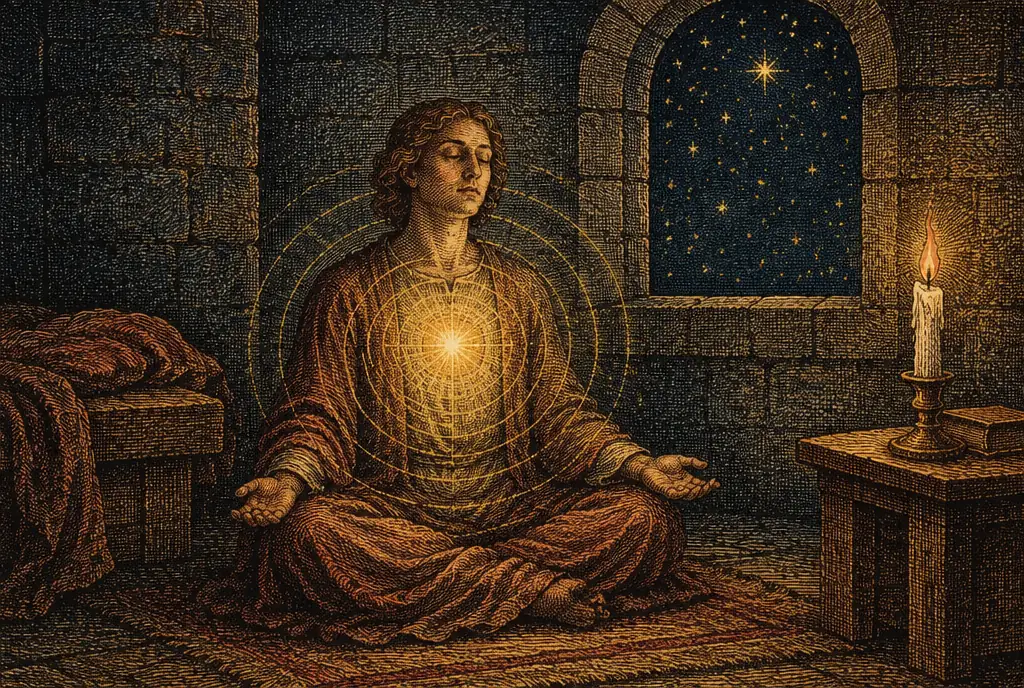
A nightmare is a vivid, frightening dream that wakes the sleeper, who usually remembers it clearly; most arise from REM sleep in the later part of the night.
A plain educational schematic; it does not diagnose a condition or replace professional care.
Understand the chapter you are in.
Your life’s turning points, measured from your birth.
Walk through Alex’s whole example first


Prefer to explore first?
 The Road of AgesThe turning points of your whole life, from your own chart
Walk my road
What causes nightmares?
A nightmare is a long, disturbing dream, most often of threat, pursuit or loss, that ends in waking. The sleeper comes round quickly, knows where they are, and can tell the dream. Because REM periods lengthen towards morning, nightmares cluster in the last third of the night.
Occasional nightmares are ordinary, especially in childhood and in times of strain. Frequent ones that spoil sleep, or bring a dread of going to bed, are treated as a sleep problem in their own right and often follow trauma. The older meaning of the word was different: a spirit that pressed on the chest of a sleeper.
On the tree of the hidden arts: Dreams.
What sets Nightmare apart
Three features separate the nightmare from its neighbours: it is a real dream with a story, it wakes the sleeper, and it is remembered. The awakening is the defining part in sleep medicine, which sets nightmares apart from bad dreams that are slept through. Its history is a change of meaning. For a thousand years the mare was the visitor on the chest; only later did the word slide from the creature to the dream.
- Sleep stage: mostly REM sleep, in the last third of the night
- Word: night with Old English mare, a being that pressed on sleepers
- Painting: Henry Fuseli, The Nightmare, 1781
- Commonest in: childhood, easing for most people with age
- Studied remedy: imagery rehearsal: rewriting the dream by day
Often mistaken for something else: A night terror is a partial arousal from deep sleep with no story and no memory; a nightmare is a full dream that is recalled on waking.
The story behind Nightmare
The word joins night with the Old English mare, a being believed to sit on sleepers and stifle them, the scene Henry Fuseli painted in The Nightmare in 1781. That older sense matches what is now called sleep paralysis. By the nineteenth century the word had come to mean any bad dream. Ernest Jones gave a psychoanalytic account in On the Nightmare in 1931, and imagery rehearsal therapy was developed for chronic nightmares from the 1990s.
Why Nightmare matters
Telling a nightmare from a night terror or sleep paralysis decides what help fits, since the three arise in different states of sleep.
How to read Nightmare
Dream workers treat a nightmare as a dream with its feeling turned up, and ask what waking fear it is rehearsing.
Nightmare in practice: an example
A woman wakes at five from a dream of a flooding house, heart racing, and can describe every room of it at breakfast.
Where readings of Nightmare go wrong
A bad dream is not an omen; nightmares that recur for weeks, or follow a trauma, are a matter for a doctor or therapist.
Sources and editorial method
This entry summarizes the tradition in the Almanac's own words; where no source is listed, it is an editorial summary rather than a primary text, and symbolic readings are named as the tradition's, not as fact.
If nightmares come most nights, or replay something that happened to you, a doctor or therapist can help.
- Source
- The Great Almanac Dictionary
- Category
- Consciousness & Spiritual Psychology
- Aliases
- nightmares, nightmare meaning, what causes nightmares, bad dreams, why do I have nightmares
- Last updated
- 2026-09-26
See Nightmare in your personal almanac
A definition tells you what it is; your own birth chart tells you what it means for you. The Oracle casts your real chart and answers for your love, your work, and your year ahead, in conversation. It opens with the 7-day Oracle trial.
Speak with the OracleRelated terms
More in Consciousness & Spiritual Psychology
- Quantum Superposition
- The Prince
- Xenoglossy
- Burden of Proof
- Didgeridoo
- Frederic Myers
- Internal Family Systems
From the reference page to your own chart
Every word here
is in your own chart.
- Your life’s turning points, measured from your birth
- A practical next step to consider
- It opens with 7 days free: the AI Oracle on thirty hidden arts, and your daily horoscope
$0 today, then $19/month after 7 days. Cancel anytime.
Common questions
What causes nightmares?
Stress, grief, fever, lack of sleep, alcohol and some medicines are common triggers. Frequent nightmares are also a well-known sequel of trauma. Often no single cause can be found.
What is the difference between a nightmare and a night terror?
A nightmare is a dream from REM sleep, usually late in the night, that the sleeper wakes from and remembers. A night terror comes from deep non-REM sleep early in the night, with screaming or thrashing and little or no memory.
Do nightmares mean something bad is about to happen?
There is no evidence that they foretell events. Research ties them to present stress and past experience, and many traditions read them as showing a fear that wants attention.


