
The tarot
Seventy-eight cards: a game of the 1400s that became a book of images.
Where does the tarot come from, and how do its major and minor arcana work?
The arts of putting a question to a set of symbols. The house reads them as a mirror for your own thinking, never as a judge, and it draws nothing itself: it reads what you bring.
Mirrors for a question, and how to use them
Ask the OracleHow do tarot, the runes and the I Ching work, and how should I use them?
Divination is the putting of a question to a set of symbols: cards turned, lots cast, stalks counted. The three best known in the West today come from very different places. The tarot began as a card game in fifteenth-century Italy, the runes are the old Germanic alphabet, and the I Ching is a Chinese classic some three thousand years old. Each hands the asker a picture or a short text, and the work lies in reading it against the question.
No controlled test has shown that cards, runes or coins foretell events, and the house does not claim they do. What they can do is slow a person down and hand them an image they did not choose, which readers often say shows what they already think. That is the use kept here: a mirror for a question. The Oracle draws nothing itself. It reads what a reader brings, and it leaves matters of health, money, law and relationships to the reader's own judgement and the right help.
As the diviners' craft of the cards, the runes and the Book of Changes teaches it.
Every divining art is built from the same few parts. There is a question, put by the asker, whom the older books call the querent. There is a closed set of signs, each with its own name and meaning: seventy-eight cards, twenty-four runes, sixty-four figures of six lines. There is a way of choosing among the signs that the asker does not steer: the shuffle and the cut, the rune drawn blind from the bag, the fall of the coins, the counting of the stalks. And there is the reading, in which a reader, very often the asker, sets the sign that came against the question that was put.
The art lives in that last part. A sign alone says only what it always says: the Tower is always the Tower, and Isa is always ice. It is a fixed sign meeting a particular question, in a particular place in the draw, that makes a reading, and everything the books teach serves that meeting: what the signs mean, how the places are set, and how the signs are read together.
In Cicero's dialogue On Divination the art is divided in two. One kind works by art: it reads outward signs by learned rules, as the augur reads the flight of birds and the haruspex the entrails of a sacrifice. The other works by nature: it comes unbidden, in dreams and in the inspired speech of a prophet. The first is learned from books and teachers; the second is received.
The cards, the runes and the Book of Changes, like the lots of old, belong to the first kind. Each is a vocabulary of signs whose meanings its tradition has fixed, with a rule for choosing among them, and each can be studied sign by sign, as a language is. The pendulum and the dark glass stand nearer the second kind. They have no set of signs: the pendulum answers by a swing that rises in the holder's own hand, and the glass by images that rise in the gazer's own eye, to be read afterwards as a dream is read.
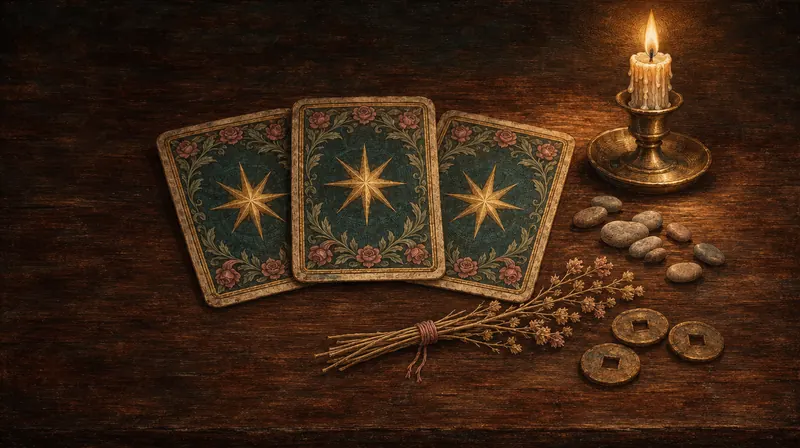
The tarot speaks in pictures. Its twenty-two trumps, the Major Arcana, show the great figures and turning points of a life, the Magician and the Hermit, Death and the Tower, the Star and the World, and many readers read them in order as one long journey, the Fool's. Its fifty-six suit cards, the Minor Arcana, show the matters of every day in four suits. In the Golden Dawn's scheme Wands belong to fire, Cups to water, Swords to air and Pentacles to earth, and readers commonly gloss them as will and enterprise, feeling and love, thought and strife, and work and goods.
The runes speak in single words. Each of the twenty-four is at once a letter, a sound and a name, and the name is an ordinary thing, cattle, hail, ice, the sun, the yew, the horse, which the caster reads as a force at work in the matter. They stand in three families of eight, and three old poems, English, Norwegian and Icelandic, give the names their riddling verses, which are read before any modern keyword.
The Book of Changes speaks in counsel. It is built from two lines, the whole and firm line of yang and the broken and yielding line of yin, which make eight trigrams of three lines and sixty-four hexagrams of six. A hexagram is not a scene but a time, such as Waiting, Conflict, Return or the Well. Its Judgement names the time; its Image says how the superior person acts in it; its line sayings follow the time from its beginning in the lowest line to its end in the highest. A line that has reached its extreme turns into its opposite and gives a second figure, the way the time is tending.
So the three ask different things of a reader. The tarot's pictures are looked at, the runes' names are weighed, and the Book's words are read slowly, as advice about conduct. Each has its own page, where every card, every rune and every figure is taught in turn.
Every book of the craft begins with the question. It is put into words and written down before anything is shuffled or cast, so that it cannot drift afterwards to fit the answer. One question is put at a time, plainly, in the asker's own words.
The questions that read well are open and turned toward the asker's own part: what am I not seeing in this, what do I need to understand about it, what would help me now. A question about another person's mind, a date, or a bare yes or no about the future gives the signs little to show. The Book of Changes sets the rule for asking in its fourth figure, Youthful Folly: the teacher answers the first sincere asking, but to ask a second and a third time is to trouble the oracle, and the troublesome are given no answer. So a question is put once, and put again only when the matter itself has changed.
Between the question and the reading comes the choosing, and in every art the rule is the same: the asker sets the frame, the question and the places, and then lets the signs fall without steering them. The cards are shuffled and cut; the runes are drawn blind from the bag or scattered on a white cloth; the coins are thrown six times and the figure built from the bottom line up.
Why a fall of chance should answer a question, the traditions explain in two ways. The older answer is that the fall is not mere chance. Tacitus tells that among the Germans the lots were taken up only after a prayer to the gods, the priest, or in a household its father, looking up to the sky as he lifted them; and the Great Commentary on the Book of Changes says that the book has no thought and does nothing, but is still, and when a question moves it, it reaches through to every matter under heaven. The newer answer, which follows Jung, is that chance supplies a picture the asker would never have chosen, and what the asker finds in it shows where they themselves stand. Many readers hold one view, some hold both lightly, and the reading as a mirror, taught on its own page, rests on the second.
A reading is built in layers. First comes the sign itself: the picture looked at plainly before any book is opened, the rune's name and its verse, the figure's Judgement. Then the sign in its place. Every spread fixes its places before the draw, such as past, present and what is coming, or the matter, what crosses it and the counsel, and a card is read as the answer to the question its place asks. The Book of Changes has its places built in: the first line is the beginning, the sixth the end, and the fifth the place of the ruler.
Then the sign among its neighbours. Tarot readers weigh what falls together: many trumps are commonly taken to mean that the matter turns on great forces, many court cards that other people are much in it, and a run of one suit that the matter belongs to that suit's element. A card that comes out upside down is read, by those who use reversals, as its meaning turned inward, blocked or delayed, and the rule is chosen before the draw and kept to. Last comes the whole, gathered into one plain sentence in the reader's own words, which is what the reading has to say.
The books start a student small. One deck is chosen and kept to, most often the Rider-Waite-Smith deck or one drawn after it, since most books follow its pictures. Each morning a single card is drawn with no question but the day, looked at for a minute, described in plain words and noted down, and in the evening the student looks back to see what in the day it touched. Over a year every card comes round several times, each time in a different light.
The other two vocabularies are learned the same way, from the ground up. The student of the runes learns the row in its three families, with the names and the old verses, and draws one rune a day. The student of the Book of Changes learns the eight trigrams first, their names, images and natures, until any hexagram can be seen at a glance as one trigram over another, and only then reads a figure cast for a question, slowly, a line at a time.
Through all of it the student keeps a journal: the date, the question, the signs and their places, the first thing each one stirred, and the one sentence. A single draw is a moment. The journal, read back after a month, shows the questions that keep returning and the fears that came to nothing, and it teaches more than any draw.
Careful readers keep a few plain rules. No one is read without asking, and nothing in a spread is taken as a fact about another person. Matters of health, money, law and whether to stay with someone are not put to the signs; when they come up in a reading they are taken to a doctor, an adviser, a lawyer or a trusted friend, and to the asker's own judgement. A reading is a prompt for thought, and the decision stays with the one who has to live it.
Two habits show that a draw has turned from a mirror into a master: drawing again until the answer pleases, and being unable to act without drawing first. The remedy the reflective readers give is simple: put the cards away for a while and make the next choice without them. The quiet arts of the pendulum and the glass ask for more care still, and their own page gives it in full.
The branches of this art stand on the ground laid here. Three are the vocabularies: the tarot, with every trump and every suit card taught in turn; the runes, with the twenty-four names and their old verses; and the I Ching, with the trigrams, the casting by stalks and by coins, and all sixty-four figures. The branch on reading as a mirror teaches the way of reading itself: the question, describing a card before interpreting it, the card one dislikes, and where the mirror stops.
The branch on bringing your own draw teaches how a draw is written down and laid out, from one card and three to the Celtic Cross, so that the Oracle can read it beside the asker's chart. The branch on the pendulum and scrying teaches the quiet arts of the swinging weight and the dark glass, with their cautions. A beginner does well to read the mirror first, then to choose one vocabulary and stay with it for a season, and to come to the larger spreads once single signs have grown familiar.
The Oracle draws no cards and casts nothing; it reads what you bring. Treat any divining art as a mirror for your own thinking, never as the judge of your health, money, legal matters or relationships.
Each one is a question you can ask.
Seventy-eight cards: a game of the 1400s that became a book of images.
Where does the tarot come from, and how do its major and minor arcana work?
The old Germanic letters, and what is and is not known of casting them.
What are the runes, and what is truly known of using them for divination?
China’s Book of Changes: sixty-four hexagrams, each the shape of a moment.
What is the I Ching, and how is a hexagram read?
Why a spread works on the reader’s own thinking, and where to stop.
How do I use a tarot reading as a mirror for my own thinking without letting it decide for me?
Tell the Oracle what you drew, and it reads it with you beside your chart.
I drew some tarot cards. How do I tell you what I drew so you can read them with me?
The quiet arts of the swinging weight and the dark glass.
What are the pendulum and scrying, and what makes a pendulum move?
Each opens its page in the dictionary.
French writer, born Alphonse-Louis Constant, who trained for the Catholic priesthood and left before ordination. His Dogme et Rituel de la Haute Magie (1854 to 1856) shaped modern occultism: he tied the twenty-two tarot trumps to the Hebrew letters and drew the goat-headed figure of Baphomet as an emblem of balanced opposites.
Chief of the Norse gods, and the one who pays for wisdom. In the poem Hávamál he hangs nine nights on the windswept tree, wounded with a spear, “given to Odin, myself to myself”, and takes up the runes. In another tale he gives an eye to drink from Mímir’s well. The poems were written down in Iceland in the thirteenth century from older tradition.
French apothecary and astrologer, Michel de Nostredame. His Prophéties, first printed in 1555, are rhymed quatrains, nearly all without dates, written in a deliberately dark style. Catherine de’ Medici favoured him at the French court.
Swiss psychiatrist, founder of analytical psychology. He studied alchemy, Gnosticism, astrology and the I Ching as pictures of the psyche: Psychology and Alchemy (1944), the idea of synchronicity, and The Red Book, written from 1914 to 1930 and published in 2009. He wrote that he sometimes cast a patient’s horoscope to understand them, and his own statistical test of astrology and marriage proved nothing either way.
Vettius ValensMichael ScotWilliam LillyCourt de GébelinEtteillaMarie Anne LenormandArthur Edward WaitePamela Colman SmithCassandraTiresiasThe SibylGiacomo CasanovaPaschal Beverly RandolphPapusThothTycho BraheTommaso CampanellaElias AshmoleJohannes KeplerMacGregor Mathers
The sixth senseMagic and protectionThe Tree of LifeAlchemyDreamsPhysics and the mysticsSymbols
The Fool’s JourneyDictionary: TarotDictionary: I ChingDictionary: RunesSearch the treeThe whole tree
Make today specific
The same sky reaches everyone differently. Your birth details turn a general forecast into one theme, and one thing worth doing about it.
One instrument, one answer. Explore the preview; membership opens every tool.
Read more

