
Odin
Norse myth; written down in Iceland in the 13th century
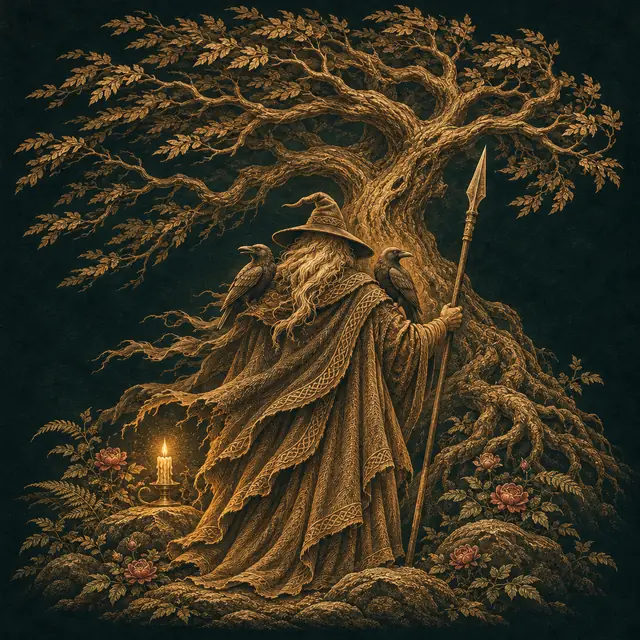
What is the story of Odin, and what does it warn of?
The story and its sources
Chief of the Norse gods, and the one who pays for wisdom. In the poem Hávamál he hangs nine nights on the windswept tree, wounded with a spear, “given to Odin, myself to myself”, and takes up the runes. In another tale he gives an eye to drink from Mímir’s well. The poems were written down in Iceland in the thirteenth century from older tradition.
The teaching
Taught from the Poetic Edda, above all Hávamál and Völuspá, with Snorri Sturluson's Edda and Ynglinga saga.
The All-father
Snorri tells of Odin as the All-father, eldest and highest of the gods, who with his brothers Vili and Ve killed the frost giant Ymir and made the world from his body: the earth from his flesh, the sea from his blood, the mountains from his bones and the sky from his skull. Walking on the shore, the three found two trees and made from them the first man and woman, Ask and Embla, and Odin gave them breath and life.
From his high seat he sees over all the worlds. Two ravens, Thought and Memory, fly out over the earth each day and come back to tell him what they have seen; two wolves eat the food from his table, for wine is all he needs; and he rides Sleipnir, the grey horse with eight legs.
The eye in the well
Odin pays for wisdom with himself. Under the root of the world tree that reaches towards the frost giants lies the well of Mímir, in which wisdom and understanding are hidden, and Mímir, who drinks from it each morning, knows all things. Odin came there and asked for a single drink, and was given it only when he left one of his eyes in the well as a pledge. So the seeress of Völuspá can tell him that she knows where his eye is hidden, in the famous well of Mímir, and that Mímir drinks mead each morning from the pledge of the Father of the Slain.
Nine nights on the tree
Hávamál, the sayings of the High One, gives his own account of the runes. He hung, he says, on the windswept tree nine whole nights, wounded with a spear, a sacrifice of himself to himself, on the tree whose roots no one knows. No one gave him bread or a horn to drink from. He peered downward, took up the runes, screaming he took them, and fell back from the tree. Then he learned nine mighty songs from his mother's brother and won a drink of the precious mead, and began to grow and to be wise; one word led him on to another word, one deed to another deed.
The eighteen charms
The poem ends with the charms he knows, eighteen of them, and says what each can do, though not its words. The first is called Help, against sorrows and sickness; others are for healers, for blunting an enemy's blade, for loosing fetters, for stopping an arrow in flight, for turning a curse back on the one who sent it, for quenching a burning hall, for calming wind and sea, for bringing friends home whole from battle, and for making a hanged man walk and talk with him. The last he tells to no one, except perhaps the woman who holds him in her arms or his sister, for what only one knows is best kept.
The mead of poetry
Snorri tells how he won the mead. The gods made from their spittle a man named Kvasir, so wise that no one could ask him a question he could not answer; two dwarfs killed him and brewed his blood with honey into a mead that makes whoever drinks it a poet or a scholar, and it passed to the giant Suttung, who hid it inside a mountain with his daughter Gunnlöð to guard it. Odin, calling himself Bölverk, worker of harm, did a summer's work for Suttung's brother in return for one drink, had him bore through the rock, slipped through the hole as a snake, and lay three nights with Gunnlöð, who let him have three drinks; with them he emptied all three vessels.
Then he flew home as an eagle with Suttung after him, and spat the mead into vessels the gods set out. Hávamál keeps his own word on it: he swore an oath on a ring and left Gunnlöð weeping, and who, it asks, shall trust his word?
The seeress and the end of the gods
In Völuspá Odin calls up a seeress and pays her with rings and necklaces to tell what she knows. She tells it all, from the void before the world, when there was neither sand nor sea nor grass, to the gods who built and played in their golden youth, the first war, the death of Baldr, and the end that is coming. Brothers will fight and kill each other; it will be an axe age, a sword age, a wind age, a wolf age, before the world goes down. Heimdall will blow his horn, Odin will take counsel of Mímir's head, the tree will tremble, and the wolf will swallow the father of the gods. Then she sees the earth rise again from the sea, green for ever, and the gods who remain find in the grass the golden pieces of their old game.
Odin the sorcerer
Snorri's Ynglinga saga tells of him as a king out of the East whom his people worshipped. He could change his shape; his body would lie as if asleep or dead while he went, as a bird or a beast, a fish or a serpent, to far lands in an instant on his own errands or other men's. With words alone he could quench fire, still the sea and turn the wind; he kept the head of Mímir, preserved with herbs and charms, and it told him hidden things; and he knew seiðr, the magic of seeing what is fated and of working on it, by which he could bring death or sickness, though the saga says it carried such shame for a man that it was taught to priestesses.
He laid down that the dead should be burned with their goods, so that each would come to Valhalla with what was burned with him, and when he lay dying he had himself marked with a spear's point and claimed for his own all who die by weapons.
What the story teaches
Odin's tellers teach that wisdom has a price and that the wise pay it in themselves: an eye given to a well, nine nights of wounding and hunger, a self offered to the self. What he wins he shares, the mead with the gods and with poets. He knows the end of the gods from the seeress and the dead, and does not run from it, but gathers the fallen warriors in Valhalla to fight beside him on the last day.
The counsel of Hávamál is wisdom of a homelier kind, and it is his too. Let a guest look about him at the door, for no one knows where an enemy sits; fire, food and dry clothes for the traveller who comes in from the cold; no one carries a better burden on the road than good sense, nor a worse one than too much ale; go often to a friend's house, for brushwood and tall grass grow over a path that no one walks; cattle die, kinsmen die, and one dies oneself, but the good name a person wins never dies. The rune row his hanging won is taught letter by letter on the branch The runes.
Who took it up
Modern rune reading and several occult movements of the twentieth century claimed him. The Nazi use of runes and of Germanic myth is part of that later history and no part of the old poems.
What later tellings added or changed
Rune “meanings” for fortune-telling. The old sources give names and verses for the runes and no system of divination; the systems in use now are modern.
The texts that tell it
- HávamálPoem, written down about 1270
The Sayings of the High One, a poem of the Poetic Edda in Odin’s voice. It gives wise counsel for guests and travellers, tells of his loves, and of how he hung nine nights on the windswept tree and took up the runes, ending with a list of eighteen charms he knows. It is the chief source for Odin as seeker of wisdom.
Ask the Oracle about it - VöluspáPoem, written down about 1270
The Prophecy of the Seeress, in which a wise woman called up by Odin tells the making of the world, the death of Baldr, the last battle of Ragnarök and a new earth rising green from the sea. It opens the Poetic Edda and is the great poem of the Norse cosmos.
Ask the Oracle about it - Gesta DanorumChronicle, about 1200
Saxo Grammaticus’s Latin history of the Danes, which tells of Othinus as a sorcerer whom men took for a god, with tales of his magic, his disguises and his exile. Written by a Christian clerk, it shows Odin from the outside.
Ask the Oracle about it - Prose EddaMyth, about 1220
Snorri Sturluson’s book for poets, which tells the myths of the gods in prose: Odin’s eye given at Mímir’s well, his winning of the mead of poetry, his ravens and his eight legged horse. It is the fullest account of the Norse gods to survive.
Ask the Oracle about it - Ynglinga sagaSaga, about 1230
The first saga of Snorri’s Heimskringla, which makes Odin a king from the east who came north and was worshipped after his death, skilled in seiðr, a magic of seeing and changing fate, and able to send his spirit out in the shape of a beast. It is the main old source for his magic.
Ask the Oracle about it - The Ring of the NibelungOpera, 1876
Richard Wagner’s cycle of four operas, in which Wotan, his German Odin, bound by his own treaties, loses his power and watches the end of the gods. It shaped how the modern world pictured him.
Ask the Oracle about it
How the house tells a life
This is a story, told with its sources and with what later tellings added or changed. What it means for you is yours to judge.
The arts it feeds
Lives near it in time
Stories of forbidden knowledge
Hermes TrismegistusSolomon and the demonsLilithMerlinMorgan le FayThe Holy GrailLokiFaustThe Monkey KingThe GolemChristian RosenkreuzHiram AbiffThe whole tree

