
What is the story of Faust, and what does it warn of?
The story and its sources
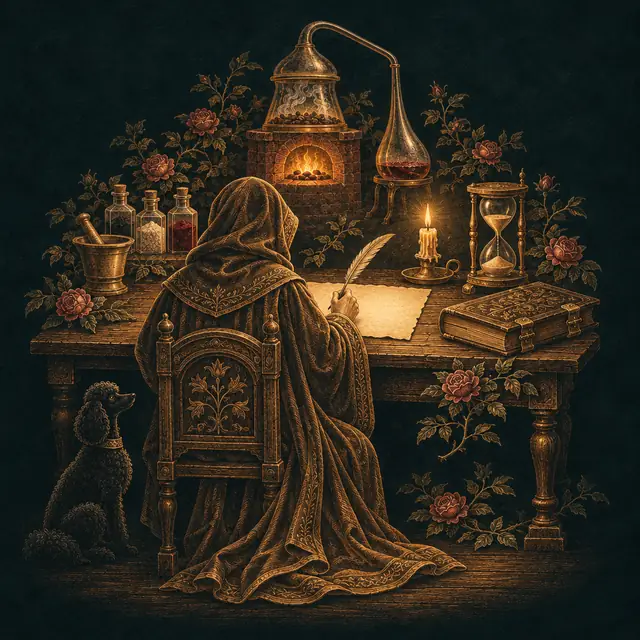
A real man stands behind the legend: Johann Georg Faust, a wandering German astrologer, alchemist and fortune-teller of the early sixteenth century, named with scorn in a handful of letters and town records. Within fifty years the chapbook Historia von D. Johann Fausten (1587) had him sign away his soul for twenty-four years of knowledge and pleasure. Christopher Marlowe put it on the English stage about 1592, and Goethe made it his life’s work (Part One 1808, Part Two 1832), in which Faust is saved.
The teaching
Taught from the Faust book of 1587, Marlowe and Goethe, with Gounod's opera and Thomas Mann's Doktor Faustus.
The bargain
Every telling turns on one bargain. A scholar who has mastered every faculty of learning and is no wiser for it turns to magic and calls up a spirit, who will serve him in this life, fetch him whatever he wants and answer every question, and take him at the end: after twenty-four years, in the Faust book and in Marlowe, by a pact signed in the scholar's blood. The years go in journeys, disputations about heaven and hell, tricks at the courts of popes and emperors and the love of Helen called up from the dead, and at midnight on the last night the devil comes. Goethe turned the pact into a wager that Faust would never be content, and let him be saved because he never stopped striving. The three tellings are told scene by scene on the branch Faust in Forbidden knowledge.
Gounod: the scholar made young
Gounod's opera of 1859 takes Goethe's first part and makes it Marguerite's tragedy. The old Faust, alone in his study at dawn, is about to drink poison when the songs of young people going out to the fields stop him; he curses life and calls on Satan, and Méphistophélès appears, dressed as a gentleman, with a bargain: here on earth he will be Faust's servant, and below Faust will be his. A vision of Marguerite at her spinning wheel decides it, and a potion makes Faust young.
At the fair Méphistophélès sings of the golden calf that all the world adores, and when Marguerite's brother Valentin and his friends see what he is, they hold up the hilts of their swords as crosses, and he shrinks back. Faust courts Marguerite with Méphistophélès's help: a casket of jewels left at her door, over which she sings as she sees herself so beautiful in the mirror, and a night in her garden. Then he leaves her.
Gounod: judged and saved
Abandoned and with child, Marguerite goes to pray, and Méphistophélès, unseen, torments her with the voices of the damned. Valentin comes home from the war, fights Faust, falls by the devil's help, and dies cursing his sister. In prison, half mad, having killed her child, she refuses Faust's offer of escape and calls on the pure and radiant angels to carry her soul to heaven. She dies; Méphistophélès cries that she is judged, voices from above answer that she is saved, and the choirs of Easter sing that Christ is risen.
Mann: the composer's pact
Thomas Mann's novel of 1947 makes the scholar a German composer, Adrian Leverkühn, whose life is told by a devoted friend writing in the last years of the Second World War. Proud, cold and afraid that music has said all it can say, Adrian seeks out a disease from a prostitute he calls Hetaera Esmeralda, after a butterfly, and weaves the letters of her name into his music as a figure of notes. In Italy the Devil comes to him in changing shapes and tells him what he has bought: twenty-four years of genius, a breakthrough past the exhausted art of his time, paid for with his soul and on one condition, that he shall not love, for love warms, and his life must be cold.
The years bring the works and take the people he loves. A young violinist who won his friendship is shot dead; his little nephew, a child everyone adores, dies of a fever of the brain, and Adrian believes he has killed him by loving him. His last work is The Lamentation of Doctor Faustus, written, he says, to take back the Ninth Symphony and its hymn to joy. When it is done he gathers his friends to hear it, confesses the pact to them in a wild speech, and collapses at the keyboard into a madness that lasts the rest of his life. His friend ends the book praying for the soul of his friend and of his fatherland.
What the story teaches
Each age has drawn its own lesson from Faust. For the Lutheran chapbook, curiosity and pride open the door to the devil and despair shuts it behind him. For Marlowe the story is the tragedy of a great mind that wants more than its share and cannot turn back. Lessing, who began a Faust he never finished, meant the devils' triumph to be only a phantom, since God would not give humankind its noblest drive, the thirst for knowledge, only to damn it; Goethe saved his Faust because he strove to the end.
Oswald Spengler named the whole restless striving of the West after him, and Mann turned the old warning on his own country, whose bargain with the demonic promised greatness and ended in ruin. Mann adds the hardest price of all: a mind sold for greatness loses first its power to love.
Who took it up
The historical Faust belonged to no known order. Books of magic were later printed under his name.
What later tellings added or changed
The pact itself. No record of the man mentions one; it is the story’s device for asking what a person will give to know and to have.
The texts that tell it
- Letters naming the wandering FaustLetters, 1507 to 1540
The real man appears in a handful of letters and town records: the abbot Johannes Trithemius scorns him in 1507 as a boasting fool, Conrad Mutianus in 1513 as a braggart, and the town of Ingolstadt sends him away in 1528. They show a wandering astrologer and fortune teller and say nothing of any pact.
Ask the Oracle about it - Historia von D. Johann FaustenChapbook, printed 1587
The first Faust book, printed at Frankfurt by Johann Spies, in which Faust signs away his soul to the devil Mephostophiles for twenty four years of knowledge and pleasure, and is carried off at the end. Written as a Lutheran warning, it was translated into English within a few years.
Ask the Oracle about it - Doctor FaustusPlay, about 1592, printed 1604
Christopher Marlowe’s tragedy, drawn from the English translation of the chapbook, which gives Faust the famous vision of Helen and a last hour of terror before the clock strikes. It made the legend part of English drama.
Ask the Oracle about it - Goethe’s FaustPlay, 1808 and 1832
Goethe’s dramatic poem, the work of his whole life: in the first part Faust bargains with Mephistopheles and ruins Gretchen, in the second he travels through classical myth and empire. In the end he is saved, because he never ceased to strive.
Ask the Oracle about it - FaustOpera, 1859
Charles Gounod’s opera, drawn from Goethe’s first part and centred on the love of Faust and Marguerite, which became one of the most performed operas of the nineteenth century.
Ask the Oracle about it - Doktor FaustusNovel, printed 1947
Thomas Mann’s novel of a German composer who trades his health for genius, told as a parable of Germany’s fall into Nazism. It is the great modern retelling of the pact.
Ask the Oracle about it
How the house tells a life
This is a story, told with its sources and with what later tellings added or changed. What it means for you is yours to judge.
The arts it feeds
Lives near it in time
Stories of forbidden knowledge
LilithMerlinMorgan le FayThe Holy GrailOdinLokiThe Monkey KingThe GolemChristian RosenkreuzHiram AbiffThe Sorcerer’s ApprenticeFrankensteinThe whole tree

