
Frankenstein
The novel by Mary Shelley, 1818
What is the story of Frankenstein, and what does it warn of?
The story and its sources
Frankenstein; or, The Modern Prometheus is a novel by Mary Shelley, begun in 1816 by Lake Geneva when she was eighteen and published in 1818. Victor Frankenstein is a student, not a doctor: he reads Agrippa, Paracelsus and Albertus Magnus as a boy, turns to modern chemistry, and gives life to a creature he then abandons in horror. The creature, who has no name, learns to speak and read, asks for a companion, is refused, and destroys those Victor loves. The experiments of Galvani and Aldini with electricity and dead tissue stood behind it.
The teaching
Taught from Mary Shelley's novel of 1818 and her introduction of 1831, with the stage and screen that retold it.
The story in brief
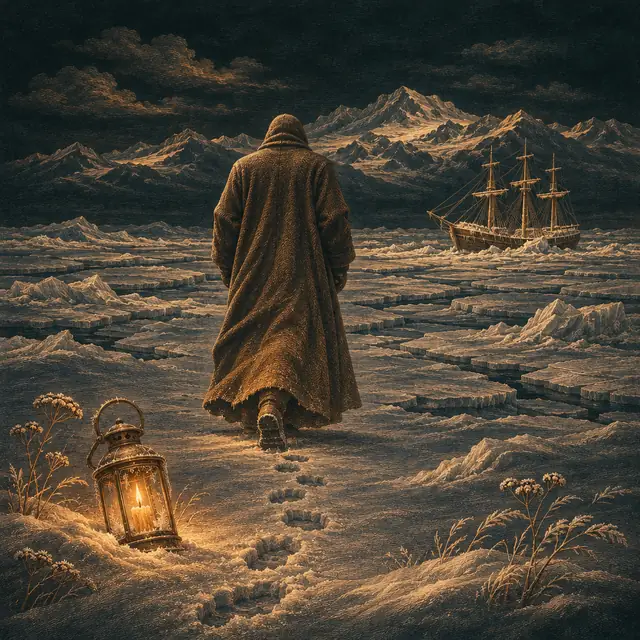
An explorer sailing for the Pole takes aboard a dying man found on the ice, and the man tells him his story as a warning. Victor Frankenstein, a student of Geneva who read the old alchemists as a boy and modern chemistry at the university, finds the secret of giving life, builds a man of gigantic size from the stuff of charnel houses, and runs from it in horror the moment it opens its eyes. Abandoned, the creature learns to speak and read and to long for love; refused it by every human face, he kills Victor's little brother, lets a servant hang for it, and asks his maker for a companion. Victor begins one and destroys it, and the creature takes his friend and his bride. The maker hunts his creature into the Arctic, where Victor dies and the creature goes off across the ice to burn himself. The novel is told chapter by chapter on the branch Frankenstein in Forbidden knowledge.
What the creature read
The creature's education is the heart of his half of the book. Hidden in a hovel against a cottage, he learns speech by listening to a poor exiled family, the De Laceys, and history from the book the son reads aloud to the Arabian girl he loves, Volney's Ruins of Empires, from which he learns of riches and rank and that he has neither, nor family, nor any name.
Then he finds three books in a leather case in the woods. The Sorrows of Werter teaches him gentle and domestic feeling and makes him wonder at death; Plutarch's Lives teach him to admire the heroes of past ages and to love virtue; and Paradise Lost he reads as true history. Like Adam he is joined by no link to any other being, but Adam came forth perfect from the hands of a God who cared for him, and he is wretched and alone. Many times he thinks Satan the fitter emblem of his state, for like Satan he looks on the happiness of others and feels the bitter gall of envy.
Safie's story
Inside the creature's story stands another, of the family he watches. Felix De Lacey had freed a Turkish merchant unjustly condemned in Paris, and loved the merchant's daughter, Safie; for it the family was stripped of its fortune and driven into exile, and the merchant, once safe, broke his word and ordered his daughter home. Safie, whose Christian mother had taught her to aspire to a free mind and an independent spirit, fled across Europe to find Felix. The creature watches the family welcome the stranger who cannot speak their language, and learns it with her. They take in a foreigner from a distant land; the same family, when it sees his face, beats him from the door.
The waking dream
In her introduction of 1831 Mary Shelley tells where the story came from. In the wet summer of 1816 by Lake Geneva, Byron proposed that each of the company write a ghost story; for days she could think of nothing, while the men talked of the principle of life, of the experiments of Dr Darwin, and of whether a corpse might be brought back to life, perhaps by galvanism. That night, unable to sleep, she saw with shut eyes the student kneel by the thing he had made and saw it stir. He flees, hoping it will sink back into dead matter, and wakes to find it standing at his bedside, looking at him with yellow, watery, but speculative eyes.
What had terrified her, she knew, would terrify others, and next day she began with the words It was on a dreary night of November. She bade her hideous progeny go forth and prosper.
The stage and the screen
The stage drew its own moral at once. The first play, in 1823, was called Presumption, and its title says what it taught: the overreacher punished. Its playbill named the creature only by a dash, which Mary Shelley, who went to see it, thought a rather good way of naming the unnameable. The film of 1931 opened with an actor stepping in front of the curtain to warn the audience, and gave its maker the cry, cut by the censors of the day, that now he knew what it feels like to be God.
What the tellers teach
Each telling draws its own lesson. Percy Shelley, reviewing the novel, read it as a study in how evil is made: treat a person ill and he becomes wicked; answer love with scorn, single out one being as the outcast of his kind and cut him off from his fellows, and malice and selfishness are forced upon him. Mary Shelley's revision of 1831 leans towards fate, with Victor speaking of a destiny too strong for him, as if his ruin had been decreed from the first. And the subtitle had named him from the start: the Modern Prometheus, after the Titan who shaped humankind from clay and brought it fire, and was chained for it.
Who took it up
None; it is fiction. Victor’s first teachers in the book are the alchemists and magicians whose lives the house also keeps.
What later tellings added or changed
That the monster is called Frankenstein, that he is a grunting brute, and the laboratory with its lightning and its cry of “It’s alive!”: those come from the stage and from the film of 1931. In the book Victor’s wrong is not that he sought knowledge but that he would not care for what he made.
The texts that tell it
- Frankenstein; or, The Modern PrometheusNovel, 1818
Mary Shelley’s novel, begun by Lake Geneva in 1816 and published anonymously in three volumes. Victor Frankenstein, a student who read Agrippa, Paracelsus and Albertus Magnus as a boy, gives life to a creature and abandons it. It is the oldest text of the story and the source of all the rest.
Ask the Oracle about it - Frankenstein, revised editionNovel, 1831
The one volume edition in which Mary Shelley revised the text and added her introduction telling of the ghost story contest at the Villa Diodati. Most readers for a century and more knew the novel in this form.
Ask the Oracle about it - Presumption; or, The Fate of FrankensteinPlay, 1823
A play by Richard Brinsley Peake, given at the English Opera House in London, the first stage version. It gave the creature no speech and Victor an assistant, and Mary Shelley went to see it. The stage began the changes the films carried on.
Ask the Oracle about it - FrankensteinFilm, 1931
The Universal film directed by James Whale, with Boris Karloff as the creature. The laboratory with its lightning, the cry that it is alive and the flat headed, grunting monster come from here, not from the book. Through it the creature came to be called by his maker’s name.
Ask the Oracle about it
How the house tells a life
This is a story, told with its sources and with what later tellings added or changed. What it means for you is yours to judge.
The arts it feeds
Lives near it in time
Stories of forbidden knowledge
The Holy GrailOdinLokiFaustThe Monkey KingThe GolemChristian RosenkreuzHiram AbiffThe Sorcerer’s ApprenticeJekyll and HydeDorian GrayDraculaThe whole tree

