
The Golem
Jewish legend; the Prague tale is first printed in the 19th century
What is the story of the Golem, and what does it warn of?
The story and its sources
In Jewish tradition a golem is a figure of clay brought to life by the letters of a holy name; the word is in the Psalms, and the Talmud tells of sages who made such a creature. The famous story sets it in Prague, where Rabbi Judah Loew, the Maharal (died 1609), makes a golem to protect the Jewish quarter and must unmake it when it grows beyond control.
The teaching
Taught from the Psalms and the Talmud, the Sefer Yetzirah and its commentators, and the Prague tales of 1847 and 1909.
The unshaped substance
The word is in the Psalms, where the singer says that God saw him before he was made: “Thine eyes did see my substance, yet being unperfect”, and the Hebrew for that unformed substance is golem. The Talmud uses the word of Adam himself, telling his first day hour by hour: in the first hour his dust was gathered, in the second he was made a golem, a shapeless mass, in the third his limbs were stretched out, and in the fourth a soul was cast into him. A golem, then, is a body not yet given its life, the clay of a man before the breath.
The man Rava made
The Talmud also tells the oldest tale of a made man. If the righteous wished it, says Rava, they could create a world, for only their sins divide them from God. Rava created a man and sent him to Rabbi Zeira, who spoke to him and got no answer, and said: you are from the companions; go back to your dust. Two other sages, it adds, sat every Sabbath eve over the book of creation, and a calf a third grown was made for them, and they ate it.
Making by the letters
The Book of Creation teaches that God made the world with ten numbers and twenty-two letters, engraving, weighing and combining them, and its medieval readers took its last words, that Abraham looked and understood and succeeded in creating, as a sign that a sage may repeat a small part of the work. Eleazar of Worms, about 1200, gives the way as his circle of German pietists knew it: take virgin earth from a mountain where no one has ploughed, knead it with pure running water and shape a figure, then recite over each limb the letters of the alphabet joined in turn to the letters of the Name, in the order the book sets.
It is done in purity, as an act of contemplation, a sharing in the wonder of creation. The commentators tell of the makers walking round the figure as they recite, and undoing it by walking and reciting the other way. The letters and their order are taught on the branch The twenty-two paths.
Truth and death
Medieval tellers wrote a word on the made man's brow. In one tale the prophet Jeremiah and his son study the book for three years and make a man on whose forehead stands the Lord God is truth, emet in Hebrew. The man takes a knife and scrapes away its first letter, aleph, leaving met, dead, so that it reads the Lord God is dead. He tells them why: when people see that men too can make a man, they will forget their Maker and turn to the makers; let them undo him. They recite the combinations backwards, and he goes back to dust. Ever after, the golem lives by a word on its brow or the Name in its mouth, and dies when one letter is taken away.
The golem of Prague
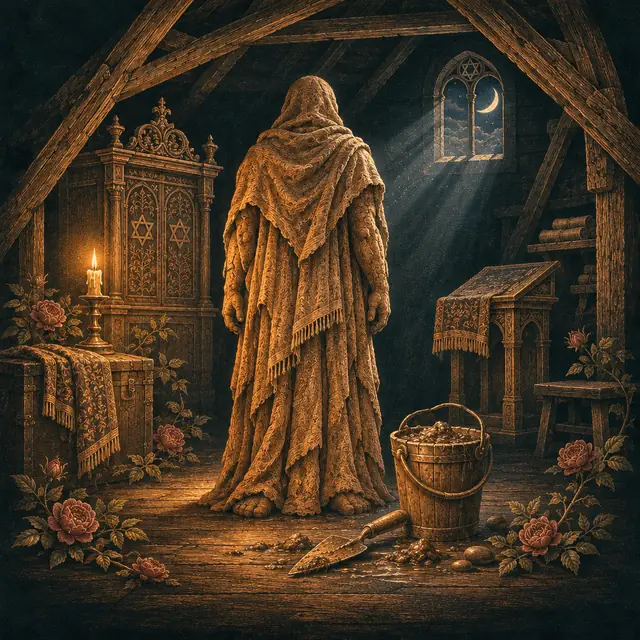
In the tales printed at Prague in the nineteenth century, Rabbi Judah Loew makes a golem to serve him, to chop wood and carry water, and every Friday before the Sabbath he takes the Name from its mouth so that it may rest. One Friday he forgets. While the congregation is singing the psalm that begins the Sabbath, word comes that the golem is tearing through the Jewish town; the rabbi runs out and pulls the Name from its mouth, and it falls to the ground as clay. When he comes back the psalm is begun again, which is why, it is said, the Old-New Synagogue sings it twice to this day; and the clay was laid in its attic.
The defender against the libel
Yudl Rosenberg's book of 1909 gave the golem its fullest story. Answered in a dream, the rabbi makes it to defend the Jews of Prague against the blood libel, the lie that they used Christian blood. With his son-in-law and a pupil he goes down to the river before dawn, for the four elements: the son-in-law is fire, the pupil water, the rabbi air, and the golem itself earth. They shape a man of clay. The son-in-law walks round it seven times reciting the combinations he has been given, and it glows red like fire; the pupil walks round it in his turn, and water runs through it; the rabbi sets the Name in its mouth, and together they say the verse of Genesis, that God “breathed into his nostrils the breath of life; and man became a living soul”, and the golem opens its eyes.
Mute and obedient, it serves in the rabbi's house, and goes out by night to catch those who carry dead children into Jewish homes to start a libel. When the danger is past the rabbi unmakes it in the synagogue attic, walking round it the other way and saying the words backwards, and forbids anyone to go up there again.
What the story teaches
The Talmud's own lesson is double: the righteous, if their sins did not divide them from God, could create a world, and yet the man Rava made could not speak, and a sage who met him sent him back to dust. Later teachers read that silence as the mark of the soul, which God alone gives. The tellers of emet and met add the danger in the making itself, that the maker may forget the Maker.
The Prague tales teach the danger of the servant: a strength made to protect, with no will or voice of its own, must be watched and put to rest, and runs wild the moment its maker forgets. Modern tellers have made it the double of a dreaming soul, as Gustav Meyrink did, and a name for the made machine, as in Norbert Wiener's God and Golem, Incorporated, a book on the learning machine and the moral weight it lays on its makers.
Who took it up
It belongs to Jewish folklore and to the study of the Sefer Yetzirah, not to any order. Later occult writers borrowed it.
What later tellings added or changed
The link to Rabbi Loew, which appears in print only in the nineteenth century, two hundred years after his death. Nothing from his lifetime tells it.
The texts that tell it
- Psalm 139Scripture, biblical
The only place where the word golem stands in the Bible: the psalmist says that God’s eyes saw his unformed substance before he was made. From this word for something unshaped the later legend took its name.
Ask the Oracle about it - Talmud, Sanhedrin 65bScripture, compiled by about 600
A passage of the Babylonian Talmud telling that the sage Rava created a man and sent him to another sage, who spoke to him, found that he could not answer, and told him to return to dust. It is the oldest tale of a made man in Jewish tradition.
Ask the Oracle about it - Sefer YetzirahBook, date unknown, before 10th century
The Book of Creation, a brief and difficult text telling how the world was formed from the ten numbers and the twenty two letters of the Hebrew alphabet. Medieval commentators read it as a guide to making a golem by the combination of letters.
Its date and author are unknown; tradition ascribed it to Abraham.
Ask the Oracle about it - SippurimLegend, printed 1847
A collection of Jewish tales of Prague published by Wolf Pascheles, among the first printings of the story of Rabbi Judah Loew making a golem, some two centuries after the rabbi’s death.
Ask the Oracle about it - The Wonders of the MaharalChapbook, printed 1909
Yudl Rosenberg’s Hebrew book of tales, printed in Poland, which made the golem a defender of the Jews of Prague against the blood libel, the slander that Jews used Christian blood. It is the source of most later tellings.
Presented as an old manuscript, it was Rosenberg’s own work.
Ask the Oracle about it - Der GolemNovel, printed 1915
Gustav Meyrink’s dreamlike novel of the old Jewish quarter of Prague, where the golem appears every thirty three years. It was a best seller, and with Paul Wegener’s films of the same years fixed the golem in modern imagination.
Ask the Oracle about it
How the house tells a life
This is a story, told with its sources and with what later tellings added or changed. What it means for you is yours to judge.
The arts it feeds
Lives near it in time
Stories of forbidden knowledge
Morgan le FayThe Holy GrailOdinLokiFaustThe Monkey KingChristian RosenkreuzHiram AbiffThe Sorcerer’s ApprenticeFrankensteinJekyll and HydeDorian GrayThe whole tree

