
Two streams
Jewish Kabbalah and the Hermetic Qabalah: what each is.
What is the difference between Jewish Kabbalah and the Hermetic Qabalah?
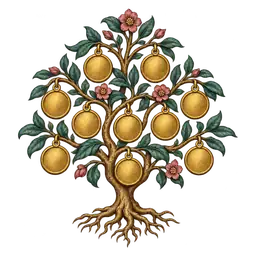
The Tree of Life is a map of ten emanations and the paths between them. It belongs to Jewish mysticism, and the Western occult orders later borrowed and changed it; the house says which stream it is speaking of.
Ten lights, and where you stand among them
Ask the OracleWhat is the Tree of Life, and where do I stand on it now?
Kabbalah, a Hebrew word for what is received, is the mystical tradition of Judaism. It took shape in Provence and Spain in the twelfth and thirteenth centuries, produced its great book, the Zohar, in Castile around 1280, and was remade in the Galilee town of Safed in the 1500s. Its best known image is the Tree of Life: ten sefirot, the qualities through which the infinite God is said to act and be known, joined by twenty-two paths.
Two streams carry that image today, and they should not be confused. Jewish Kabbalah is studied inside the life of Torah, prayer and commandment. The Hermetic Qabalah was made by Christian and occult writers from the Renaissance onward, who took the Tree and joined it to tarot, astrology and ritual magic. The house says which stream it is speaking of, teaches the ideas only, and leaves the practical use of divine names and amulets where Jewish tradition keeps it, with a teacher.
As the Kabbalah of the Sefer Yetzirah, the Zohar and Safed teaches it.
Kabbalah begins where speech gives out. Before and beyond everything is Ein Sof, the Without End: God as God is, of whom nothing can be said or thought, without limit, form or image. Everything else the art teaches is about how the hidden becomes known: how the infinite can act in a world that has limits, and how a person in that world can come near to what has none.
Its answer is the sefirot, ten ways in which the Without End goes out, acts and is known. The kabbalists insist that the ten do not divide God, who remains one; they are like one light shining through ten panes of coloured glass. The masters differ on what the ten are. Some teach that they are God's own being made manifest, others that they are his instruments, and Moses Cordovero teaches that they are both: a divine light clothed in vessels.
The sefirot go out in order, each receiving from the one above it and giving to the one below. Keter, the crown, is the first stirring of will, so near the Without End that it is also called nothing. Chokhmah, wisdom, is the first flash in which all is present at once; Binah, understanding, receives that point and unfolds it into form. Chesed, lovingkindness, gives without measure; Gevurah, strength and judgement, sets the limit; Tiferet, beauty, joins the two in truth and compassion. Netzach, endurance, presses on; Hod, splendour, yields and gives thanks; Yesod, foundation, gathers the lights above and passes them on; and Malkhut, the kingdom, receives them all and is the divine presence dwelling in the world, the Shekhinah.
The Sefer Yetzirah, the Book of Formation, calls them the ten sefirot belimah, a word read as closed, as without substance or as of nothing, and fixes their number: ten and not nine, ten and not eleven. Cordovero opens his great summary of the art with a gate named for that sentence. Each of the ten holds something of all the others, so that no quality is ever found alone. The ten are taught one by one, with their many names and their places in Scripture and in the body, on the page of the ten sefirot.
The ten stand in a figure. Three lines run down it: on the right Chokhmah, Chesed and Netzach, the side of giving; on the left Binah, Gevurah and Hod, the side of limit; and down the middle Keter, Tiferet, Yesod and Malkhut, where the two are joined. The world stands on both sides held together, for mercy without judgement floods and judgement without mercy crushes, as the page of the three pillars teaches.
Twenty-two lines join the ten, one for each letter of the Hebrew alphabet, and with the ten they make the thirty-two wondrous paths of wisdom with which, the Sefer Yetzirah says, the world was made: three mother letters for the three elements it counts, seven doubles for the planets and the days, and twelve simples for the signs and the months. The letters are not only signs for sounds but the stones of creation, and they are taught letter by letter on the page of the twenty-two paths.
The figure is also a human form. Scripture says that the human being was made in the image of God, and the kabbalists read that image as the ten: the right arm is lovingkindness and the left strength, the trunk is beauty, the two legs are endurance and splendour, and the rest of the ten have their places too, with the crown above the head. So the Tree is at once a map of how God acts and a map of a person, and whoever studies the one is studying the other.
The soul has its levels as the world does. The Zohar names three: nefesh, the life of the body, given to everyone; ruach, the spirit, grown by good deeds; and neshamah, the highest soul, which comes with study and service of the whole heart. Later teaching adds two more above them. A person, in this art, is a small world in whom all the levels meet, and what a person does moves them all.
The light comes down not once but through four worlds, each a step further from its source. The kabbalists read them out of a verse of Isaiah: “Even every one that is called by my name: for I have created him for my glory, I have formed him; yea, I have made him.” Being called by the name is Atzilut, emanation, the world of the sefirot themselves; creating is Beriah, creation, the world of the throne; forming is Yetzirah, formation, the world of the angels; and making is Asiyah, action, the world of deeds, to which this world belongs.
The Safed masters teach that each world has its own ten sefirot, so that the whole Tree stands four times over, each world receiving from the one above it, and that the four worlds answer to the four letters of the divine name. The levels of the soul answer to them as well: the life of the body to action, the spirit to formation, the higher soul to creation, and the two highest levels to emanation and to what lies beyond it.
The light does not only come down; it goes out and comes back. The Sefer Yetzirah says that the vision of the ten is like a flash of lightning, and that the word in them runs and returns, words it takes from the living creatures of Ezekiel, who “ran and returned as the appearance of a flash of lightning.” The kabbalists take running and returning as a rhythm of the spiritual life: the light reaching out and drawing back, the soul longing toward its source and turning back to its work in the world. The same book gives its reader a first counsel of restraint: keep the mouth from speaking and the heart from pondering, and if the heart runs, bring it back to its place.
Between the worlds the movement runs both ways. The Zohar's rule is that an awakening from below calls forth an awakening from above: what people do, pray and intend stirs the flow of the sefirot, and the flow comes down to meet them. Its whole drama is the union of Tiferet, the Holy One, blessed be He, with Malkhut, the Shekhinah, whom wrongdoing divides and every commandment done with intention, kavvanah, helps to join; the Sabbath is their wedding. That story is told on the page of the Zohar and Safed.
Isaac Luria tells the beginning in three acts, and the later art reads everything through them. First the Without End withdrew into itself to leave room for a world: the tzimtzum. Into that room it sent a ray of light, and the lower vessels made to hold the light could not bear it and broke, scattering sparks of holiness among the shards, which became the husks, the qelippot, that hide them. The work left to people is tikkun, the repair: every good act done with intention lifts a spark and returns it to its place. All three are taught in full on the page of the Zohar and Safed.
The tradition guards this study, and its cautions belong to its foundations. The Torah is read on four levels, the plain sense, the hint, the homily and the secret, and Kabbalah is the study of the fourth, which never cancels the other three. Its books are written for readers already at home in Torah, prayer and law, and it is learned from a teacher. Its masters divide it into the contemplative Kabbalah of ideas, which seeks to understand the sefirot and the meaning of the commandments, and the practical Kabbalah of holy names and amulets, which most of them forbade or kept for very few. What these pages teach is the first, and the page of the two streams gives the cautions in full.
The occult orders read the same figure in their own way, and this stream is named wherever it is meant. The Hermetic Qabalah spells its names Kether, Chokmah, Tiphareth and Malkuth, numbers the sephiroth from one to ten and the paths from eleven to thirty-two, and makes the Tree a map of every symbol: a planet, a colour, a god and an angel on each sephirah, and a Hebrew letter and a tarot trump on each path. It draws the descent of the light as a lightning flash striking down through the ten in the order of their numbers and the way back as a serpent winding up the paths; it lays the four worlds on the four elements and the four suits of the cards; and it makes the Tree a ladder of grades, climbed from Malkuth upward.
Where the two streams part, both are given and each is named. The Jewish sources set the letters on the paths in more than one arrangement and match the sefirot to the planets in differing orders; the Hermetic tables are one stream's choice among them, and the tarot on the paths belongs to that stream alone.
The student learns the Tree a step at a time. First the ten names in their order, with what each means, until they come without effort. Then their pairs and their places on the three lines, and the three groups of letters that join them. Then the four worlds, and the story of withdrawal, breaking and repair. Only then does the student read a verse of Scripture for the sefirot it touches, a verse of water or of the right hand speaking of Chesed and one of fire or of the left hand speaking of Gevurah, and last of all learn the ten as qualities to recognise in a day: where there was giving, where restraint, and where the two were held together in truth.
The branches can be taken in the same order. The two streams come first, so that every book can be placed. The ten sefirot, the three pillars and the twenty-two paths build the figure; the Zohar and Safed tell its great story; and one sefirah for now brings a single quality down into the reader's own week, beside one thing in the reader's chart, using the Hermetic table of planets and saying so.
Jewish Kabbalah and the Hermetic Qabalah of the occult orders are different streams; the Oracle says which it is speaking of. It teaches the ideas, not the practical use of names or amulets, which Jewish tradition keeps for study with a teacher.
Each one is a question you can ask.
Jewish Kabbalah and the Hermetic Qabalah: what each is.
What is the difference between Jewish Kabbalah and the Hermetic Qabalah?
The ten emanations, from Keter at the crown to Malkhut at the foot.
What are the ten sefirot of the Tree of Life in Kabbalah?
Mercy, severity, and the middle way between them.
What are the three pillars of the Tree of Life in Kabbalah?
The Hebrew letters that join the sefirot.
What are the twenty-two paths of the Tree of Life in Kabbalah?
The great book of thirteenth-century Spain, and Isaac Luria’s school.
What is the Zohar, and what did Isaac Luria teach in Safed about Kabbalah?
One of the ten read beside one thing in your chart.
Which sefirah of the Tree of Life in Kabbalah speaks to what I am living now?
Each opens its page in the dictionary.
French writer, born Alphonse-Louis Constant, who trained for the Catholic priesthood and left before ordination. His Dogme et Rituel de la Haute Magie (1854 to 1856) shaped modern occultism: he tied the twenty-two tarot trumps to the Hebrew letters and drew the goat-headed figure of Baphomet as an emblem of balanced opposites.
In Jewish tradition a golem is a figure of clay brought to life by the letters of a holy name; the word is in the Psalms, and the Talmud tells of sages who made such a creature. The famous story sets it in Prague, where Rabbi Judah Loew, the Maharal (died 1609), makes a golem to protect the Jewish quarter and must unmake it when it grows beyond control.
Florentine priest, physician and scholar, head of the circle the Medici gathered at Careggi. He put all of Plato into Latin and, before it, the Corpus Hermeticum, which he believed as old as Moses. His Three Books on Life (1489) teach how to temper the planets within oneself by music, scent, food and image, and are the first book of what is now called psychological astrology. He gave the West the phrase “Platonic love” and the idea of one ancient theology running from Hermes to Plato.
Abraham AbulafiaMoses de LeónJohannes ReuchlinPico della MirandolaIsaac LuriaIsrael RegardieGershom ScholemHeinrich KhunrathThe Baal Shem TovWilliam Wynn WestcottMacGregor MathersStanislas de GuaitaDion FortuneLilithCornelius AgrippaFrancis BarrettJoséphin PéladanPapusArthur Edward WaiteFranz BardonEnoch
Magic and protectionTarot, runes, I ChingThe Hermetic principlesHerbs, oils and stonesForbidden knowledgeSacred geometrySymbols
The Tree of LifeThe Twenty-Two LettersDictionary: KabbalahSearch the treeThe whole tree
Make today specific
The same sky reaches everyone differently. Your birth details turn a general forecast into one theme, and one thing worth doing about it.
One instrument, one answer. Explore the preview; membership opens every tool.
Read more

