
What are the twenty-two paths of the Tree of Life in Kabbalah?
What it is
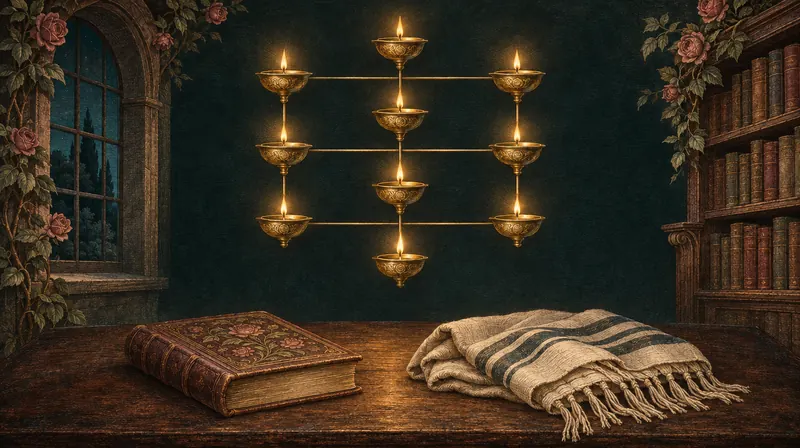
Twenty-two lines join the ten sefirot, one for each letter of the Hebrew alphabet. With the sefirot they make the thirty-two paths of wisdom named at the opening of the Sefer Yetzirah. That book sorts the letters into three mothers, seven doubles and twelve simples, and links them to the three elements it counts, the seven planets and days, and the twelve signs and months. In the diagram used in Safed the lines follow the same count: three run across, seven run down and twelve run slantwise.
The teaching
As the Sefer Yetzirah with the Tree of each stream teaches it.
Thirty-two paths of wisdom
The Sefer Yetzirah opens by saying that the world was made with thirty-two wondrous paths of wisdom: the ten sefirot and the twenty-two letters of the Hebrew alphabet. The letters are not only signs for sounds. They are the stones the world is built from: God engraved them, carved them, weighed them, exchanged them and combined them, and formed through them everything that is formed and everything that will be.
The book shows the power of combining with a sum. Two stones build two houses, three build six, four build twenty-four, five a hundred and twenty, and from there the count goes beyond what the mouth can speak and the ear can hear.
Three, seven and twelve
The book sorts the letters by their sounds and their work. Three are mothers, aleph, mem and shin, standing for air, water and fire. Seven are doubles, each with a hard and a soft sound, and they stand for the seven planets, the seven days, the seven gates of the face, which are the two eyes, the two ears, the two nostrils and the mouth, and seven pairs of opposites. Twelve are simples, with one sound each, and they stand for the twelve signs, the twelve months, twelve organs and twelve powers of a person.
The versions of the book differ in which double goes with which planet and which power goes with which letter. What follows gives each letter its name, its meaning and its place by one main version.
The three mothers
Aleph, whose name means an ox, is air and breath, the balance between fire and water; in the year it is the temperate season and in the body the chest. It has no sound of its own and carries whatever vowel it is given. The Zohar tells that when the letters came before God, each asking that the world be made through it, aleph held back in humility, and was given the first place in the Ten Commandments as its reward.
Mem, whose name means water, is water, silent and humming; in the universe it is the earth below, in the year it is the cold and in the body the belly.
Shin, whose name means a tooth, is fire and hisses; in the universe it is the heavens, in the year it is the heat and in the body the head. Its three upright strokes are often read as three flames.
The doubles: bet, gimel, dalet
Bet, a house, is the letter with which the Torah begins, and the Zohar says God chose it from all the letters because it begins the word for blessing. It governs wisdom, whose opposite is folly, and it sounds as b or v.
Gimel, a camel, governs wealth, whose opposite is poverty. The Talmud reads gimel and dalet side by side as a lesson in giving: the foot of the gimel reaches toward the dalet because the generous run after the poor.
Dalet, a door, governs seed and fruitfulness, whose opposite is desolation. Its name is close to the Hebrew word for the poor, which is how the Talmud can read it as the one the gimel runs to help.
The doubles: kaf, pe, resh, tav
Kaf, the palm of the hand, governs life, whose opposite is death, and it sounds as k or kh.
Pe, the mouth, governs dominion, whose opposite is slavery, and it sounds as p or f.
Resh, the head, governs peace, whose opposite is war, the pair the book sets for it among the seven.
Tav, a mark, the last letter of the alphabet, governs grace, whose opposite is ugliness. In Ezekiel's vision a mark is set on the foreheads of those who grieve over the city's wrongs, and the word for that mark is tav.
The simples: he, vav, zayin, chet
He, a window, governs speech; its sign is the Ram and its month Nisan, when the year of the festivals begins in spring.
Vav, a hook or nail, the letter that joins words together as and, governs thought; its sign is the Bull and its month Iyar.
Zayin, a weapon, governs walking and motion; its sign is the Twins and its month Sivan, the month in which the Torah was given.
Chet, a fence, governs sight; its sign is the Crab and its month Tammuz, at the height of summer.
The simples: tet, yod, lamed, nun
Tet, whose name the occult orders read as a serpent, governs hearing; its sign is the Lion and its month Av.
Yod, a hand, the smallest letter, little more than a point from which the shapes of the others are drawn, governs action; its sign is the Virgin and its month Elul.
Lamed, an ox goad, the tallest letter, rising above the line, governs the union of man and woman; its sign is the Scales and its month Tishri, which brings the new year.
Nun, a fish, governs smell; its sign is the Scorpion and its month Cheshvan, the one month without a festival.
The simples: samekh, ayin, tsadi, qof
Samekh, a prop or support, governs sleep; its sign is the Archer and its month Kislev, which holds the festival of lights.
Ayin, an eye, governs anger; its sign is the Goat and its month Tevet, in the depth of winter.
Tsadi, a fish hook, governs taste; its sign is the Water Bearer and its month Shevat, when the new year of the trees is kept.
Qof, the back of the head, governs laughter; its sign is the Fishes and its month Adar, the month of Purim, when joy is increased.
The paths on the Tree
In the Tree drawn by the Safed school the letters keep their groups: the three mothers run across, joining the two sides; the seven doubles run down; and the twelve simples run slantwise. The Tree the Hermetic orders use places the letters in plain alphabetical order instead, from aleph between Keter and Chokhmah down to tav between Yesod and Malkhut, and numbers the paths from eleven to thirty-two, after the ten sefirot.
The trumps on the paths
On those paths the Golden Dawn sets the tarot trumps in order: the Fool on aleph, the Magician on bet, the High Priestess on gimel, the Empress on dalet, the Emperor on he, the Hierophant on vav, the Lovers on zayin, the Chariot on chet, Strength on tet, the Hermit on yod, the Wheel of Fortune on kaf, Justice on lamed, the Hanged Man on mem, Death on nun, Temperance on samekh, the Devil on ayin, the Tower on pe, the Star on tsadi, the Moon on qof, the Sun on resh, Judgement on shin and the World on tav.
The doubles then take their planets from the trumps: Mercury for bet, the Moon for gimel, Venus for dalet, Jupiter for kaf, Mars for pe, the Sun for resh and Saturn for tav. This table belongs to the Hermetic stream alone.
Language before things
In Jewish learning the letters are studied through the Sefer Yetzirah and its commentaries, with a teacher, and the meditative use of their combinations is left to that setting. What any reader can take from the book is its way of seeing: the world is spoken before it is made, and things are words before they are things. Its readers have long joined that teaching to the proverb that death and life are in the power of the tongue.
How it is practised
In Jewish learning the letters are studied through the text of the Sefer Yetzirah and its commentaries, with a teacher. Abraham Abulafia, in the thirteenth century, made the combining of letters a path of its own, and his own tradition restricted it. The Hermetic stream uses the paths for guided imagination, called pathworking, moving in the mind from one sefirah to the next. The house teaches neither as a practice. What a reader can do is learn the three groups of letters and see how an old book built the world out of an alphabet: a way of thinking in which language comes before things.
Where it comes from
The Sefer Yetzirah is short, early and hard to date; scholars place it anywhere from the second century to the sixth, and Saadia Gaon wrote a commentary on it in 931. It speaks of letters as the building blocks of creation and says nothing of a tree. From that idea grew the legend of the golem, a figure of earth that a sage brings to life with letters. Later kabbalists drew the paths in more than one arrangement. The Hermetic stream uses the one printed by Athanasius Kircher in the 1650s, and the Golden Dawn set a tarot trump and a planet or sign on each path, a scheme the Jewish sources do not have.
What is known, and what is not
The Sefer Yetzirah survives in several versions that differ in length and in which letter goes with which planet, so there is no single original table. The tarot attributions date from 1781, when Court de Gébelin and the Comte de Mellet first proposed the link; Éliphas Lévi built on it and the Golden Dawn rearranged it. They are a Hermetic invention. The idea that letters shape reality is a religious teaching and is not open to test.
Its words
- Sefer Yetzirah
- The Book of Formation, a short early Hebrew text that builds the world from ten numbers and the twenty-two letters.
- Sefirot
- The ten qualities or emanations of the Tree of Life, from Keter, the crown, to Malkhut, the kingdom. One of them is a sefirah.
- Golem
- In Jewish legend, a figure of earth given life by a sage through the Hebrew letters, which moves but cannot speak. The Prague tale is a late one.
- Abraham Abulafia
- The wandering kabbalist born at Saragossa in 1240, who taught a Kabbalah of experience built on combining and reciting letters, and was opposed for it.
Ask the Oracle further
What are the three mothers, seven doubles and twelve simples in Kabbalah?Why does the Hermetic Qabalah set a card on each path of the Tree of Life?
Before you practise
Jewish Kabbalah and the Hermetic Qabalah of the occult orders are different streams; the Oracle says which it is speaking of. It teaches the ideas, not the practical use of names or amulets, which Jewish tradition keeps for study with a teacher.
Its other branches
Two streamsThe ten sefirotThe three pillarsThe Zohar and SafedOne sefirah for nowThe whole artSearch the tree

