
The ten sefirot
The ten emanations, from Keter at the crown to Malkhut at the foot.
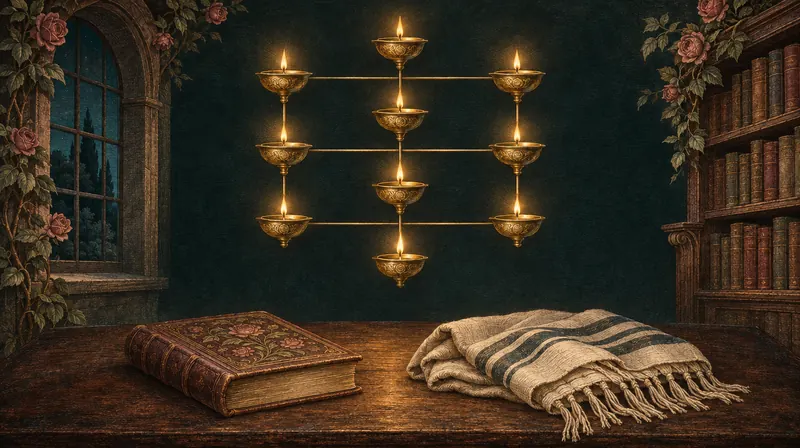
What are the ten sefirot of the Tree of Life in Kabbalah?
What it is
The sefirot are ten aspects through which the infinite, the Ein Sof, is said to reach the world. From the top they are Keter, crown; Chokhmah, wisdom; Binah, understanding; Chesed, lovingkindness; Gevurah, strength or judgement; Tiferet, beauty or balance; Netzach, endurance; Hod, splendour; Yesod, foundation; and Malkhut, kingdom, where the divine presence dwells in the world. They are not ten gods, nor ten parts of God. The kabbalists compare them to coloured glass through which one light shines.
The teaching
As the Kabbalah of Spain and Safed teaches it.
Ein Sof and the ten
Above and before the sefirot is Ein Sof, the Without End: God as God is in himself, of whom nothing can be said, not even that he is one in the way a thing is one. From Ein Sof the light goes out through ten sefirot, the ways in which God acts and is known. They are not ten gods and not ten pieces of God. The kabbalists compare them to water poured into vessels of different colours, which seems to take the colour of each vessel while the water itself does not change. The Sefer Yetzirah fixes their number: ten and not nine, ten and not eleven.
Seven of their names come from a verse of David's prayer: “the greatness, and the power, and the glory, and the victory, and the majesty: for all that is in the heaven and in the earth is thine; thine is the kingdom.” Greatness is Chesed, power is Gevurah, glory is Tiferet, victory is Netzach, majesty is Hod, all that is in heaven and earth is Yesod, and the kingdom is Malkhut.
The crown, wisdom and understanding
Keter is the crown, the first and highest, so near to Ein Sof that it is sometimes called Ayin, nothing, for no thought can grasp it. It is the divine will before any plan, the first stirring of wanting that there be a world. As a crown sits above the head and is not part of it, Keter sits above the other nine.
Chokhmah is wisdom, the first flash in which all that will be is present at once and undivided, like a seed or a single point. The kabbalists read the first words of the Torah, in the beginning, as with wisdom: wisdom is the beginning. It is called the father, and it stands at the head of the right side.
Binah is understanding, the palace that receives the point of wisdom and unfolds it into detail and form, as a womb receives a seed and shapes it. It is called the mother, and it stands at the head of the left side. It is also called return, teshuvah, because all things come back to it, and the Talmud speaks of fifty gates of understanding, all but one of them given to Moses.
Da'at, knowledge, is where wisdom and understanding meet and become one's own, as people in Scripture are said to know one another. It is not an eleventh sefirah. Some schemes count it in place of Keter, so that the number stays ten; others treat it as the hidden inner face of the crown.
Lovingkindness, strength and beauty
Chesed is lovingkindness, also called Gedulah, greatness: love that gives without measure and without asking whether the receiver deserves it. It is the right arm, water and the colour white, and Abraham, whose tent stood open on every side for guests. Alone it would flood everything; it needs a limit.
Gevurah is strength, also called Din, judgement, and Pachad, fear: the power to restrain, to measure, to say no and to set a bound. It is the left arm, fire and the colour red, and Isaac, bound on the altar in awe. It gives every gift its shape; cut off from Chesed it turns harsh, and the Zohar finds there the root of evil.
Tiferet is beauty, also called Rachamim, compassion: the balance of love and judgement, not a compromise but a harmony, mercy that knows the truth. It is the heart and trunk of the body, the centre of the Tree, and Jacob, to whom Scripture gives truth. It is called the Holy One, blessed be He, the king, the sun and the Written Torah, and the six sefirot from Chesed to Yesod gather round it.
Endurance, splendour and foundation
Netzach is endurance, victory and eternity: the power to persist, to keep on and to overcome. It is the right leg, and Moses, who led the people forty years through the desert.
Hod is splendour and majesty, and is linked with acknowledgement and giving thanks: the power to yield, to admit, to give way with grace and to praise. It is the left leg, and Aaron the priest, who served and blessed. Netzach and Hod are a pair, pressing on and holding back, like two legs that walk only by taking turns, and together they are the source from which prophecy flows.
Yesod is foundation, the channel that gathers the light of all the sefirot above it and passes it down to Malkhut. It is the organ of the covenant, and Joseph, called the righteous, and of it is read the verse that the righteous one is the foundation of the world. Its quality is faithfulness, the keeping of the covenant, and the right joining of giver and receiver.
Malkhut, the kingdom
Malkhut is the kingdom, the last of the ten, which receives all the others and has no light of its own, as the moon has none. It is the Shekhinah, the divine presence dwelling in the world; it is the community of Israel, the Oral Torah, the bride, the Sabbath queen, and David the king. It is speech, where thought becomes deed.
It is also the gate. Whoever would come to the sefirot above comes through it, and Joseph Gikatilla's Gates of Light, a dictionary of the names of the sefirot, begins with Malkhut for that reason and climbs from there to the crown.
The ten in the body
A passage of the Tikkunei Zohar, still printed in many prayer books, lays the sefirot on the human form: Chokhmah is the brain, and Binah the heart, with which the heart understands; Chesed is the right arm and Gevurah the left; Tiferet is the trunk; Netzach and Hod are the two thighs; Yesod is the end of the body, the sign of the holy covenant; and Malkhut is the mouth, which is called the Oral Torah. The crown rests above the head. The same passage reminds the reader that God is one, but not in the way that numbers count.
The seven shepherds
Each of the seven lower sefirot has a face in Scripture: Abraham for Chesed, Isaac for Gevurah, Jacob for Tiferet, Moses for Netzach, Aaron for Hod, Joseph for Yesod and David for Malkhut. At the festival of Sukkot they are welcomed into the booth as guests, the ushpizin, one leading on each of the seven nights in that order, so that the week of the festival walks down the Tree.
How the ten are learned
The ten are learned first by name and in order, then in their pairs and their places on the three lines, and then by their many other names. Each sefirah has dozens, drawn from Scripture: Malkhut is also the moon, the sea, the earth, the bride and the gate; Chesed is the right hand, water and the morning. With the names a student learns to read a verse for the sefirot it touches, so that a verse about water or the right hand speaks of Chesed, and one about fire or the left hand of Gevurah.
Last of all the ten are learned as qualities to recognise in one's own life: where there was giving, where restraint, and where the two were held together in truth. That is where the Jewish study of the sefirot has always led, from the map above to the conduct of a person below.
How it is practised
The sefirot are learned first as a list, then as pairs that balance, then as qualities to notice in a day: where there was giving, where restraint, where the two were held together. In Jewish practice the seven lower sefirot are counted through the forty-nine days between Passover and Shavuot, one pairing a day, as a review of character. A reader can borrow the habit of attention without the rite, taking one quality for a week and watching where it shows.
Where it comes from
The word first appears in the Sefer Yetzirah, where the ten sefirot are simply the ten numbers. In the Bahir and among the kabbalists of thirteenth-century Spain they became qualities within God, most with names drawn from Scripture. An eleventh name, Da'at, knowledge, is used in some schemes in place of Keter, so the count stays at ten. Luria's school also pictured the ten as a human figure of light, Adam Kadmon, the primordial man. The tree-shaped diagram is later than the idea: one of the first printed versions is on the title page of a Latin book published at Augsburg in 1516.
What is known, and what is not
The texts and their dates are established, and the names differ a little between schools: Chesed is also Gedulah, and Gevurah is also Din. What the sefirot are is a matter of faith and interpretation, on which kabbalists themselves disagreed, some calling them God's own being and others his instruments. As a set of ten human qualities they are a map for reflection. Nothing about them can be measured, and no chart can fix where a person stands among them.
Its words
- Sefirot
- The ten qualities or emanations of the Tree of Life, from Keter, the crown, to Malkhut, the kingdom. One of them is a sefirah.
- Ein Sof
- Hebrew for without end: God as God is beyond the sefirot, of whom nothing can be said.
- Sefer ha-Bahir
- The Book of Brightness, a short book of sayings and parables known in Provence from the late 1100s, where the sefirot first appear as powers within God.
- Da'at
- Knowledge: the point on the middle line where wisdom and understanding join. Schemes that count it leave Keter out, so the sefirot still number ten.
- Adam Kadmon
- The primordial man: in Luria's teaching the first form the light takes after the contraction, the sefirot pictured as a human figure. It is a symbol.
Ask the Oracle further
What is the difference between Chesed and Gevurah among the sefirot?Why is Da'at sometimes shown on the Tree of Life and sometimes left out?
Before you practise
Jewish Kabbalah and the Hermetic Qabalah of the occult orders are different streams; the Oracle says which it is speaking of. It teaches the ideas, not the practical use of names or amulets, which Jewish tradition keeps for study with a teacher.
Its other branches
Two streamsThe three pillarsThe twenty-two pathsThe Zohar and SafedOne sefirah for nowThe whole artSearch the tree

