
The three pillars
Mercy, severity, and the middle way between them.
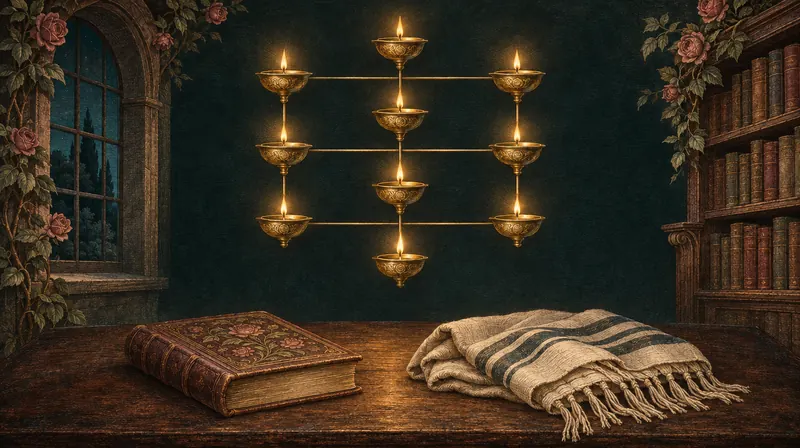
What are the three pillars of the Tree of Life in Kabbalah?
What it is
The ten sefirot of the Tree of Life are drawn in three columns. On the right stand Chokhmah, Chesed and Netzach, the side of mercy: giving, widening, saying yes. On the left stand Binah, Gevurah and Hod, the side of judgement: limit, form, saying no. Down the middle run Keter, Tiferet, Yesod and Malkhut, where the two are balanced. The teaching in the picture is that neither side is good alone. Mercy without limit floods, judgement without mercy crushes, and a life needs both held together.
The teaching
As each stream of the Tree in its turn teaches it.
Right, left and centre
The ten sefirot stand in three lines. On the right are Chokhmah, Chesed and Netzach; on the left Binah, Gevurah and Hod; in the centre Keter, Tiferet, Yesod and Malkhut. The right is the side of giving, widening and drawing near; the left is the side of measure, limit and holding back; the centre is where the two are joined. The Zohar speaks of a right line, a left line and a middle line that unites them, and its account of the divine life is the story of the three held in balance or thrown out of it.
Mercy joined to judgement
Why the world stands at all is taught in a saying that Rashi gives on the first verse of Genesis. At first it was God's thought to create the world by the quality of judgement alone; seeing that it could not endure, he set the quality of mercy first and joined it to judgement. The world is built on both lines at once and would not last on either alone.
The Zohar tells the same in its own way. Before the world as it is, there were kings who reigned and died, the kings of Edom named in Genesis, and it reads them as worlds of judgement without balance, which could not stand.
When the left breaks loose
Judgement is not evil; it is the form that love needs. But when the left side is cut off from the right and acts alone, it becomes the root of what the Zohar calls the other side, the sitra achra, the realm of harm. Judgement without mercy crushes, and mercy without judgement floods and spoils. The middle line is not the absence of the two but their meeting, and the kabbalists name it with a third word: truth.
The middle bar
Scripture gives the middle line an image. The boards of the tabernacle were held by a bar through their centre: “And the middle bar in the midst of the boards shall reach from end to end.” The kabbalists read that bar as the middle line, as Tiferet, and as Jacob, who joins the love of Abraham to the awe of Isaac. The line runs from the crown through Tiferet and Yesod to Malkhut, and it is the path of the light from Ein Sof to the world: down the middle, fed from both sides.
The three mothers
The Sefer Yetzirah knows the same pattern in its three mother letters. Mem is water and hums, shin is fire and hisses, and aleph is air, the breath that decides between them: on one side the pan of merit, on the other the pan of guilt, and the tongue of the balance between them. The kabbalists set the water on the right with Chesed, the fire on the left with Gevurah and the air in the middle with Tiferet, so that the three lines of the Tree are already present in the alphabet.
Push away with the left
The Talmud brings the three lines down to the raising of a child and the teaching of a pupil: let the left hand push away and the right hand draw near. Both hands work, and neither works alone. The limit is set, but the drawing near is never withdrawn, and that held pair is the middle line in daily life.
Jachin and Boaz
In the occult orders the outer lines become pillars, named for the two bronze pillars at the porch of Solomon's temple: “he set up the right pillar, and called the name thereof Jachin: and he set up the left pillar, and called the name thereof Boaz.” Jachin, he will establish, stands over the Pillar of Mercy; Boaz, in it is strength, over the Pillar of Severity; and between them runs the Middle Pillar, which this stream also calls the Pillar of Mildness or of Equilibrium.
The pillars are built into the halls of these orders. In the Golden Dawn's first grade the candidate is led between two pillars, one black and one white, and the teaching is that the way lies between them, through the balance of the two forces and never by one of them alone.
The way of the middle
For the Hermetic stream the Middle Pillar is also the way of the mystic, who rises straight up from Malkuth through Yesod and Tiphareth toward the crown, while the outer pillars are the ways of the occultist, who works with the forces of each side in turn; Dion Fortune teaches the two ways so. The exercises of this stream that work on the body along that pillar are not taught here.
Living on three lines
A student works with the three lines by noticing which of them a habit or a moment belongs to: a yes given too freely, a no given too fast, or the rarer act that is both kind and true. Most people lean one way by nature, and the teaching is not to leave their own side but to join it to the other. The middle is not a grey place halfway between; it is the line of Jacob, where love and judgement each receive what is due to them and are bound into one.
How it is practised
As a mirror the three columns give a quick check on any decision. A reader asks what the generous course would be, what the strict course would be, and what would do justice to both. People tend to lean one way by temperament, always yielding or always holding the line, and the picture helps them see the side they neglect. This is reflection with pen and paper. The ritual exercises of the Hermetic stream are not taught here.
Where it comes from
Kabbalists of the thirteenth century already spoke of a right, a left and a middle line, and the Zohar traces harm in the world to judgement cut loose from mercy. The names Pillar of Mercy, Pillar of Severity and Pillar of Mildness come from the Hermetic stream, which also set Jachin and Boaz, the bronze pillars of Solomon's temple, over the whole outer columns. The exercise called the Middle Pillar belongs to the same stream: Israel Regardie published it in 1938 from the teaching of the Golden Dawn.
What is known, and what is not
The three lines are well attested in the Jewish sources, and the pillar names in the Hermetic ones. Jewish sources, later parts of the Zohar among them, already name Jachin and Boaz for Netzach and Hod; setting them over the whole outer columns is the occult and Masonic reading. As a way of weighing a choice the scheme has the standing of a good proverb. It describes no force that can be detected, and it gives no rule for which side a person should favour in a given case.
Its words
Ask the Oracle further
Which pillar of the Tree of Life do I lean toward, mercy or severity?Where does the idea of Jachin and Boaz on the Tree of Life come from?
Before you practise
Jewish Kabbalah and the Hermetic Qabalah of the occult orders are different streams; the Oracle says which it is speaking of. It teaches the ideas, not the practical use of names or amulets, which Jewish tradition keeps for study with a teacher.
Its other branches
Two streamsThe ten sefirotThe twenty-two pathsThe Zohar and SafedOne sefirah for nowThe whole artSearch the tree

