Mystical systems
Tarot
Direct answer
Tarot is a deck of illustrated cards used historically for games and later for symbolic, occult, psychological, and reflective reading systems.
Tarot is a card system whose images became a symbolic language for archetypes, choices, and life patterns.
$0 today, then $12/month after 7 days. Cancel anytime.
At a glance
- Found in
- Mystical Systems
- Related
- Birth Chart, Zodiac, Transit
Tarot is a card system whose images became a symbolic language for archetypes, choices, and life patterns.
A lineage map for books and systems; it avoids presenting symbolic traditions as literal fact.
What does your own chart say about you?
Choose love, work or purpose. Your reading is written from your chart. Your reading uses your own birth details.
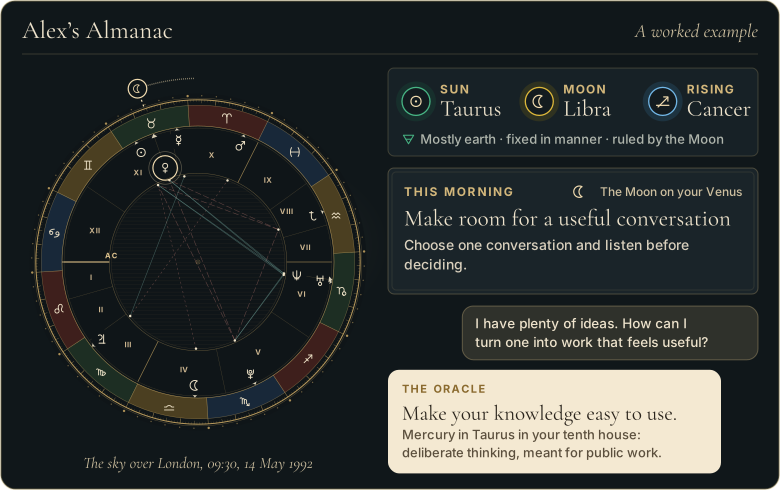
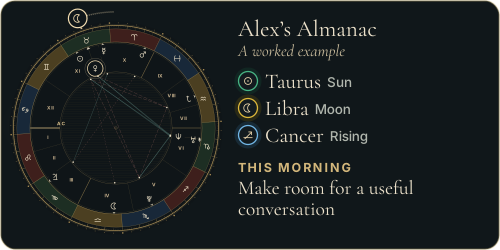
Walk through Alex’s whole example first
 The Road of AgesSee the turning points of your whole life, from your birth date
See your road's shape
The Road of AgesSee the turning points of your whole life, from your birth date
See your road's shape
Prefer to explore first?
 The Road of AgesThe turning points of your whole life, from your own chart
Walk my road
The Road of AgesThe turning points of your whole life, from your own chart
Walk my road
Free, by email
Your daily Almanac letter
One short letter at 7 each morning: the day’s theme read for your own chart, and one thing to do with it.
What sets Tarot apart
Tarot began as a card game in northern Italy in the mid fifteenth century, with a fifth suit of triumphs (trionfi) added to the usual four, and the game of tarocchi is still played in parts of Europe. The divinatory use is a later layer: in the 1780s Antoine Court de Gébelin claimed an Egyptian origin and Etteilla produced a deck for fortune-telling, and neither claim has historical support.
- Deck: 78 cards: 22 Major Arcana and 56 Minor Arcana in four suits
- Earliest decks: Italy, 1440s, among them the Visconti-Sforza cards, painted for ducal families
- Game name: tarocchi in Italian, tarot in French, from the 1500s
- Egyptian claim: Court de Gébelin, 1781; no source before the late 1700s connects the cards to Egypt
- Rider-Waite-Smith: 1909, A. E. Waite with Pamela Colman Smith; the model for most English-language decks
Often mistaken for something else: Playing cards share ancestry with tarot but the 22 trumps are its own; the cards were a game for three centuries before anyone used them to read a question.
The story behind Tarot
Tarot cards developed in Europe as playing cards before occult writers, especially from the eighteenth century onward, reinterpreted them as esoteric symbols.
The spiritual meaning of Tarot
Spiritually, tarot asks whether images are being used as mirrors for reflection or as masters over conscience.
Tarot in the Bible
Christian readers should not treat tarot as spiritual authority, guaranteed divination, or a replacement for prayer, Scripture, conscience, and wise counsel.
Why Tarot matters
Tarot matters because it carries two histories at once: a European card-game tradition and a later esoteric reading tradition. That difference helps readers avoid treating every image as ancient doctrine or automatic prophecy.
A lecture on this, free to read

Sources and editorial method
This entry summarizes the tradition in the Almanac's own words; where no source is listed, it is an editorial summary rather than a primary text, and symbolic readings are named as the tradition's, not as fact.
- Source
- The Great Almanac Dictionary
- Category
- Mystical Systems
- Last updated
- 2026-09-26
Read symbols without surrendering agency
A definition tells you what it is; your own birth chart tells you what it means for you. The Oracle casts your real chart and answers for your love, your work, and your year ahead, in conversation. It opens with the 7-day Seeker trial.
Speak with the OracleYour year, written once from your chart alone: the Cosmic Codex reads the whole of it, month by month. Open the Cosmic Codex
Related terms
More in Mystical Systems
From the reference page to your own chart
Every word here
is in your own chart.
- A personal reading about love, work or purpose, written from your chart
- A practical next step to consider
- It opens with 7 days free, with the AI Oracle and daily guidance
$0 today, then $12/month after 7 days. Cancel anytime.
Common questions
What is tarot?
Tarot is a deck of illustrated cards used historically for games and later for symbolic, occult, psychological, and reflective reading systems.
Where does tarot come from?
Tarot cards developed in Europe as playing cards before occult writers, especially from the eighteenth century onward, reinterpreted them as esoteric symbols.
What does tarot mean spiritually?
Spiritually, tarot asks whether images are being used as mirrors for reflection or as masters over conscience.
Free, by email
The Almanac, in your inbox at 7
One short letter at 7 each morning: the day’s theme read for your own chart, and one thing to do with it.