
Marsilio Ficino
1433 to 1499
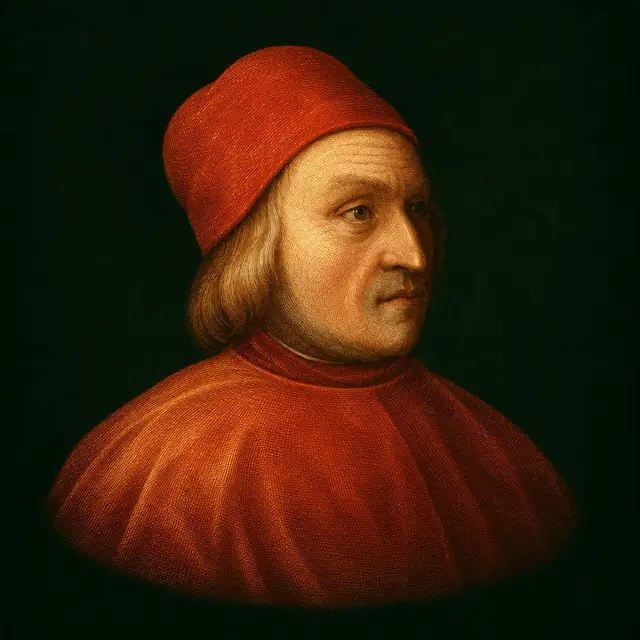
Who was Marsilio Ficino, and what is truly known of them?
What is known
Florentine priest, physician and scholar, head of the circle the Medici gathered at Careggi. He put all of Plato into Latin and, before it, the Corpus Hermeticum, which he believed as old as Moses. His Three Books on Life (1489) teach how to temper the planets within oneself by music, scent, food and image, and are the first book of what is now called psychological astrology. He gave the West the phrase “Platonic love” and the idea of one ancient theology running from Hermes to Plato.
The teaching
Taught from his own books, above all the Commentary on the Symposium, the Platonic Theology and the Three Books on Life.
The ancient theology, in brief
Ficino holds that one ancient theology runs from Hermes to Plato and agrees with the Christian faith; that the soul stands at the middle of all things, the knot that binds the world; and that a fine spirit joining soul and body can be fed by light, music and scent, through which the scholar, prone to the melancholy of Saturn, draws on the gentler life of the Sun, Jupiter and Venus. All of that is taught on Ficino and the Renaissance. Here is the rest: his teaching on love, on the soul that does not die, and on a person's own genius.
Love is the desire for beauty
Love, Ficino teaches in his commentary on the Symposium, is the desire to enjoy beauty. Beauty is a grace that comes most often from the harmony of many things, and it is perceived by three powers only: the mind, sight and hearing. Smell, taste and touch perceive pleasures, not beauty, so a desire that seeks them is not love but lust, or love gone mad.
Beauty itself is the splendour of the divine face, a ray that shines first in the angelic mind, then in the soul, then in the body of the world. Whoever loves a beautiful thing is drawn by that ray, whether he knows it or not.
The circle of love
God's goodness goes out from him, and the world turns back to him, in one circle. Insofar as it begins in God and draws, it is called beauty; insofar as it passes into the world and moves it, love; insofar as it returns to its source and joins the work to its maker, pleasure. Love begins in beauty and ends in joy, and by it all things are moved from the good to the good.
Two Venuses
There are two Venuses, as Plato's speakers say. The heavenly Venus, born without a mother, is the power of the angelic mind to know and love divine beauty; the common Venus, daughter of Jupiter and Dione, is the power in the soul of the world that brings forth beauty in bodies. So there are two loves, and both are honourable: one contemplates beauty and the other begets it. Love goes wrong only when the second forgets the first, and a body's beauty is loved as if it were the whole of beauty.
One death, two lives
Love is a kind of death. The lover forgets himself and thinks only of the beloved, and so dies in himself and lives in the other. When love is returned there is one death and a double resurrection: the lover lives in the beloved, and lives again in himself when he finds himself loved in the other. This is the love between friends that he called Platonic, in which two people love each other for the sake of the good, and God is the bond of every true friendship.
The four frenzies
The soul came down into the body whole and was scattered there among many cares. Four divine frenzies, which Plato named in the Phaedrus, bring it back. The frenzy of the Muses, poetry and music, wakes the sleeping soul and tunes its discord; the frenzy of Dionysus, the rites of worship, gathers its scattered parts into the mind; the frenzy of Apollo, prophecy, lifts the mind toward the One above it; and the frenzy of Venus, love, turns that One of the soul to God himself. Love is the most powerful and the noblest of the four.
The soul does not die
The Platonic Theology argues across eighteen books that the soul is immortal. The mind longs for the whole of truth and the whole of good, and nothing in this life can satisfy that longing; but nature makes no desire in vain, so the soul must reach its end beyond the body. The human being, restless with cares that no animal knows, would be the most miserable of creatures if death ended everything.
In contemplation the soul already draws back from the body for a while and tastes the life to come, and so philosophy, as Plato said, is a practice of dying.
Your own genius
Each person is born with a guardian genius, given by the heavens at birth, and the third of the Three Books on Life tells how to know it. Watch what you have loved to do since childhood, what comes to you easily and what you return to without being driven: that is the work your genius points to. Whoever follows it lives well and with less strain; whoever forces a life against it labours in vain and is unhappy. So he counsels each reader to find the life that his star and genius favour, and to follow it.
Images and their limits
The same book reports what Arabic and Hermetic authors taught of images engraved in stones or metals under chosen stars. Ficino weighs them and holds back: whatever power they have, he judges, comes from the matter and the heavens rather than the figure, and he trusts medicines, scents and music more. He does not approve of images, he says, but only reports them, and he will have nothing to do with demons. His own practice was the gentlest part of it: light, clean air, walking, the lyre, and a hymn sung at the right hour.
Rejoice in the present
On the walls of his Academy, one of his letters says, there were words that gather his teaching into a few lines: all things are directed from the good to the good; rejoice in the present; set no value on wealth and do not seek honours; flee excess, flee business; rejoice in the present.
Orders and memberships
A Catholic priest from 1473. His “Platonic Academy” was a circle of friends, not a secret society.
The legend
That the Hermetic writings he translated are Egyptian wisdom older than Moses. Casaubon dated them in 1614 to the early Christian centuries.
Their works
- Three Books on LifeBook, 1489
De vita libri tres, a book for scholars on keeping health, lengthening life and drawing down the favour of the heavens by music, scent, food, colour and image. Its third book, on images and the planets, is the founding text of Renaissance natural magic and of what is now called psychological astrology.
Ask the Oracle about it - PimanderTranslation, 1463; printed 1471
His Latin version of the Corpus Hermeticum, made at Cosimo de’ Medici’s wish before he finished Plato, because the Hermetic books were thought older. It went through many editions and set Hermes Trismegistus at the head of the Renaissance chain of ancient sages.
The books he translated are of the early Christian centuries, not of ancient Egypt.
Ask the Oracle about it - The Works of PlatoTranslation, printed 1484
His Latin version of all the dialogues of Plato, with introductions to each, the first complete Plato in the West. It was the standard Plato of Europe for two centuries.
Ask the Oracle about it - Platonic TheologyBook, 1469 to 1474; printed 1482
Eighteen books on the immortality of the soul, setting the soul at the centre of the order of being, between God and the body. It is his chief work of philosophy and joins Plato to Christian faith.
Ask the Oracle about it - Commentary on the SymposiumCommentary, 1469
De amore, a commentary on Plato’s dialogue on love, set at a banquet of friends at Careggi. From it come the idea of Platonic love and the doctrine of beauty as a ray of the divine that leads the soul upward.
Ask the Oracle about it - The Enneads of PlotinusTranslation, printed 1492
His Latin version of the Enneads of Plotinus, with a commentary on each treatise, printed at Florence. It was the first complete Plotinus in the West, and through it Plotinus was read for three centuries.
Ask the Oracle about it - LettersLetters, printed 1495
Twelve books of his letters to friends, patrons and pupils across Europe, on philosophy, friendship, astrology and the troubles of Florence. They show the circle at Careggi in its life.
Ask the Oracle about it
How the house tells a life
This life is told from the record, with what is documented, what is legend and what was forged kept apart. A membership in an order is stated only where documents show it. A person’s chart explains none of their deeds.
The arts it feeds
The Tree of LifeThe Hermetic principlesHerbs, oils and stonesSacred geometry
Lives near it in time
Thinkers and teachers
Ibn ArabiAlbertus MagnusRumiRoger BaconRamon LlullMeister EckhartJohannes ReuchlinPico della MirandolaNiccolò MachiavelliIgnatius of LoyolaTeresa of ÁvilaJohn of the CrossThe whole tree

