
Niccolò Machiavelli
1469 to 1527
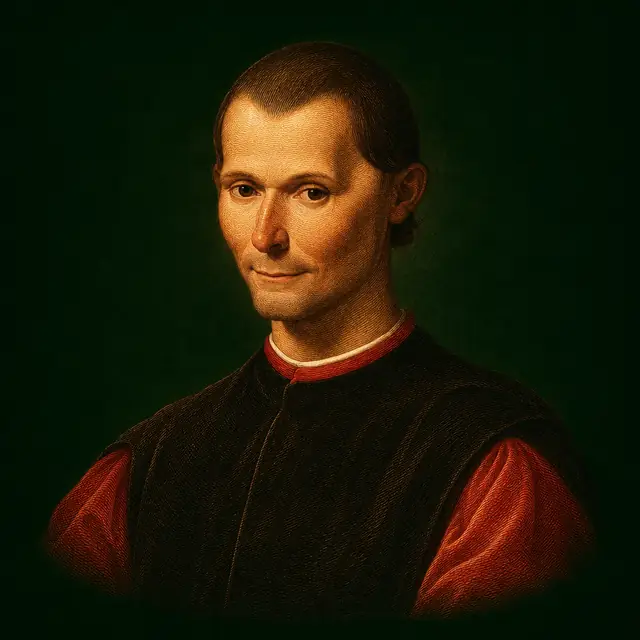
Who was Niccolò Machiavelli, and what is truly known of them?
What is known
Florentine official and diplomat who served the republic from 1498 until the Medici returned in 1512, when he was dismissed; early in 1513 he was jailed and tortured. In forced retirement he wrote The Prince (1513, printed 1532), which describes how rulers in fact win and keep power, and the longer Discourses on Livy, which argue for republics.
The teaching
Taught from his own books, above all the Discourses on Livy, with The Prince, The Art of War and The Mandrake.
The Prince, in brief
The Prince teaches what rulers do, not what they ought to do: that a new ruler must learn how not to be good and use it as need requires; that it is safer to be feared than loved if he cannot be both, though never hated; that he must be both fox and lion; and that fortune governs half of what happens, and virtù, skill and nerve made ready beforehand, the other half. That book is taught chapter by chapter on The Prince. The longer book he wrote beside it, the Discourses on Livy, teaches how a free people keeps itself free, and most of what follows comes from it.
Two humours, and the tumults that made Rome free
In every republic there are two humours, the people's and the great's: the great wish to command and oppress, and the people wish only not to be commanded and oppressed. Most writers blame the quarrels between the senate and the plebs of Rome, but Machiavelli holds that those tumults were the first cause of Roman liberty. Every law made in favour of freedom was born of their disunion. Good examples come from good education, good education from good laws, and good laws from the very tumults that so many condemn without thinking.
The mixed state
There are three good kinds of government, rule by one, by the few and by the many, and each slides easily into its own corrupt twin: princedom into tyranny, aristocracy into the rule of a narrow clique, popular government into licence. The cycle can turn for ever unless a lawgiver mixes the three, so that prince, nobles and people each keep watch on the others. Sparta was given such an order at once by Lycurgus; Rome came to hers by chance, through her quarrels, and was the stronger for it.
Where the guard of liberty belongs
The guard of a free state is best placed with the people, because they want only not to be dominated, and so have the greater will to live free. And a people is wiser and more constant than a prince. It is not without reason, he writes, that the voice of a people is likened to the voice of God: a people judges well between two speakers of equal skill, chooses its magistrates better than a prince does, and is less ungrateful.
A people without laws is as bad as a prince without laws. But an unruly people can be brought back by the words of a good man, while a bad prince can be cured only by steel.
Accusation and slander
A republic needs a lawful way for any citizen to accuse another of a public wrong before the magistrates or the people, because the anger of a city must have an outlet. Where it has none, it breaks out by private or foreign means and ruins the state. Slander is the opposite and does only harm: it needs no witness and no proof, and where open accusation is allowed, slander has no room. Florence, he says, suffered for want of such an outlet, and her factions grew from it.
Religion and the signs
Religion is the foundation of good order. Numa gave Rome her religion, and the fear of the gods made it easy to lead armies, keep oaths and bring in new laws; so the heads of a republic must keep the foundations of its religion, and the corruption of a religion is the surest sign of a state's ruin. He blames the Christianity of his day not for its teaching but for an idle reading of it that praises only the humble and contemplative and leaves the world to the wicked; rightly read, he says, it allows the love and defence of one's country.
One chapter turns to foretelling. Before great events in a city or a province there are always signs, he notes, prophecies, revelations and portents in the sky: the friar Savonarola foretold the coming of the French, and lightning struck the cathedral before the death of Lorenzo de' Medici. He leaves the cause to those who know things natural and supernatural, adding that perhaps, as one philosopher holds, the air is full of intelligences who see what is coming and warn people out of pity.
Back to the beginnings
Every body of people, a religion, a kingdom or a republic, decays as its first goodness wears away, and lives long only if it is drawn back from time to time toward its beginnings. That can come from outside, by a disaster that shakes it awake, as the sack of Rome by the Gauls did; or from within, by a good law or by a good man whose example renews it. Saint Francis and Saint Dominic renewed the Christian religion in that way, by poverty and by the example of the life of Christ, when it was close to dying out.
Fortune and the times
A man prospers while his way of acting fits the times and fails when it no longer does, and since few people can change their nature, the same character that raised a man brings him down when the times turn. Fabius won by slowness when Rome needed slowness. A republic is luckier than a prince, because it has citizens of many natures and can bring forward the one the times require.
People can second fortune but cannot oppose her; they can weave her threads but cannot break them. They must never give up, for they do not know her ends, and she goes by crooked and unknown ways.
Arms of one's own, and a comedy
The Art of War, a dialogue in a Florentine garden, teaches that a state must arm its own citizens rather than hire soldiers, and that the ancients are to be imitated in their hard and strong things, their discipline and their love of the common good, not in their soft ones. The Mandrake teaches by laughter: a foolish husband believes that a potion of mandrake will give him an heir, a friar is bought, and the trick succeeds because everyone in it is credulous or for sale. Credulity and greed are the deceiver's best tools.
Orders and memberships
He belonged to no secret order; he was a civil servant of the Florentine republic.
The legend
That he taught “the end justifies the means”: the sentence is not in The Prince. Whether the book is advice, warning or satire has been argued for five centuries.
Their works
- The PrinceTreatise, written 1513, printed 1532
A short book on how new rulers win and keep power, written in forced retirement after his dismissal and torture. It describes what princes in fact do rather than what they ought to do, and gives a famous chapter to Fortune, which a ruler can resist only in part. Its readers have argued for five centuries over whether it is advice, warning or satire.
Ask the Oracle about it - Discourses on LivyTreatise, about 1513 to 1519, printed 1531
A long commentary on the first books of the Roman historian Livy, arguing that a free republic with its quarrels kept in the open is the strongest kind of state. One chapter notes that great events in cities are often preceded by signs and prophecies, and leaves the cause to those who know the things of nature.
Ask the Oracle about it - The MandrakePlay, about 1518
A comedy of Florence in which a young man wins a married woman by a trick: her foolish husband is persuaded that a potion of the mandrake root will give him an heir. The play laughs at credulity, at greed and at a bribable friar, and is counted among the best Italian comedies of its century.
Ask the Oracle about it - The Art of WarTreatise, printed 1521
A dialogue set in a Florentine garden on how a state should arm itself, urging a citizen militia in place of hired soldiers. It was the only one of his political books printed in his lifetime and was read across Europe by soldiers and statesmen.
Ask the Oracle about it - Florentine HistoriesBook, presented 1525, printed 1532
A history of Florence from its beginnings to 1492, written at the request of the Medici pope Clement VII and handed to him in 1525. It reads the city’s factions and feuds as a long lesson in how liberty is won and lost.
Ask the Oracle about it
How the house tells a life
This life is told from the record, with what is documented, what is legend and what was forged kept apart. A membership in an order is stated only where documents show it. A person’s chart explains none of their deeds.
The arts it feeds
Lives near it in time
Thinkers and teachers
Roger BaconRamon LlullMeister EckhartMarsilio FicinoJohannes ReuchlinPico della MirandolaIgnatius of LoyolaTeresa of ÁvilaJohn of the CrossTycho BraheGiordano BrunoFrancis BaconThe whole tree

