
Giordano Bruno
1548 to 1600
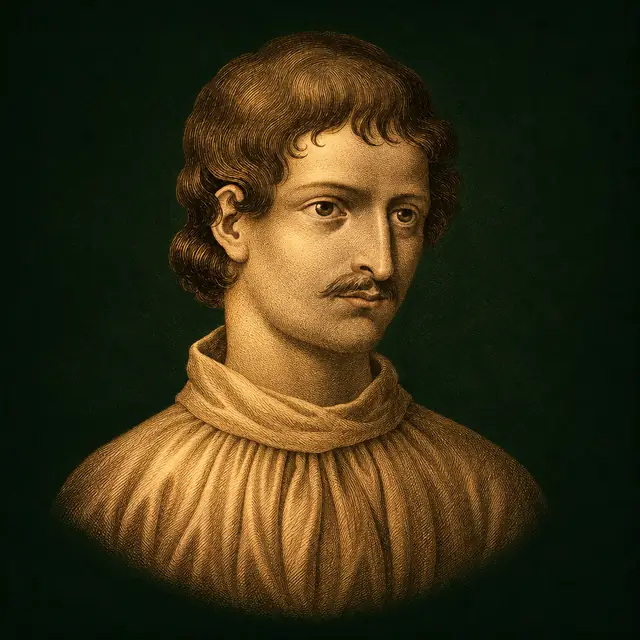
Who was Giordano Bruno, and what is truly known of them?
What is known
Italian philosopher, born at Nola near Naples. He became a Dominican at Naples in 1565 and fled in 1576, when a case for heresy was opened against him. For fifteen years he moved across Europe: Geneva, Toulouse, Paris, where he taught the art of memory, London, where he printed his Italian dialogues in 1584 and 1585, then Wittenberg, Prague, Helmstedt and Frankfurt. He taught that the universe has no bound and no centre and holds countless worlds like ours, and he drew on the Hermetic books. In 1592 his Venetian host, Giovanni Mocenigo, denounced him to the Inquisition. He was sent to Rome, held seven years, refused in the end to recant, and was burned on the Campo de’ Fiori on 17 February 1600.
The teaching
Taught from his Italian dialogues of 1584 and 1585, with On the Shadows of Ideas and On Magic.
The infinite universe
Bruno reasons from the cause to the effect. An infinite power that made only a finite world would be idle in the rest of its power, and a goodness that held itself back would not be perfect goodness; so the effect must be worthy of its cause, and the universe is infinite. It has no edge and no centre, or rather any place in it may be called the centre, and its edge is nowhere. It is one, endless and unmoving as a whole, and within it move countless worlds: the fixed stars are suns, each with its own earths about it, and our sun is one star among them.
We are already in heaven
So the Earth is not the low dregs of the world beneath a perfect heaven. There is one space, one boundless air, in which every star and every earth moves, and we stand in the heavens already, on a star among stars. No crystalline shells carry the stars round: each world is a great living creature that moves by its own soul, as the Earth turns on itself and goes round the sun by its own life.
In The Ash Wednesday Supper he defends Copernicus as more than a maker of tables, as one who saw the truth of things, and he answers the objection from Scripture: the Bible speaks to the people in the language they know, to teach them how to live, not to teach them natural philosophy. His Expulsion of the Triumphant Beast, where Jupiter clears the constellations of the gods' vices and sets virtues in their places, is taught on Ficino and the Renaissance.
The inner artist
The same life fills everything from within. The soul of the world, and the universal mind that is its first power, is the inner artist of all things: it forms matter from inside, as a seed shapes the plant it grows into, and not from outside, as a carpenter shapes wood. Matter is not a dead, empty receiver; it holds every form within it and brings them forth, and in the infinite, form and matter, power and act, are one.
Since all things are full of soul, nothing is wholly dead, and what we call death is only the passing of one form into another. In the infinite even opposites meet: the greatest and the least, the one and the many, coincide.
The shadows of ideas
The human mind does not see the ideas themselves, the pure forms in the divine mind, but their shadows, and a shadow is not darkness but the trace of light, the way by which the mind climbs toward it. On the Shadows of Ideas joins this teaching to the old art of memory, of places and images set in order. Bruno sets his images on turning wheels lettered after the manner of Ramon Llull, images drawn from the stars, from the things of nature and from the inventors of the arts, so that by turning the wheels the mind can combine them without end. The aim is to order the images within the mind after the order of the universe itself, until memory becomes a mirror of the whole.
The heroic frenzy
The love of the divine is the heroic frenzy, and in his sonnets with their commentary he tells it through the story of Actaeon. The hunter goes out into the woods of nature after the goddess and sees Diana bathing: the divine not in itself, which no one can look upon, but as it shines in nature. At that sight he is turned into a stag and torn apart by his own hounds, which are his thoughts.
The seeker becomes what he sought. The mind that hunts the infinite is changed into it, dies to its old self and lives the life of the divine. This frenzy is not the madness of the brute, which falls below reason, but a fire that lifts the mind above it.
Bonds
Magic, as On Magic teaches it, is the knowledge and use of bonds. Everything is tied to everything else, because one spirit runs through all things and joins them; the magus learns how one thing draws, holds or repels another, and works through voice, song, image, figure and sign upon that spirit, and above all upon the minds of others. Of all the bonds love is the greatest, and the others come back to it. The one who would bind others must take care not to be bound himself, for whoever loves without measure is held by what he loves.
Against pedants and cheats
His comedy The Candlemaker shows the other face of the same teaching. A pedant puffed up with Latin, a miser who hopes to make gold and a lover who wants a love charm are all fooled by rogues, one of them dressed as a magician, because each wants something the world will not give him honestly. The credulous make the cheat. Its title page carries his motto, sad in gladness, glad in sadness: the double face of one who laughs at the follies he sees and grieves over them.
Orders and memberships
A Dominican friar from 1565 until he fled the order in 1576. At Geneva he joined the Calvinist church for a few months and was shut out of it. Mocenigo told the Inquisition that he meant to found a sect of his own; no such body is known. The case that he spied in the French embassy in London is argued and not settled.
The legend
That he was burned for teaching that the Earth moves. The full record of the trial is lost; the summary found in 1940 puts first his denials of Catholic doctrine, with the countless worlds among other points. That he was the magus of a secret Hermetic brotherhood is a modern reading of his books.
Their works
- On the Infinite Universe and WorldsBook, printed 1584
One of the Italian dialogues he printed in London, arguing that the universe has no bound and no centre and holds countless suns with their own worlds. It is the boldest statement of the teaching that later cost him his life.
Ask the Oracle about it - The Ash Wednesday SupperBook, printed 1584
A dialogue built round a supper in London where he defended Copernicus against two Oxford doctors, mixing astronomy, satire of English manners and his own vision of a living, endless cosmos.
Ask the Oracle about it - The Expulsion of the Triumphant BeastBook, printed 1584
A moral allegory in which Jupiter, grown old, clears the constellations of their vices and sets virtues in their place. It praises the religion of the Egyptians as he found it in the Hermetic books, and was among the books questioned at his trial.
Ask the Oracle about it - On the Shadows of IdeasTreatise, printed 1582
His first printed book on the art of memory, dedicated to Henry III of France, joining the old method of places and images to wheels of letters after Ramon Llull and to images of the stars. It was this art that brought him to the king.
Ask the Oracle about it - The CandlemakerPlay, printed 1582
A coarse and lively comedy of Naples in which a pedant, a miser and a lover who seeks a love charm are all fooled by rogues, among them a false magician. It mocks the credulity he saw round magic.
Ask the Oracle about it - On the Heroic FrenziesBook, printed 1585
Sonnets with prose commentary on the lover of the divine, who like Actaeon sees the goddess and is turned into the quarry of his own thoughts. It is dedicated to Sir Philip Sidney.
Ask the Oracle about it - On MagicTreatise, written about 1590
A Latin treatise on magic as the working of bonds between all things through spirit, image and voice, left in manuscript and printed only in the nineteenth century. It shows how he joined magic to his philosophy of a living universe.
Ask the Oracle about it
How the house tells a life
This life is told from the record, with what is documented, what is legend and what was forged kept apart. A membership in an order is stated only where documents show it. A person’s chart explains none of their deeds.
The arts it feeds
The Hermetic principlesForbidden knowledgePhysics and the mystics
Lives near it in time
Thinkers and teachers
Pico della MirandolaNiccolò MachiavelliIgnatius of LoyolaTeresa of ÁvilaJohn of the CrossTycho BraheFrancis BaconTommaso CampanellaJohannes KeplerJakob BöhmeAthanasius KircherRobert BoyleThe whole tree

