
Robert Boyle
1627 to 1691
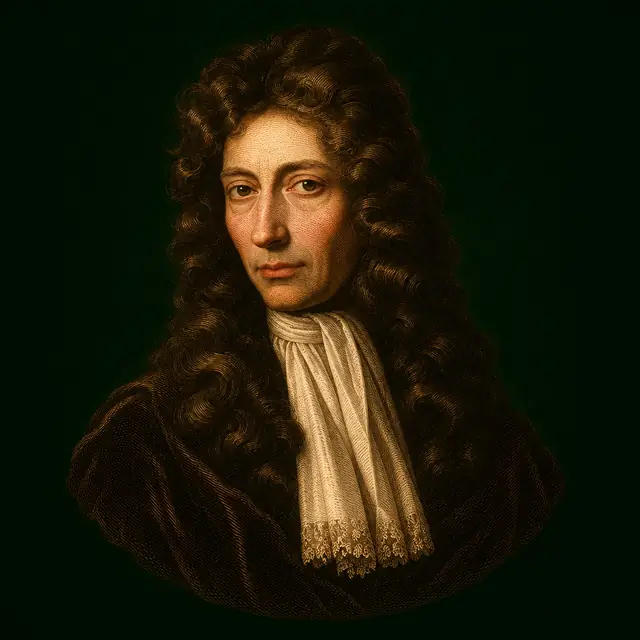
Who was Robert Boyle, and what is truly known of them?
What is known
Anglo-Irish natural philosopher, born at Lismore Castle, the fourteenth child of the Earl of Cork. After Eton and a tour of the Continent he settled to experiment, at Oxford from 1656 and in London from 1668. With Robert Hooke he built an air pump and showed what air does for flame, sound and breath; the rule that the pressure and volume of air vary inversely bears his name. The Sceptical Chymist (1661) attacked both the four elements of the schools and the three principles of Paracelsus. He was a founding fellow of the Royal Society. All his life he also sought the transmutation of metals: he printed a paper in 1676 on a mercury that grew hot with gold, and in 1689 helped to have the old law against multiplying gold repealed. A devout Christian, he paid for translations of the Bible.
The teaching
Taught from his own books, above all The Sceptical Chymist, the Spring of the Air and The Christian Virtuoso.
The sceptical chymist
Boyle's teaching begins with a doubt about the furnace. In The Sceptical Chymist four friends talk in a garden: Themistius speaks for the four elements of the schools, Philoponus for the three principles of the chymists, salt, sulphur and mercury, Eleutherius listens, and Carneades, who speaks for Boyle, questions them both. He does not deny that bodies have parts. He denies that the fire shows what they are.
His reasons come from the laboratory. Fire does not only part bodies; it joins them too, as it makes glass from sand and ashes, so what comes out of the flask may be new bodies and not first ones. The same body gives different things in an open fire and in a closed vessel. Gold and some other bodies give no elements at all, whatever heat is used. And the salt, sulphur and mercury drawn from different bodies are not alike, so they are not simple. A chymist who calls whatever his fire leaves an element has named his products, not found the ingredients of nature.
What an element would be
Carneades then says what an element would have to be: certain first and simple bodies, wholly unmixed, made neither of other bodies nor of one another, which are the ingredients of every mixed body and into which every mixed body is finally resolved. Having set the definition, he doubts that any such bodies are found in all mixed bodies at all.
He tells of a willow raised by van Helmont in a tub of weighed earth and given nothing but water, which grew to a great weight while the earth lost almost none, and of a squash he raised himself in the same way. Water alone, it seemed, had become wood, bark and leaf. If one substance can take so many forms, Boyle reasons, the elements are not fixed kinds.
Matter and motion
In place of elements and principles he sets the corpuscles. There is one universal matter, common to all bodies, divided into very small particles of many sizes and shapes and set in motion. How the particles are joined, their texture, makes each body what it is, and all its qualities, colour, taste, heat and the power to dissolve or to heal, follow from size, shape, motion and arrangement. Matter and motion are his two great principles. A key, he says, is only iron of a certain shape, yet it has the power to open a lock because of its fit with another body; so the powers of things are their textures in relation to other textures, not hidden forms.
He shows it with saltpetre. Fire parts saltpetre into a volatile spirit and a fixed salt quite unlike it; join the two again and saltpetre comes back. Nothing was lost but an arrangement, and nothing was needed to restore it but the parts brought together. The world as a whole is for him like the great clock at Strasbourg, where every movement follows from the frame and the parts once the maker has set them going.
The spring of the air
Air, Boyle teaches, has weight and a spring: it is like a heap of tiny springs, or a fleece of wool, pressed down by the air above it and pushing back. With the pump he and Hooke built he draws the air out of a glass and watches what follows. A candle goes out and a coal stops glowing. The sound of a bell inside grows faint. Warm water begins to boil. The mercury of a barometer set inside falls as the air is drawn off and rises when it is let back in. Living creatures cannot last in the emptied glass, which shows that breath needs something in the air.
Then he measures the spring. He traps air in the short, closed leg of a bent glass tube and pours mercury into the long, open leg: double the pressure on the air and it takes half the room, treble it and it takes a third. The volume of a body of air varies inversely as the pressure on it.
Experiments plainly told
His method is as much his teaching as his results. A matter of fact is made by experiment, repeated and seen by witnesses, and then told so plainly and fully, with the vessels, the weights, the weather and the failures, that a reader could repeat it. He writes a whole essay on the unsuccessfulness of experiments, to warn that the same trial may fail with other materials or in other hands, and he holds that a failure honestly reported is worth more than a system built in haste. Judgement waits until the facts are many.
The search for the stone
The same man seeks the philosophers' stone all his life, and his corpuscles are his reason for hope. If every metal is made of one universal matter, differing only in the size, shape and texture of its particles, then nothing in nature forbids one metal from being changed into another: the task is to find the agent that can rearrange the parts. He prints an account of a mercury, purified by his own long labour, that grows hot when mixed with gold, and offers it as a possible step towards the stone. In another account he tells of a red powder that made gold worse, turning it into a baser metal: if a powder can make gold baser, he reasons, a powder may make a base metal better.
Quicksilver and its fumes are poisons, and nothing in these accounts is to be tried. Boyle himself kept his processes back, as the adepts of his day did.
The Christian virtuoso
Boyle teaches that the study of nature leads to God. The more closely the experimenter looks at the frame of the world, the eye, the order of the heavens, the fitting of every part to its use, the more he sees the wisdom of its maker, so that a virtuoso, a man given to experiment, is better placed than most to be a Christian. He warns against speaking of Nature as a goddess who abhors a vacuum or does nothing in vain: Nature is no agent at all, but the order God made and keeps. And he distinguishes what is above reason from what is against it, for some things of faith pass our understanding without contradicting it, as much in nature passes it too.
He left money in his will for sermons, preached every year, to defend the Christian religion against unbelievers without entering into the quarrels of Christians among themselves, so that the case of his books would go on being made after him.
Orders and memberships
A founding fellow of the Royal Society, whose presidency he declined in 1680. The “Invisible College” of his letters of 1646 and 1647 was a group of friends who shared practical learning, not a secret order. In 1677 and 1678 a Frenchman, Georges Pierre, drew money and gifts from him with letters from a society of alchemists that did not exist.
The legend
That the Invisible College was a Rosicrucian lodge working behind the Royal Society. That he made gold: he wrote that he had seen metal changed by a stranger’s powder, and after his death Locke sent Newton a sample of his red earth, of which nothing came.
What was forged, or is false
The Priory of Sion papers, forged in France in the 1960s, which name him a Grand Master.
Their works
- The Sceptical ChymistBook, printed 1661
A dialogue attacking both the four elements of the schools and the three principles of Paracelsus, and arguing that matter is made of small particles. It is a founding book of chemistry, though its author remained a seeker after transmutation.
Ask the Oracle about it - New Experiments touching the Spring of the AirBook, printed 1660
The account of his experiments with the air pump built with Robert Hooke, showing what air does for flame, sound and breath. The second edition carried the rule that the pressure and volume of air vary inversely.
Ask the Oracle about it - Of the Incalescence of Quicksilver with GoldEssay, printed 1676
A paper in the Philosophical Transactions describing a mercury that grew hot when mixed with gold, which he thought might lead towards the stone. Newton, writing to the Royal Society’s secretary, advised that such things be kept quiet.
Ask the Oracle about it - The Christian VirtuosoBook, printed 1690
His argument that the study of nature, far from leading to unbelief, leads a careful man towards faith in its maker. It was written late in life by a devout Christian who also paid for translations of the Bible.
Ask the Oracle about it
How the house tells a life
This life is told from the record, with what is documented, what is legend and what was forged kept apart. A membership in an order is stated only where documents show it. A person’s chart explains none of their deeds.
The arts it feeds
Lives near it in time
Thinkers and teachers
Giordano BrunoFrancis BaconTommaso CampanellaJohannes KeplerJakob BöhmeAthanasius KircherEmanuel SwedenborgThe Baal Shem TovBenjamin FranklinGeorge WashingtonThomas PaineAugustin BarruelThe whole tree

