
Two alchemies
The laboratory art, and the picture of inner change read in it.
What is the difference between laboratory alchemy and the alchemy of the soul that Jung described?
Alchemy is two things: the old laboratory art of changing metals, and the picture of inner change that Jung and others read in it. The house reads it as the second, and gives no recipe.
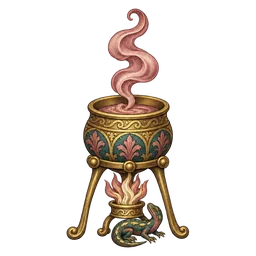
The stages of inner change
Ask the OracleWhich stage of the alchemical work am I in now?
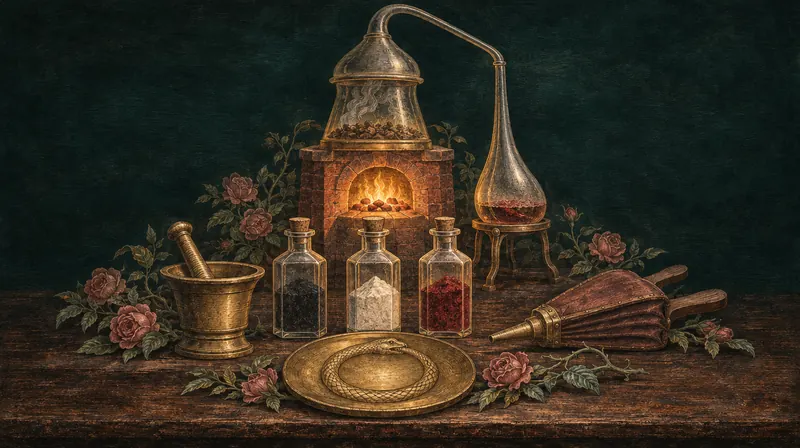
Alchemy was a working craft for some seventeen centuries: furnaces such as the slow-burning athanor, glass vessels and recipes for dyeing, refining and changing metals, written down in Greek in Roman Egypt, enlarged in Arabic, and carried into Latin Europe in the twelfth century. Its books speak in a code of kings, dragons, colours and planets, which is why one page can be read as a recipe, as medicine or as a figure of the soul.
Today it is read in two ways. Historians of science study it as early chemistry and call it chymistry, since alchemy and chemistry were one pursuit until about 1700. Readers of Carl Jung take its images as a map of inner change. The house keeps to the second reading and gives no recipe: the old ones used mercury, lead and antimony.
As the alchemical tradition from the Emerald Tablet to Jung teaches it.
Alchemy begins from a conviction about nature: that she works toward perfection, and that a skilled hand can help her finish what she leaves unfinished. In the earth, the books teach, the metals grow slowly and ripen as fruit ripens, lead toward gold, and in the vessel the worker does in weeks what nature does in ages. The whole labour is called the Great Work, the magnum opus, and the books speak of it as one work, done on metals, on medicines and, as some of them say, on the worker too.
Its charter is the Emerald Tablet, which the alchemists kept as the outline of their art: one thing from which all things are born, whose father is the Sun and whose mother is the Moon, separated gently, raised from earth to heaven and brought down again, and fixed until its power is whole. The tablet is read line by line on the Hermetic page; what follows is the ground the alchemical books build on it.
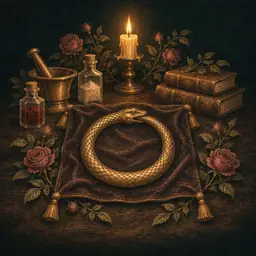
Everything is made of one first matter, the prima materia, which has no form of its own and can take every form. The Greek manuscripts draw the teaching as a serpent that bites its own tail, with the words the all is one. Out of the first matter come the four elements, and each is a pair of qualities: fire is hot and dry, air hot and moist, water cold and moist, earth cold and dry. Neighbours share a quality, so each element can pass into the next, water warmed into air and air cooled into water, and the four make a wheel, not a wall.
That wheel is the whole possibility of the art. If the elements turn into one another, no body is fixed for ever: bring it back toward its first matter and it can be given a nobler form. Turn the elements round, the books say, and what is sought is found. Some add a fifth, the quintessence, the purest essence of a thing drawn out by long refining, which they liken to the incorruptible stuff of the heavens.
Within the elements the books look for principles, the ways matter behaves. Every metal, the Arabic masters teach, is made of a sulphur and a mercury: the sulphur is the hot, fiery part that burns, the mercury the cold, flowing part that melts and flies. Joined in different measures and purities they make the different metals, and in perfect measure and purity they make gold. Paracelsus adds a third, salt, the fixed part that stays as ash, and matches the three to soul, spirit and body. They are not the yellow stone, the quicksilver and the kitchen salt but three behaviours found in everything, and they are taught on the page of salt, sulphur and mercury.
The same pair runs through the art's pictures. The sulphur is the Sun, the king, the masculine and the red; the mercury is the Moon, the queen, the feminine and the white. The work parts them, purifies each and joins them again, and the books' favourite picture of that joining is a marriage.
The method is two words, dissolve and coagulate, solve et coagula. The matter is broken down, by fire, by water or by slow rotting, until its old form is gone, and then it is gathered and fixed in a new one. Around those two moves the books set their operations, calcination, solution, separation, conjunction, putrefaction, distillation, sublimation and fixation, and one rule governs them all: make the fixed volatile and the volatile fixed. The page on the two alchemies sets the operations out one by one.
The work is done in a closed vessel over a gentle fire. The vessel is shut with the seal of Hermes, which is why anything closed so that nothing can pass is still called hermetically sealed; the furnace, the athanor, keeps an even heat for weeks; and the fire is raised by degrees. Every book warns that haste and a fierce fire spoil the work. None of it is to be tried: the old work used mercury, lead, antimony and acids, which are poisons, and here it is taught only as the books picture it.
The work is watched in colours, each the sign that one stage is done. First comes the blackening, nigredo, when the matter rots and dies: Saturn's time, pictured as a crow, a black sun or a king in his tomb. A play of many colours, the peacock's tail, promises the change. Then the whitening, albedo, a washing under dew and moonlight, which gives the white stone and silver. Some books count a yellowing, citrinitas, as a dawn, and every count of the colours ends in the reddening, rubedo: the Sun, gold, the red king risen and wedded to the white queen.
The order runs one way only, the white out of the black and the red out of the white, and the books expect it to be travelled more than once. Each stage is taught with its pictures on the page of the four stages.
The end of the work is the stone of the philosophers, a substance that perfects whatever it touches. Cast in a small amount onto a base metal, the books say, it turns it to gold, and taken as medicine it restores the body; that second power is the elixir. The white stone, made at the whitening, perfects to silver, and the red, made at the reddening, to gold. Its matter is common and despised, trodden underfoot and recognised by no one, and the books call it a stone that is no stone. What the stone is, and how the books picture its birth, is taught on the page of the philosopher's stone.
The work keeps time with the sky. Seven metals answer to the seven planets, lead to Saturn, tin to Jupiter, iron to Mars, gold to the Sun, copper to Venus, quicksilver to Mercury and silver to the Moon, and each pair shares one sign, so that the metals stand as a ladder from the heaviest to the brightest. The vessel is a small world, and the work is the making of the world done again in little: of its own teaching the tablet says, “So was the world created.” The ladder of metals and their signs is set out on the page of the seven metals and seven planets.
The books write in figures, and learning to read them is learning the art. They warn at once that their words are not to be taken plainly: our gold, says the Rosarium, is not common gold, and the mercury of the wise is not the quicksilver of the shops. One thing has a hundred names, the first matter being water, sea, chaos, dragon, serpent and lead in turn, and one picture can stand at once for a substance, an operation and a stage. The king who dies in the bath, the crow, the swan, the phoenix rising from its fire and the marriage of king and queen are each a step of the work, drawn so that it can be remembered and hidden at the same time.
A reader can meet any figure with four questions: what matter it names, what operation it shows, which colour of the work it belongs to, and, in the inner reading, what change it pictures in the worker. A single plate of an emblem book, looked at slowly, can be read for a month.
The books insist that the work needs a pure heart as much as a steady hand. The worker is to be patient, humble, sober and honest, for greed spoils the work as surely as a fierce fire, and the rule of the Mutus Liber, a book told almost wholly in pictures, is to pray, read, read, read, read again, and work.
The second alchemy takes that insistence further. Carl Jung read the stages as a change in the worker: the first matter as what a person would rather not look at, the vessel as a steady attention that holds it, the fire as feeling kept at a bearable heat, and the stone as the self made whole. The page on the two alchemies sets the two readings side by side, and the house reads the art in the second way.
Nothing in this art is mixed, heated or swallowed; the student's tools are paper, a pen and time. Begin with the alphabet of the art: the four elements and their qualities; the sulphur, the mercury and the salt; the seven planets with their metals and their signs, which John Dee read as built from three marks, the circle, the crescent and the cross; and the colours of the work in their order. Then take one emblem, ask it the four questions, and keep a dated page of what it shows; look at it again a month later and write what has changed in the reading.
The branches go deeper in an order of their own. The two alchemies come first, since they tell how the same books are read in two ways. The four stages give the course of the work, salt, sulphur and mercury its matter, the seven metals and seven planets its ladder, and the philosopher's stone its end. Who the alchemists were gives the line of teachers, from Zosimos and Mary the Jewess to Newton, each best met in their own words.
Alchemy is read here as a picture of inner change. Never follow an old recipe: they used mercury, lead, antimony and acids, and nothing here is meant to be mixed, heated or swallowed.
Each one is a question you can ask.
The laboratory art, and the picture of inner change read in it.
What is the difference between laboratory alchemy and the alchemy of the soul that Jung described?
Blackening, whitening, yellowing, reddening.
What are the four stages of alchemy: nigredo, albedo, citrinitas and rubedo?
Paracelsus’s three principles: body, soul and spirit.
What did Paracelsus mean by salt, sulphur and mercury in alchemy?
What the alchemists said they sought, and what it stood for.
What was the philosopher’s stone in alchemy, and what did it stand for?
Lead to gold, as Saturn to the Sun.
How did alchemy match the seven metals to the seven planets?
From Alexandria and Jabir to Newton’s private papers.
Who were the great alchemists, from Jabir to Isaac Newton?
Each opens its page in the dictionary.
 Ouroboros
Swiss physician and alchemist, born Theophrastus von Hohenheim. He turned alchemy towards medicine, brought minerals and chemicals into the pharmacy, and taught that the dose makes the poison. A treatise printed after his death (1566) describes the four kinds of elemental beings: gnomes, undines, sylphs and salamanders.
The mathematician and physicist of the Principia also wrote, in private, about a million words on alchemy and more on biblical prophecy and chronology. He copied out and translated the Emerald Tablet. The papers were sold in 1936; the economist John Maynard Keynes, who bought many, called him “the last of the magicians”.
Swiss psychiatrist, founder of analytical psychology. He studied alchemy, Gnosticism, astrology and the I Ching as pictures of the psyche: Psychology and Alchemy (1944), the idea of synchronicity, and The Red Book, written from 1914 to 1930 and published in 2009. He wrote that he sometimes cast a patient’s horoscope to understand them, and his own statistical test of astrology and marriage proved nothing either way.
A real man stands behind the legend: Johann Georg Faust, a wandering German astrologer, alchemist and fortune-teller of the early sixteenth century, named with scorn in a handful of letters and town records. Within fifty years the chapbook Historia von D. Johann Fausten (1587) had him sign away his soul for twenty-four years of knowledge and pleasure. Christopher Marlowe put it on the English stage about 1592, and Goethe made it his life’s work (Part One 1808, Part Two 1832), in which Faust is saved.
EmpedoclesZosimos of PanopolisMary the ProphetessJabir ibn HayyanAvicennaAlbertus MagnusRoger BaconArnald of VillanovaNicolas FlamelTycho BraheRudolf IIHeinrich KhunrathMichael MaierRobert BoyleJohann Wolfgang von GoetheFulcanelliKing MidasThe PhoenixMichael ScotEdward KelleyJakob BöhmeJohann Valentin AndreaeElias AshmoleChristian RosenkreuzJekyll and HydeRamon LlullRobert FluddH. Spencer LewisMircea EliadeThe Monkey KingArthur Edward Waite
The spirit realmTarot, runes, I ChingThe Hermetic principlesDreamsPhysics and the mysticsHerbs, oils and stonesForbidden knowledgeThe sixth sense
The Great WorkDictionary: AlchemySearch the treeThe whole tree
Make today specific
The same sky reaches everyone differently. Your birth details turn a general forecast into one theme, and one thing worth doing about it.
One instrument, one answer. Explore the preview; membership opens every tool.
Read more

