
Rudolf II
1552 to 1612
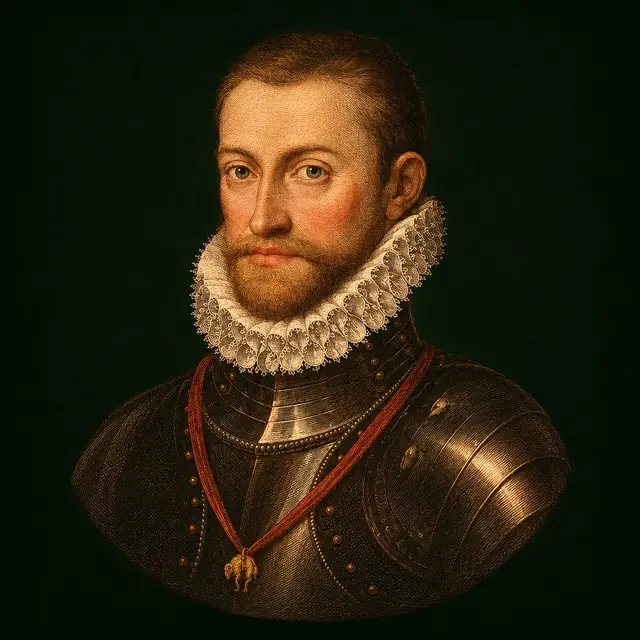
Who was Rudolf II, and what is truly known of them?
What is known
Habsburg ruler, Holy Roman Emperor from 1576 and king of Bohemia and Hungary. Schooled in Spain, he moved his court to Prague in 1583 and made it a meeting place of painters, instrument makers, astronomers and alchemists. Tycho Brahe and then Kepler were his mathematicians; the tables Kepler finished in 1627 bear his name. John Dee had one audience with him in 1584, Edward Kelley worked for him as an alchemist and ended in his prisons, and Michael Maier was his physician. His cabinet of art and curiosities was among the largest in Europe. He never married, suffered long spells of melancholy, granted the Bohemian Protestants freedom of worship in 1609, and was forced to yield Hungary in 1608 and Bohemia in 1611 to his brother Matthias, keeping only the empire. He died in Prague castle.
The teaching
Taught from the record of his court at Prague: its cabinet of wonders, its painters, its alchemists and its astronomers.
The world gathered in a room
Rudolf's court teaches by gathering. Its cabinet of art and wonders is a picture of creation in small, and its inventory sorts the whole into three kinds. The naturalia are the works of nature: shells and corals, horns and minerals, bezoars and mandrake roots. The artificialia are the works of human hands: paintings, carved gems, bronzes, turned ivory, clocks and figures that move by clockwork. The scientifica are the instruments by which the heavens and the earth are measured. Walked through in order, the cupboards show the maker's work, the human work that imitates it, and the tools by which both are understood.
The pieces the court loved best stand on the border between the kinds: a nautilus shell mounted by a goldsmith as a cup, a branch of coral finished in silver, a slab of stone whose veins already look like hills and clouds, which the court's stone cutters completed as a landscape. In each, nature begins a work and art completes it. The lesson of the cabinet is that the two are one labour, and that art is nature carried further by human hands.
Virtues hidden in stones and roots
The court kept many natural things for their hidden virtues as well as for their strangeness. The bezoar, a stone that forms in the stomach of the wild goat of Persia and of other beasts, was held to draw out poison, and the court's goldsmith set bezoars in gold so that they could be kept at hand. The mandrake, a root that can grow in the shape of a little man, was held to carry powers of its own and was treasured in the cabinet; it is a poisonous plant, and it was kept, not taken. Gems were cut in the court's own workshops and prized for their colour and their fire, and for the virtues that the old books of stones gave to each.
The work of fire
Alchemy at Prague is a craft of the court, pursued in the open. The emperor kept laboratories, paid adepts who came to him from across Europe and gathered their books and manuscripts, and he asked of the art the two things it had always promised together: gold, the perfect metal, and the medicine, the elixir that perfects a sick body as the stone perfects a base metal. The court's rule was trial. A process was to be shown at the furnace before witnesses, and an adept who promised the stone was held to his word.
The heavens measured
The court's astronomy rests on measurement. The most exact record of the planets yet made, gathered by Tycho Brahe over a lifetime of nights, passed at Prague to the man who could read it. From Tycho's measures of Mars, Johannes Kepler found that a planet moves not in a circle but in an ellipse with the Sun at one focus, sweeping out equal areas in equal times, and he dedicated the book that says so, the New Astronomy of 1609, to the emperor.
The same men served the court's astrology, for the emperor wished to know what the heavens were bringing. Kepler, who cast its horoscopes, held that the angles the planets make with one another stir the soul as a harmony stirs a listener: they move a person's nature, and they do not decide a person's deeds.
Vertumnus: every season in one face
The court's painters teach the cabinet's lesson in play. Giuseppe Arcimboldo builds a face out of the things of the world: in his Vertumnus the emperor's features are pears and apples, cherries and grapes, ears of wheat, flowers, gourds and roots, each painted true to nature, and seen together they are a man. The riddle says that a person is made of the world and answers to it part for part.
Vertumnus is the Roman god of the turning year, who can take every shape, and in the picture the fruits of every season grow at once, which no garden can do. The poet Gregorio Comanini, who wrote verses for it, read it as praise of its sitter: under this ruler the seasons bear together, as they did in the golden age.
Orders and memberships
A Catholic sovereign and, from 1585, a knight of the Golden Fleece, the Habsburg order of chivalry. No secret order is documented; the alchemists he paid formed no society.
The legend
That he paid six hundred ducats for the Voynich manuscript, believing it to be Roger Bacon’s: the only source is a letter of 1665 that repeats what its writer had been told. That the Maharal of Prague showed him the golem: the rabbi was received at the castle in 1592, and what was said there is not recorded. That gold was made before him.
Their works
- The Kunstkammer at PragueCollection, from the 1580s
His cabinet of art and curiosities in Prague castle, among the largest in Europe: paintings, clocks and instruments, gems, mandrakes and bezoar stones, coins and natural wonders, listed in an inventory of 1607 to 1611. It was looted by Swedish troops in 1648, and its pieces are now scattered across Europe.
Ask the Oracle about it - VertumnusPainting, about 1590
Giuseppe Arcimboldo’s portrait of the emperor as the Roman god of the seasons, his face composed of fruits, flowers and vegetables. It is the best known image of Rudolf, and of the playful taste of his court for riddles and wonders.
Ask the Oracle about it - The Imperial Crown of Rudolf IICrown, 1602
The private crown made for him in Prague by the goldsmith Jan Vermeyen, set with pearls, rubies and a great sapphire, with scenes of his reign in gold on its mitre. It became the crown of the Austrian Empire and is kept in Vienna.
Ask the Oracle about it - The Letter of MajestyCharter, 1609
The charter he granted under pressure to the estates of Bohemia, giving Protestants freedom of worship. Its breach a decade later led to the defenestration of Prague of 1618 and the Thirty Years War.
Ask the Oracle about it - The Rudolphine TablesBook, printed 1627
The tables of planetary motion built by Kepler from Tycho Brahe’s measurements and named for the emperor who had paid for them. They were the most exact of their age, and served astronomers and astrologers alike for a century.
Kepler’s work, finished fifteen years after Rudolf’s death.
Ask the Oracle about it
How the house tells a life
This life is told from the record, with what is documented, what is legend and what was forged kept apart. A membership in an order is stated only where documents show it. A person’s chart explains none of their deeds.
The arts it feeds
Lives near it in time
Lives and legends
Johannes TrithemiusCornelius AgrippaParacelsusNostradamusJohn DeeIsaac LuriaEdward KelleyHeinrich KhunrathMichael MaierRobert FluddJohann Valentin AndreaeWilliam LillyThe whole tree

