
Edward Kelley
1555 to 1597 or 1598
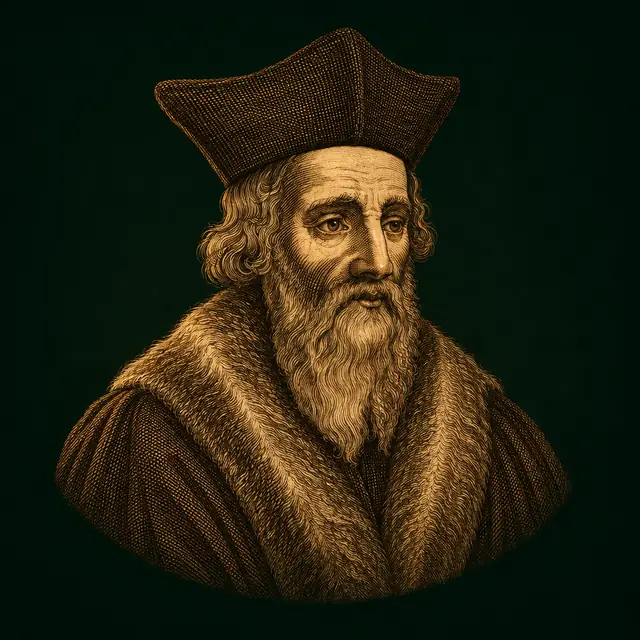
Who was Edward Kelly, the scryer and alchemist of Prague, and what is truly known of him?
What is known
English alchemist and scryer, born at Worcester in 1555 by the horoscope John Dee drew for him. He came to Dee’s house at Mortlake in March 1582 under the name Edward Talbot, and for five years was the seer of Dee’s conversations with angels: Kelley looked into the stone and reported, and Dee wrote it down. They left for Poland and Bohemia in 1583. In 1587 Kelley reported that the angels ordered the two men to hold their wives in common; Dee agreed in distress, and the partnership ended soon after. Kelley stayed in Bohemia as an alchemist under Vilém of Rožmberk, and Rudolf II knighted him in 1589 or early 1590. He was arrested in 1591, freed, jailed again, and died in late 1597 or in 1598, by the usual account of injuries from an attempt to escape.
The teaching
Taught from the actions with the angels that John Dee wrote down from his words, and the alchemical writings under his name.
The seer and the scribe
An action, as Dee calls a session, needs two men. The seer sits at the table and looks into the stone, and says what he sees and hears; the scribe sits apart at his desk, prays, puts the questions and writes down every word. Kelley is the seer and Dee the scribe. Nothing is received in silence and nothing is left to memory: each vision, each letter and each word is spoken aloud and written at once, with the day and the hour, so that the record can be read again and tested.
The stone and the holy table
The stone is a crystal, which Dee records was brought to his window by an angel and given into his keeping. It stands on the holy table, a table of sweet wood made to a pattern the angels gave, with letters and figures painted on its top. Under the stone lies a great seal of wax, the Seal of God's Truth, Sigillum Dei Aemeth, ringed with the names of God and of angels, and smaller seals of the same wax stand under the table's feet. Every part is made as the angels prescribe, in measure, matter and colour, and the angels hold that what is made otherwise will not serve.
How the angels come
When an action begins, the seer often sees a curtain hanging in the stone, which is drawn aside; then the angels appear, robed and with names. Uriel, Michael and Raphael are among the first; later come many more, among them Madimi, who first appears as a little girl and grows older over the years of the actions. Some speak, some show visions in the stone, and some point with a rod to letters on a table of squares, one letter at a time, while the seer calls out each letter and its place and the scribe writes it. The angels ask for prayer, patience and above all obedience: what they give is to be received exactly, with nothing altered and nothing left out.
The book of the speech from God
In 1583 the angels gave through Kelley a book of great tables, each a square of forty-nine by forty-nine letters, which they named Loagaeth, the speech from God. They said it held the words by which the world was made, and by which its mysteries would be opened in the last days. Its tongue, the angels taught, is the first language, the one Adam spoke in paradise before the fall, in which every name is the true name of its thing; it has letters of its own, written from right to left.
The calls
In Cracow in 1584 the angel Nalvage gave the calls, or keys: invocations in the same tongue by which the angels of the tables are addressed. They came backwards, letter by letter, pointed out on a table of letters, because the words, the angels said, are so mighty that to speak them straight would be to call up the powers they name. Only when a call was complete was it turned round and given its English sense.
The angels count forty-eight calls. Eighteen stand alone, and the last serves for the thirty aethyrs, the heavens that surround the earth, and is said thirty times with the name of each aethyr in turn. A forty-ninth, the first of all, belongs to the Godhead and is not to be spoken. Through the thirty aethyrs are set ninety-one governors, each ruling a part of the earth, whose names are given with the lands they govern.
The watchtowers
In the same summer the angels gave the great table of the earth: four tables of letters, joined by a cross of letters between them, which they call the watchtowers and set at the four quarters of the world. Its rows and columns, read in set ways, give the names of God that rule each quarter, its king, its elders and the hosts of angels below them, each host with an office: healing the sick, finding metals and precious stones, changing the forms of things, carrying from place to place, and the mechanical crafts. The system teaches that every power in creation has its angel, every angel its name, and that the name, rightly spoken by one called to speak it, reaches the angel.
Trying the spirits
The actions teach a hard discipline of doubt, and Kelley is its sharpest voice. Again and again he warns Dee that the spirits may be deceivers, devils dressed as angels, and swears he will look into the stone no more; Dee answers that they speak of God, call for prayer and repentance and agree with scripture, and the actions go on. The angels teach that the world is near its last age and that what they give is for the restoring of true religion, and they ask for obedience above reason, holding that what God commands is lawful even where the law of men forbids it. It was that rule, pressed to its end, that parted the two men.
The astronomy of the earth
The alchemical writings under his name read the art as an astronomy of the earth: the metals are the stars of the lower world, and the work is to bring them to the perfection that the heavens show. They set the sayings of the old masters side by side, Hermes, Geber, Arnald, Lull and others, to show that under many names the masters teach one thing: one matter, which is not the common gold or quicksilver of the shops; one vessel; and one fire, gentle and long. His English verses say the same to those who labour night and day in what he calls Geber's kitchen, among many books and furnaces: the more they work, the more they lose and spoil, because they do not know the one thing the masters mean.
Orders and memberships
No order is documented. Rudolf II made him a knight of Bohemia in 1589 or 1590. Nearly all that is known of his years as a seer comes from Dee’s own diaries.
The legend
That his ears had been cropped for forgery or coining at Lancaster, and that he dug up a corpse in a Lancashire churchyard to question it: both were printed after his death. That he found a red powder and a book of St Dunstan in the ruins of Glastonbury, and with them turned metal to gold before witnesses in Prague.
Their works
- The seances recorded by John DeeDiary, 1582 to 1587
Nearly all that is known of Kelley as a seer is in Dee’s own books: session after session in which Kelley looked into the stone and reported the angels’ words, the great tables of letters and the language later called Enochian, and Dee wrote them down. Part was printed in 1659 by Meric Casaubon.
Written by Dee, from what Kelley reported.
Ask the Oracle about it - Two treatises on the philosophers’ stoneTreatise, printed 1676
Alchemical writings in Latin ascribed to him, among them the Theatre of Terrestrial Astronomy, printed at Hamburg long after his death. They set out the work of the stone in the usual veiled language of the art.
Ascribed to him; how much of the text is his own is not certain.
Ask the Oracle about it - Verses in Theatrum Chemicum BritannicumPoem, printed 1652
Elias Ashmole’s gathering of English alchemical poetry prints verses on the stone under Kelley’s name, beside those of Ripley and Norton. They kept his name alive among English alchemists.
The ascription rests on the manuscripts Ashmole used.
Ask the Oracle about it
How the house tells a life
This life is told from the record, with what is documented, what is legend and what was forged kept apart. A membership in an order is stated only where documents show it. A person’s chart explains none of their deeds.
The arts it feeds
Lives near it in time
Lives and legends
Cornelius AgrippaParacelsusNostradamusJohn DeeIsaac LuriaRudolf IIHeinrich KhunrathMichael MaierRobert FluddJohann Valentin AndreaeWilliam LillyElias AshmoleThe whole tree

