
Elias Ashmole
1617 to 1692
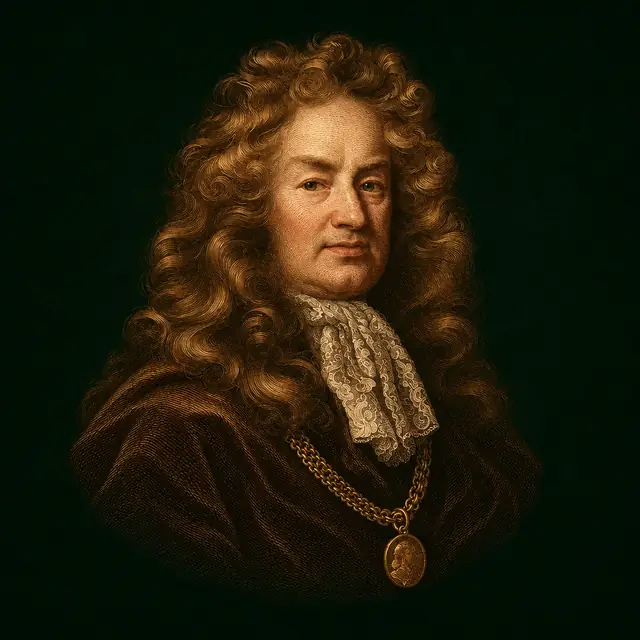
Who was Elias Ashmole, and what is truly known of them?
What is known
English antiquary, herald and collector, born a saddler’s son at Lichfield. He qualified as a solicitor and served the king in the Civil War as an officer of excise and ordnance. In the 1640s he took up astrology and alchemy; William Lilly became his friend, and in 1651 the alchemist William Backhouse adopted him as a son in the art. His Theatrum Chemicum Britannicum (1652) gathered the alchemical poems of England. At the Restoration he was made Windsor Herald, and he was one of the first fellows of the Royal Society. His history of the Order of the Garter came out in 1672. The gardener John Tradescant made over his cabinet of rarities to him by deed in 1659; Ashmole won it in court from the widow, added his own, and gave all to Oxford, where the Ashmolean Museum opened in 1683.
The teaching
Taught from his Prolegomena to the Theatrum Chemicum Britannicum (1652), his diary, and his book on the Garter (1672).
The four stones
Ashmole teaches that the stone of the philosophers is not one thing but four, and that the change of metals is the least of what the true philosophers sought. The mineral stone turns base metals into gold, and that is all it does. The vegetable stone knows the nature of every growing thing, man and beast, fowl and fish, tree and plant, and makes them grow and flourish, even out of their season. The magical or prospective stone shows the one who has it any person in any part of the world, though hidden in a closed room.
Highest is the angelical stone, so subtle that it can be neither seen, felt nor weighed, but only tasted. It gives the sight of angels and the power to speak with them in dreams and revelations, and no evil spirit dares come near the place where it is kept.
The English masters
His gathering of the English poems of the art teaches that England has a line of adepts of its own, from Thomas Norton and George Ripley down to the men of his own century, and that their verses must be read as they were written, slowly and with patience. The poets wrote in veiled words on purpose, so that the greedy and the idle should find nothing in them. The art itself, as the poems hold, passes from a master to a chosen pupil by word of mouth, and the books are a map that only one who has walked the road can follow.
Questions put to the heavens
Ashmole practised astrology as his friend Lilly taught it, and his diary shows the art in daily use. He notes the hour and often the minute of what he did, because he chose his times by the chart and judged questions by the chart of the moment: when to begin a journey or a suit, how a sickness would go, whether a matter would prosper. The same diary keeps the old physic of amulets that went with the art: in April 1681 he writes that he took a dose of his elixir and hung three spiders about his neck, and that they drove his ague away. It is his note of the old physic, given here as his and not as a remedy.
The Order of the Garter
As a herald he teaches the ceremonies of chivalry as signs, each carrying a duty. The Order of the Garter is a fellowship of the Sovereign and twenty-five companions under the patronage of St George. Each knight wears the garter, blue with the motto Honi soit qui mal y pense, shamed be he who thinks evil of it, buckled below the left knee as the bond that ties the companions to one another and to their sovereign, and with it the George, the image of the patron saint slaying the dragon.
The knight is installed in the chapel of St George at Windsor, where his banner, helm and crest hang over his stall, and the order keeps its feast on St George's day. A knight who betrays his oath is degraded: his achievements are taken down and cast out of the chapel, and his name is struck from the roll.
Knowledge by things
The museum he gave to Oxford rests on a teaching set down in its statutes. The knowledge of nature is needed for life, for health and for the comforts of life, and it cannot be had without the history of nature, which calls for the sight of particular things, above all those that are strange in their make or useful in medicine, in manufacture and in trade. So the things themselves are to be gathered, kept and shown, and the student is to learn from them as well as from books.
Orders and memberships
A Freemason: his diary records that he was made one at Warrington in Lancashire on 16 October 1646, among the earliest such records in England of a man who was no working mason, and that he attended a lodge at Masons’ Hall in London in March 1682. He was also a fellow of the Royal Society and an officer of the College of Arms.
The legend
That he was a Rosicrucian adept who gave Freemasonry its rituals. He copied the manifestos out in his own hand, and his diary notes two lodge meetings thirty-five years apart; nothing more is shown. That Backhouse left him the secret of the stone: the diary says only that he was told it.
Their works
- Theatrum Chemicum BritannicumCollection, printed 1652
His collection of the alchemical poems of England, from Thomas Norton and George Ripley to Edward Kelley, with his own learned notes and engravings. It saved many of these verses from loss.
Ask the Oracle about it - The Order of the GarterBook, printed 1672
The Institution, Laws and Ceremonies of the Most Noble Order of the Garter, his great work as a herald, tracing the history and ritual of England’s order of chivalry.
Ask the Oracle about it - Fasciculus chemicusTranslation, printed 1650
His English translation of the alchemical anthology of Arthur Dee, son of John Dee, published under the anagram James Hasolle. It was his first appearance in print as a student of the art.
Ask the Oracle about it - The Way to BlissBook, printed 1658
An old English treatise in prose on the philosophers’ stone, which he edited from a manuscript and printed with a preface of his own. It was his last publication on alchemy before he turned to heraldry and the history of the Garter.
The author of the treatise is unknown.
Ask the Oracle about it - His diaryDiary, printed 1717
Notes of his life printed after his death, which record that he was made a Freemason at Warrington on 16 October 1646 and attended a lodge in London in 1682, among the earliest such records in England.
Ask the Oracle about it - The Ashmolean MuseumCollection, opened 1683
The cabinet of rarities of the Tradescants, with his own additions, given to Oxford and housed in a building of its own. It was the first public museum in Britain.
Ask the Oracle about it
How the house tells a life
This life is told from the record, with what is documented, what is legend and what was forged kept apart. A membership in an order is stated only where documents show it. A person’s chart explains none of their deeds.
The arts it feeds
Lives near it in time
Lives and legends
Edward KelleyHeinrich KhunrathMichael MaierRobert FluddJohann Valentin AndreaeWilliam LillyIsaac NewtonThe Count of Saint-GermainCourt de GébelinGiacomo CasanovaMartinez de PasquallyFranz Anton MesmerThe whole tree

