
Giacomo Casanova
1725 to 1798
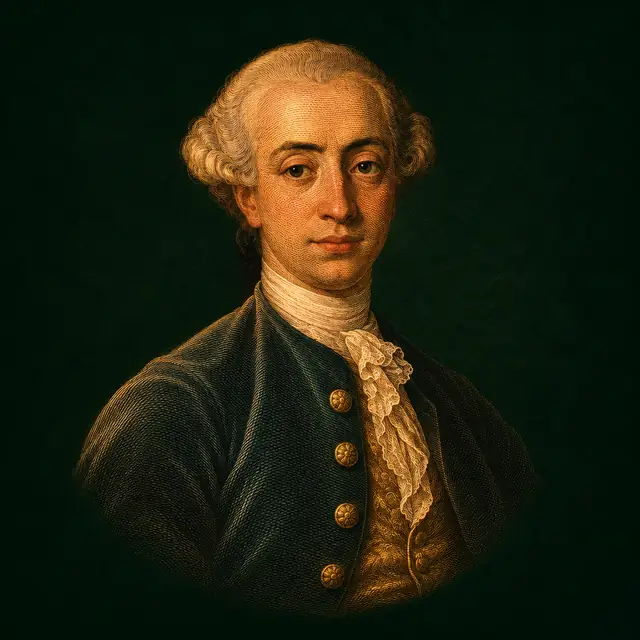
Who was Giacomo Casanova, and what is truly known of them?
What is known
Venetian adventurer and writer. In 1755 the State Inquisitors of Venice had him arrested; books of magic were found in his rooms, and he was held under the lead roof of the Doge’s Palace until he broke out in 1756. In Paris he helped to set up the state lottery in 1757. For years he passed as an adept: he worked a number oracle he called his cabbala for the senator Bragadin, and from 1757 he took large sums from the Marquise d’Urfé on the promise to have her reborn as a man by magic. His memoirs say plainly that this was a fraud. From 1785 he was librarian at the castle of Dux in Bohemia, where he wrote the Histoire de ma vie and died in 1798.
The teaching
Taught from his own Story of My Life, with his pamphlet of 1786 against the magicians of his age.
The cabbala of numbers
The oracle that made Casanova an adept is a game of numbers, and he tells how it was played. The question is written out plainly; its letters are turned into numbers; the numbers are set out in a pyramid of rows; and from the pyramid, by rules that look exact, new numbers are drawn and turned back into letters, which spell the answer, sometimes as a line of verse. The rules are for show. While he works the numbers he composes the answer in his head, and the pyramid only dresses it.
The answers were good counsel spoken in an oracle's voice, and those who asked believed that a spirit spoke through the numbers; he called it Paralis, his genius. A sound answer that is believed to come from beyond is obeyed where the same advice from a man would be ignored, and that is the whole of the oracle's power.
Why the believers believe
Casanova's memoirs are frank about the trade. The senator Bragadin and his friends wanted a wonder, and he gave them one; the Marquise d'Urfé had read every book on the spirits of the elements, longed to speak with them and to be reborn a man, and he drew his promises from her own library. In each case, as he tells it, the believer did the work: the wish to believe made the oracle, and the cheat had only to agree. He excuses himself that his counsel did them no harm and often did them good, and he never pretends that a spirit was there.
The circle in the storm
At Cesena, as a young man, he staged a raising of buried treasure for a credulous farmer: a great circle drawn on the ground, a robe and a wand, invocations in a voice of command. While he stood in the circle a violent storm broke, with thunder and lightning all about him, and he who had invented every word of the rite was seized by terror and dared not leave the circle, which he found himself trusting to keep him safe. When it passed he gave up the scheme. He tells the story against himself: a rite made to deceive others can take hold of its maker when fear comes.
The secret of the lodge
Of Freemasonry he gives a teaching he held to be true. Every young man who means to travel and to know the world, he says, should be received a Mason, for the lodges open doors everywhere. The secret of the craft is safe by its very nature: the Mason who knows it has not been told it by anyone but has guessed it for himself, so it cannot be betrayed. Those who join only to find the secret out may grow old under the trowel without ever finding it.
Against the magicians
Late in life he wrote against Cagliostro and the others who claimed to make gold, to live for centuries and to command spirits. Such men, he argues, live on the credulity of those who want wonders more than truth, and they are believed because they promise what every heart desires; the thinker's defence is to ask what is promised, and who profits by it. The warning carries the weight of a man who had worked the same trade.
Orders and memberships
A Freemason: by his memoirs he was received in a lodge at Lyon in 1750 and was made Fellow and Master in Paris a few months after, and historians accept it. He called himself a Rosicrucian when it suited a scheme; no body of that name is known to have received him.
The legend
That he had real occult powers, which his own memoirs deny, and that the memoirs are invention. Archives in Venice, Paris and elsewhere have borne out many of the people, dates and arrests he names; other scenes rest on his word alone and are told to his advantage.
Their works
- Histoire de ma vieAccount, written 1789 to 1798
The Story of My Life, written in French at the castle of Dux, telling his adventures up to 1774: his loves, his gambling, his escape from the Leads and his years as a false adept fleecing the Marquise d’Urfé, which he admits plainly as fraud. The full text was printed only from 1960.
Ask the Oracle about it - The Story of My Flight from the Prisons of VeniceAccount, printed 1788
His account of his imprisonment under the lead roof of the Doge’s Palace, where books of magic had been part of the charge, and of his escape over the roofs in 1756. It made him famous in his lifetime.
Ask the Oracle about it - IcosameronNovel, printed 1788
A long fantastic novel of a brother and sister who live for eighty years among a gentle people inside the Earth. It is one of the early works of the hollow world in fiction.
Ask the Oracle about it - Soliloque d’un penseurEssay, printed 1786
A pamphlet against Cagliostro and other magicians of the age, written by a man who knew the trade from within, warning readers against those who claim to make gold or live for centuries.
Ask the Oracle about it - Translation of the IliadTranslation, printed 1775 to 1778
His translation of Homer’s Iliad into Italian verse, with notes, printed at Venice after he was allowed to return. It shows the learned man behind the adventurer.
Ask the Oracle about it
How the house tells a life
This life is told from the record, with what is documented, what is legend and what was forged kept apart. A membership in an order is stated only where documents show it. A person’s chart explains none of their deeds.
The arts it feeds
Orders and mystery schoolsTarot, runes, I ChingMagic and protection
Lives near it in time
Lives and legends
Johann Valentin AndreaeWilliam LillyElias AshmoleIsaac NewtonThe Count of Saint-GermainCourt de GébelinMartinez de PasquallyFranz Anton MesmerEtteillaCount CagliostroAdam WeishauptNapoleon BonaparteThe whole tree

