
The Count of Saint-Germain
Died 1784
Who was the Count of Saint-Germain, and what is truly known of him?
What is known
A courtier, musician and chemist of unknown birth who moved through the courts of Europe in the middle of the eighteenth century and let it be believed that he was far older than he looked. He died in 1784 at Eckernförde, under the protection of Prince Charles of Hesse-Kassel.
The teaching
Taught from the memoirs of those who met him, Casanova's among them, and what was claimed in his name after his death.
The chemist of colours and stones
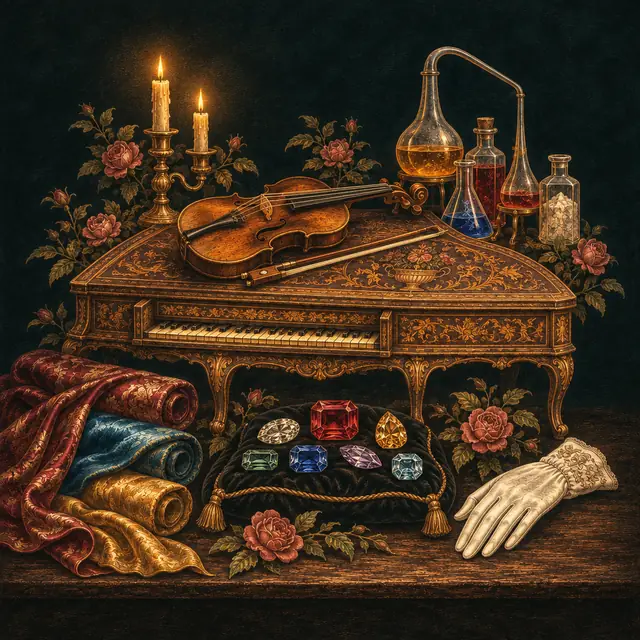
The Count presented himself as a chemist, and the arts he claimed are arts of colour and of stones: to fix colours in cloth, silk and leather so that they would not fade, to improve gems, to take the flaw out of a diamond and to make small pearls grow large. A memoir of the court of Louis XV tells that the king gave him a diamond spoiled by a flaw and had it back clear and worth far more. In his last years he and his host, Prince Charles of Hesse, worked together at dyes, and this was the art he shared with the prince.
The manner of an adept
His way of living was itself a performance of the adept. He sat at table in company and ate nothing; he spoke of kings and courts dead for centuries as if he had known them, and let his hearers draw the conclusion; he played the violin and sang, spoke many languages, and would not say where he was born. He claimed an elixir that kept him in health and youth, and hinted at more. The legend of his great age was built from what he let others believe.
The coin at Tournai
Casanova, who knew the trade from within, tells what he saw at Tournai. The Count asked for a coin, laid the twelve-sou piece on a burning coal, worked the fire with a blowpipe, and after a little while gave it back as gold. Casanova did not doubt the gold; he doubted the coin, and judged that a gold piece had been put in its place by sleight of hand while he watched the fire. Casanova's lesson is the one his own life had taught him: a wonder done before a believer proves only the skill of the one who does it.
The Most Holy Trinosophia
The illustrated manuscript that tradition gives him tells of an initiation. Its writer sends it to a friend from the prisons of the Inquisition, and recounts a journey through underground halls, through trials of fire, water and air, past altars, figures and strange writings, to the knowledge of a threefold wisdom, the trinosophia of its title. Each stage has its picture, and its admirers read the book as a map of the soul's passage from darkness to light, and as alchemy told as a journey.
The Master of the later books
After his death the Count became a teacher in other people's books. For the Theosophists he is one of the Masters, the adepts held to guide the growth of humanity from behind the scenes: called the Master Rakoczi, of a Hungarian princely house, he is said to watch over the affairs of Europe and to rule the seventh ray, the ray of ceremonial order. In the I AM movement of the 1930s Guy Ballard told of meeting him on Mount Shasta, and taught in his name the violet flame, a fire of the spirit called on in prayer to consume the faults and burdens of the past. These are claims of a later age, and nothing in the record of the man bears them out.
Orders and memberships
His last host was a leading Freemason and wrote of him with reverence; no lodge record shows the Count himself to have been a member of any order.
The legend
That he never died. Theosophists of the following century made him an immortal “Master”.
Their works
- Songs and sonatasMusic, about 1745 to 1750
Songs and violin sonatas printed in London in the 1740s under the name of the Count, when he lived there as a musician. They are among the few certain works that remain from a man known chiefly by rumour.
Ask the Oracle about it - Horace Walpole’s letter of 1745Account, 1745
A letter of Horace Walpole tells of a strange man calling himself a count, arrested in London that year as a suspected Jacobite and released, who sang and played the violin wonderfully and would not say who he was. It is one of the earliest accounts of him.
Ask the Oracle about it - La Très Sainte TrinosophieTreatise, 18th century
An illustrated manuscript of alchemical and initiatic visions, kept at Troyes, which tradition has ascribed to the Count. It was printed in the twentieth century and is prized by occult readers.
The ascription to him is not proved and rests on later tradition.
Ask the Oracle about it - Casanova’s memoirsAccount, written 1789 to 1798
Casanova met him in Paris and at Tournai and describes him in his memoirs as a learned and brilliant impostor who claimed great age and knew chemistry, a portrait written by a rival in the same trade.
Ask the Oracle about it
How the house tells a life
This life is told from the record, with what is documented, what is legend and what was forged kept apart. A membership in an order is stated only where documents show it. A person’s chart explains none of their deeds.
The arts it feeds
Lives near it in time
Lives and legends
Michael MaierRobert FluddJohann Valentin AndreaeWilliam LillyElias AshmoleIsaac NewtonCourt de GébelinGiacomo CasanovaMartinez de PasquallyFranz Anton MesmerEtteillaCount CagliostroThe whole tree

