
Count Cagliostro
1743 to 1795
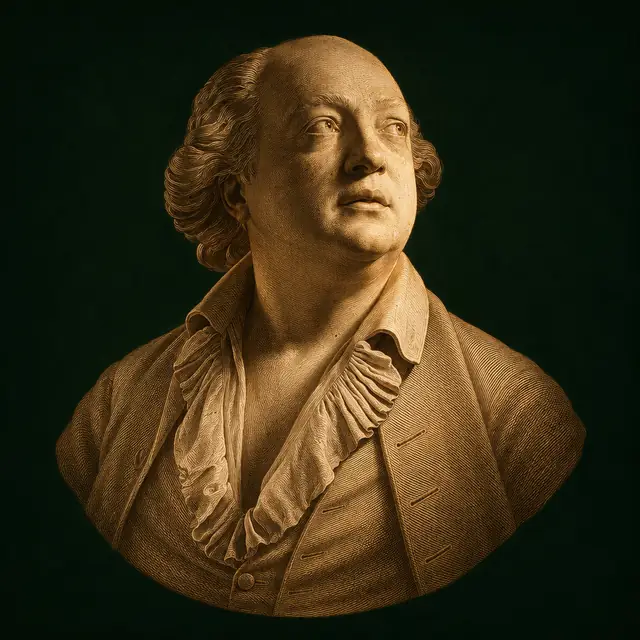
Who was Count Cagliostro, and what is truly known of them?
What is known
Adventurer and healer generally identified as Giuseppe Balsamo of Palermo. He founded an “Egyptian Rite” of Freemasonry, was tried and acquitted in the Affair of the Diamond Necklace in Paris (1786), was condemned by the Roman Inquisition, and died a prisoner in the fortress of San Leo.
The teaching
Taught from the ritual of his Egyptian Rite as its copies keep it, with the defence printed in his name in 1786.
Egyptian masonry
Cagliostro teaches that common Freemasonry is a shadow of the true craft, which is Egyptian, founded by the prophets Enoch and Elijah and handed down in the East. Its head is the Grand Copht, and its aim is the perfecting of man in soul and body: a moral regeneration that restores the innocence Adam had before the fall, and a physical regeneration that renews the body. It has three grades, Apprentice, Companion and Master, and it receives women as well as men, the women in lodges of their own.
The dove
Its most famous rite needs a child. A boy or a girl in a state of innocence, called the pupil or the dove, is set before a carafe of clear water, or behind a screen in a small tabernacle, and the master calls on God and the angels to grant the child the power of sight. Then the dove looks, and reports what appears: angels, the absent, the dead, or things happening far off, in answer to the questions put. The rite asks innocence of its seer, for it holds that the angels show themselves only to the pure.
The seven angels
The rite calls on the seven angels who stand before the throne of God and govern the seven planets: Anael, Michael, Raphael, Gabriel, Uriel, Zobiachel and Anachiel. They are the powers through whom the Grand Copht works, and the regeneration of the masters is completed by their appearing.
The moral regeneration
A master who would be made perfect retires with twelve others for forty days to a house set apart from the world. The days are given to prayer, to fasting and to the work of the rite, at fixed hours and in silence. Toward the end the seven angels appear and give each master a pentagon, a sheet of virgin parchment marked with their signs, and with it the master regains the first innocence and a power over the spirits. The ritual promises this; it is taught here as its promise, and its long fasts are not to be copied.
The physical regeneration
The second regeneration is a cure of forty days, to be taken every fifty years at the full moon of May, in the country, with a friend to tend the one who takes it. It is a regimen of thin food, purging, the letting of blood, drops and grains of a medicine the ritual calls the primal matter, and long sleeps, after which, it promises, the old skin is shed, the hair and teeth come again, and youth returns. Bleeding, purging and starving harm the body, and nothing in the cure has ever renewed one; it is told here as the ritual tells it, because it shows what Cagliostro offered.
Healing without pay
Beside the rite stood his practice as a healer. In the towns where he stayed he received the sick, the poor with the rich, gave them his remedies and asked nothing for them, keeping the old rule that the adept heals freely, and it was the healing that first drew the crowds to him.
Orders and memberships
A Freemason, initiated in London in 1777, and founder of his own Egyptian Rite. Both documented.
The legend
That he was centuries old, or made gold and the elixir of life. These were his own claims.
Their works
- Ritual of Egyptian FreemasonryRitual, 1780s
The rites of the Egyptian Rite he founded, with lodges for men and for women, a Grand Copht at their head and promises of moral and bodily renewal. It survives in manuscript copies and was printed only in the twentieth century. It is the nearest thing to a work of his own.
It survives only in copies made by others, and how much of the wording is his is not known.
Ask the Oracle about it - Mémoire pour le comte de CagliostroDefence, 1786
The printed brief for his defence in the Affair of the Diamond Necklace, drawn up with his lawyer Thilorier. It tells his own story of a childhood in Medina and Mecca and of travels in the East, and it sold in thousands in Paris. He was acquitted, and the tale it tells is his own.
Written in his name with his lawyer, and its account of his origins is not borne out by any record.
Ask the Oracle about it - Letter to the English PeopleLetters, 1786
An open letter printed in London after his expulsion from France, defending himself against the journalist Théveneau de Morande, who had named him as Giuseppe Balsamo of Palermo. It is one of the few texts that carries his own voice in public.
Ask the Oracle about it - Life of Joseph BalsamoAccount, 1791
The account of his life and trial published at Rome under the authority of the Inquisition that condemned him, and soon put into French, German and English. It is hostile and was written to discredit him, and it remains a main source for his identification with Balsamo.
An official account by his judges, not his own work.
Ask the Oracle about it
How the house tells a life
This life is told from the record, with what is documented, what is legend and what was forged kept apart. A membership in an order is stated only where documents show it. A person’s chart explains none of their deeds.
The arts it feeds
Lives near it in time
Lives and legends
The Count of Saint-GermainCourt de GébelinGiacomo CasanovaMartinez de PasquallyFranz Anton MesmerEtteillaAdam WeishauptNapoleon BonaparteMarie Anne LenormandFrancis BarrettMarie LaveauEdward Bulwer-LyttonThe whole tree

