
Court de Gébelin
About 1725 to 1784
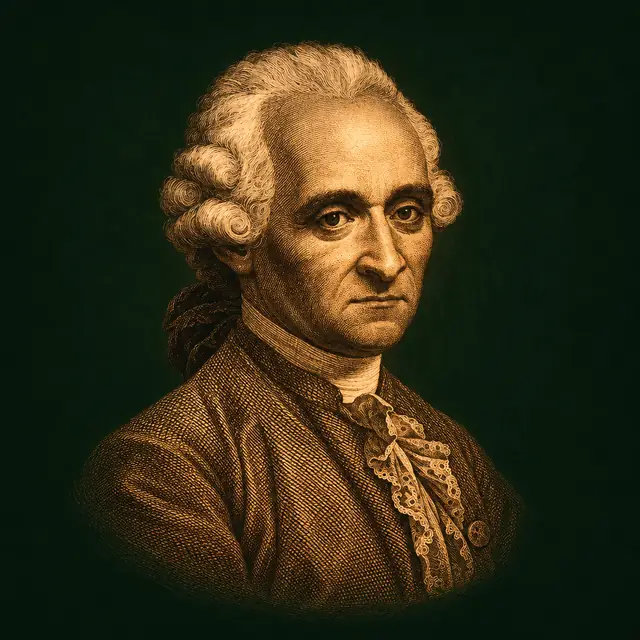
Who was Court de Gébelin, and what is truly known of them?
What is known
French Protestant pastor and scholar, son of Antoine Court, who had rebuilt the Reformed church in France. He was brought up at Lausanne, was ordained there in 1754 and settled in Paris in 1763. From 1773 to 1782 he published nine volumes of Le Monde primitif, a study of what he took to be a first golden age of mankind and its one language. In the eighth volume, in 1781, he and the Comte de Mellet declared that the tarot cards were a book of the Egyptian priests, and linked the trumps to the Hebrew letters. He became a patient and defender of Mesmer in 1783 and died in Paris in 1784.
The teaching
Taught from Le Monde primitif (1773 to 1782), above all its essay on the tarot of 1781.
The primitive world
Court de Gébelin teaches that mankind once lived in a first age of order and plenty, the primitive world of his title. Its people tilled the earth under the order of nature, worshipped one God, kept one calendar and spoke one language, and everything later peoples have, their speech and writing, their laws, their feasts and their myths, descends from it. That world was broken and scattered, but it was not lost: its traces lie in every nation's words and customs, and by comparing them a patient student can recover it, as a ruined building is recovered from the stones that lie about the field.
One language behind all languages
Speech, he holds, is natural and not arbitrary. The first words were drawn from nature itself, imitating the things they named or springing from the natural movements of the voice, and every language keeps the roots of that first tongue beneath its changes. Set Hebrew, Greek, Latin, Celtic and the tongues of modern Europe side by side, and the same roots appear with the same senses. Writing began the same way, with pictures of things, and the letters of the alphabets are those pictures worn down: each letter was once an image with a meaning.
The myths as the farmer's year
The myths of the ancients are allegories, and their subject is the first life of mankind, the tilling of the earth and the order of the year. Saturn, who reigned in the golden age, is the god of farming and of time; the twelve labours of Hercules are the twelve months of the farmer's year and the Sun's course through the twelve signs; the deeds of the gods are the calendar, the seasons and the works of the fields told as the deeds of persons. To read a myth rightly is to find the work of the year beneath it.
The tarot as the book of Thoth
In the tarot he believed he had found a book of that first world, saved by the priests of Egypt in the form of a game. Its twenty-two trumps and four suits of fourteen cards are the pages of the Book of Thoth, and its name, he says, is Egyptian: tar, a road, and ro or rog, royal, the royal road of life. The four suits are the four estates of Egypt: swords the king and the warrior nobility, cups the priesthood, batons the farmers, and coins the merchants.
He reads the trumps as Egyptian figures. The Pope and the Popess are the high priest and the high priestess; the Chariot is Osiris triumphant; the Star is Sirius, the Dog Star, whose rising told Egypt that the Nile would flood; the Devil is Typhon; the card of the Last Judgement is the creation; and the Fool, numbered nothing, stands apart from the rest. The Hanged Man, he says, is Prudence printed upside down by card makers who did not understand it: set on his feet, he stands on one foot and holds the other raised, considering where to put it down, and with Justice, Temperance and Strength he makes up the four cardinal virtues.
His collaborator the Comte de Mellet, in a second essay, set the trumps against the twenty-two letters of the Hebrew alphabet, counting backward from the World, and divided them into three sevens, the ages of gold, silver and iron. The whole reading is theirs and not the cards': the tarot is an Italian game, and nothing Egyptian is in it.
Orders and memberships
A Freemason on the record in Paris: a member of the Lodge of the Nine Sisters, to which Franklin also belonged, and of the Amis Réunis and its inner circle, the Philalèthes, which studied the high grades and occult learning.
The legend
That the tarot is the lost Book of Thoth, saved by Egyptian priests in the form of a game. It was his own guess, made forty years before the hieroglyphs could be read, and nothing supports it. The cards are first recorded in northern Italy in the fifteenth century, as a card game. Almost every later occult reading of the tarot starts from his essay.
Their works
- Le Monde primitifBook, printed 1773 to 1782
Nine volumes on what he took to be the first age of mankind, its one language and its worship, which he sought behind myths, alphabets and calendars. It was hugely admired in its day and brought him fame in the learned lodges of Paris.
Ask the Oracle about it - Essay on the Game of TarotsEssay, printed 1781
The chapter in the eighth volume of Le Monde primitif, with a second essay by the Comte de Mellet, declaring the tarot a book of the Egyptian priests and linking the trumps to the Hebrew letters. Almost every later occult tarot descends from this guess, which nothing supports.
Ask the Oracle about it - Les ToulousainesLetters, printed 1763
Letters written in defence of the Protestants of France after the execution of Jean Calas at Toulouse, continuing the work of his father for the persecuted Reformed church.
Ask the Oracle about it - Letter on animal magnetismLetters, 1783
His public letter in defence of Mesmer, written after he had been a patient and believed himself helped. He died the next year, and his death was used by Mesmer’s critics.
Ask the Oracle about it
How the house tells a life
This life is told from the record, with what is documented, what is legend and what was forged kept apart. A membership in an order is stated only where documents show it. A person’s chart explains none of their deeds.
The arts it feeds
Lives near it in time
Lives and legends
Robert FluddJohann Valentin AndreaeWilliam LillyElias AshmoleIsaac NewtonThe Count of Saint-GermainGiacomo CasanovaMartinez de PasquallyFranz Anton MesmerEtteillaCount CagliostroAdam WeishauptThe whole tree

