
Martinez de Pasqually
About 1727 to 1774
Who was Martinez de Pasqually, and what is truly known of them?
What is known
Founder of a Masonic rite of ceremonial magic in France. His birth and origins are uncertain: he is usually said to have been born at Grenoble about 1727, and his family has been called Spanish or Portuguese. From about 1754 he worked in the lodges of southern France, settling at Bordeaux in 1762, and in the later 1760s he set up the Order of Knight Masons Elect Cohens of the Universe, whose highest grade worked rites meant to draw signs from spirits. He wrote one unfinished book, the Treatise on the Reintegration of Beings, which passed round in manuscript and was printed in 1899. In 1772 he sailed to Saint-Domingue to claim an inheritance, and he died at Port-au-Prince in 1774.
The teaching
Taught from his Treatise on the Reintegration of Beings and his letters to his pupils.
The first emanation
Pasqually teaches that before time God emanated from Himself spiritual beings, to praise Him and to share in His works. They were not made from outside Him but came forth from Him, free, each with its own power and its own place in His order, and their freedom is the root of everything that follows.
The fall of the spirits
Some of these spirits, led by the first among them, wished to create as God creates, by their own power, and so to be His equals. This is the first prevarication, the first crime in the universe. God did not destroy them; He confined them. He made the physical universe as a place of limits, where their evil is held within fixed bounds and their power restrained, and matter, which seems so solid, is that boundary given form, made from three essences, which the treatise calls mercury, sulphur and salt.
Man the minor
Then God emanated man, whom the treatise calls the minor, and clothed him in a body of glory, not of flesh. He set him at the centre of creation with power over all beings, to hold the fallen spirits in check and to call them back to their Maker: man was to be the mediator between God and the fallen, a god of the earth under God.
Adam's prevarication
The first man fell as the spirits had fallen. Listening to the fallen ones, he wished to work by his own will as God works, and what came of his working was no being of light but a form of darkness, a body without life. In punishment he was himself clothed in a body of matter, the form that men now have, and cast down among the things he was meant to rule; and his posterity is born into that condition, spirits imprisoned in flesh, in the same world as the spirits they were meant to govern.
Reintegration
The end of all things is reintegration: the return of every being, man first and through him the rest, to its first property, virtue and power, spiritual and divine. Man cannot climb back by his own strength. He is helped by the good spirits, by the Repairer who came to restore him, and by a true worship handed down from Adam's son Seth through the righteous of every age, Enoch, Noah, Abraham and Moses among them. The Elect Cohens, whose name means priests, take that worship up again: their rites are the priestly service by which man resumes his office and works for the reconciliation of all.
The operations
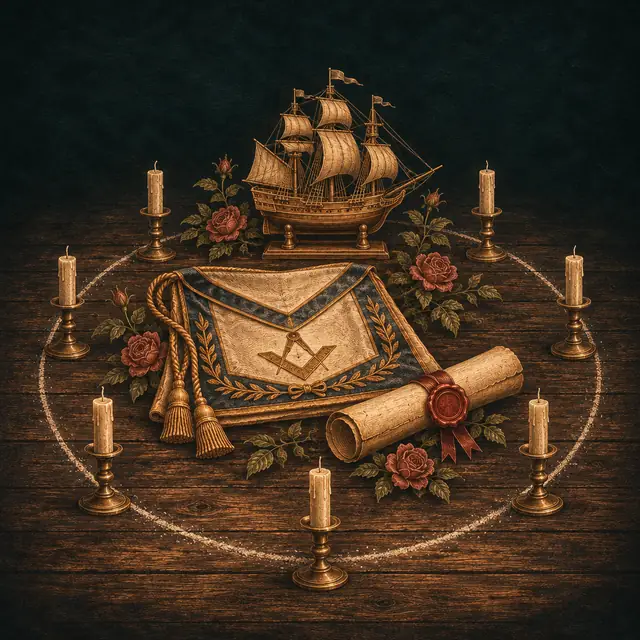
The highest members work rites the letters call operations. They are done at set times, above all near the equinoxes, in a room prepared for them, with circles and signs traced on the floor, lights set in their places, the names of spirits and long invocations, the operator alone and often lying prostrate. They are prepared for by prayer, by rules of diet and by continence, which the letters lay down; anyone whose health a fast could harm keeps none, and the rites are taught here as the order's own and not as a practice.
The sign that a work has been accepted is a pass: a light, a form, a sound or a gleam that crosses the room, which the operator notes and reports to his master. What the operators hope for above all they call the Thing: the coming of the good spirit, or of the Repairer, in a form that can be seen. His pupil Saint-Martin later kept the doctrine and left the rites for what he called the inner way, the way of the heart.
Orders and memberships
Founder of the Elect Cohens, which is documented in his letters and in those of his pupils Louis-Claude de Saint-Martin and Jean-Baptiste Willermoz. He showed a Masonic patent said to have been granted to his father by Charles Edward Stuart in 1738; its authenticity is doubted. The order faded within a few years of his death.
The legend
That he was a Rosicrucian adept, or a kabbalist of an old Jewish family carrying a secret teaching. Nothing certain is known of his descent or of his teachers. The Martinist orders founded in Paris from the 1880s claim a line of initiation back to him; no unbroken line is documented.
Their works
- Treatise on the Reintegration of BeingsTreatise, written 1770s, printed 1899
His one book, left unfinished, telling of the fall of spirits and of man and the way back to God through the rites of the Elect Cohens. It passed round in manuscript among his pupils and was printed in 1899 for the Martinist revival.
Ask the Oracle about it - Letters to WillermozLetters, 1760s and 1770s
His letters to Jean Baptiste Willermoz of Lyon, giving instructions for the rites, the grades and the running of the order. With the letters of his other pupils they are the main record of the Elect Cohens.
Ask the Oracle about it
How the house tells a life
This life is told from the record, with what is documented, what is legend and what was forged kept apart. A membership in an order is stated only where documents show it. A person’s chart explains none of their deeds.
The arts it feeds
Lives near it in time
Lives and legends
William LillyElias AshmoleIsaac NewtonThe Count of Saint-GermainCourt de GébelinGiacomo CasanovaFranz Anton MesmerEtteillaCount CagliostroAdam WeishauptNapoleon BonaparteMarie Anne LenormandThe whole tree

