
Napoleon Bonaparte
1769 to 1821
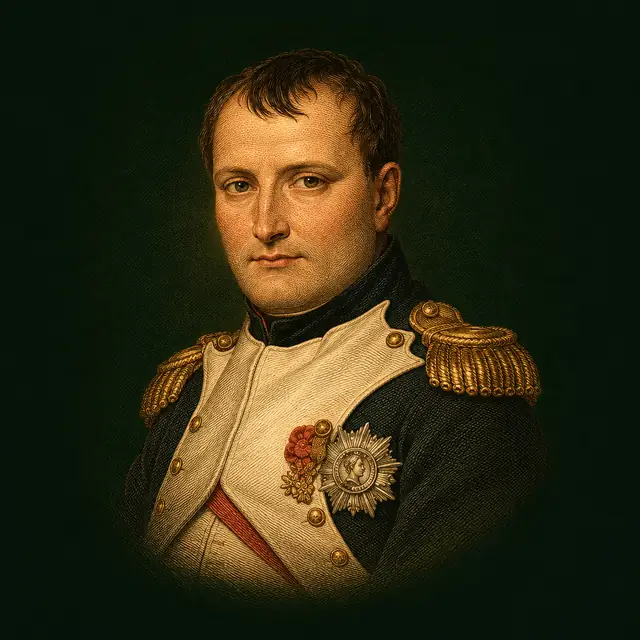
Who was Napoleon Bonaparte, and what is truly known of them?
What is known
General, First Consul and Emperor of the French. His expedition to Egypt in 1798 took scholars with it, and their Description de l’Égypte began Europe’s fascination with Egypt, which fed the esoteric revival of the next century. He spoke often of his “star”, as a figure of speech for his fortune.
The teaching
Taught from the record of his expedition to Egypt and of the lodges of his Empire, and the oracle sold under his name.
Egypt measured
What Napoleon stood for in the arts is the opposite of a mystery: Egypt was to be known by survey. With his army in 1798 went a commission of scholars, engineers and artists, and at Cairo he founded an Institute of Egypt with sections for mathematics, physics, political economy, and literature and the arts. They measured the temples and pyramids, copied the inscriptions, drew the reliefs, listed the plants and animals and described the life of the country, and the state printed the whole in three parts: the antiquities, the modern state and natural history.
The stone of Rosetta
The survey's greatest find was a slab of dark stone dug up in 1799 at Rashid, which the French called Rosetta, by soldiers rebuilding a fort. It carries one decree of the priests of Egypt in honour of Ptolemy V, written three times: in the hieroglyphs of the temples, in the demotic of daily writing, and in Greek. Because the Greek could be read, the stone was a key, and in 1822 Jean-François Champollion used it to read the hieroglyphs. From then on the Egyptians spoke for themselves, and the guesses of earlier centuries about a hidden wisdom in their signs gave way to their own words: hymns, prayers, accounts, letters and the books of the dead.
The zodiac of Dendera
In the temple of Hathor at Dendera the expedition's artist Vivant Denon drew a round zodiac carved on a ceiling, and in Paris it became a battleground: some read its stars as proof that Egyptian astronomy was many thousands of years old, older than the Bible's reckoning allowed. When Champollion could read the royal titles carved with it, they showed it to be a work of the Greek and Roman age, made after the signs of the Greek zodiac had come to Egypt, and not a relic of the first pharaohs.
The lodges as an arm of the state
Napoleon's rule for Freemasonry was use, not membership. The lodges were left free to meet and to multiply under grand officers drawn from his own family and government, so long as they kept to fraternity, charity and loyalty and left politics alone; regiments carried military lodges with them across Europe; and in return the lodges gave the Empire a network of loyal notables in every town. The craft became a part of the state's order, honoured and watched at once.
The Book of Fate
The oracle sold under his name after his death works by chance and a table. The one who consults it chooses a question from its list, then makes five rows of marks at random without counting them; each row is counted, and an odd number gives one mark and an even number two, so that the five rows make a figure, one of thirty-two. The figure and the question together point to an answer in the book. The book claims an ancient Egyptian source and says that Napoleon consulted it before his battles; it was made for the London trade, and he never saw it.
Orders and memberships
No reliable document shows that Napoleon was a Freemason. His brothers were: Joseph was Grand Master of the Grand Orient of France. Napoleon tolerated the lodges and used them as an arm of the state. He was not a Jesuit; the Society of Jesus, suppressed by the Pope in 1773, was restored only in August 1814, after his first abdication.
The legend
A night alone in the Great Pyramid, the “Red Man of the Tuileries” who foretold his fate, and the oracle book said to have been found in his cabinet. “Napoleon’s Book of Fate” was a fortune-telling book sold in London from 1822; the tale of its finding is the publisher’s.
Their works
- Description de l’ÉgypteCollection, 1809 to 1829
The vast survey of Egypt made by the scholars who went with his expedition of 1798, printed by order of the state in many volumes of text and plates. It began Europe’s fascination with Egypt, which fed the esoteric revival of the next century.
His work only as the patron who ordered it; it was written and drawn by the expedition’s scholars.
Ask the Oracle about it - Napoleon’s Book of FateOracle, 1822
A fortune-telling book sold in London, with a table of signs to be answered by chance. Its publisher told that it had been found in Napoleon’s cabinet after Leipzig and that he consulted it; the tale is the publisher’s.
Not his: the story of its finding is a publisher’s invention.
Ask the Oracle about it - Le Souper de BeaucaireEssay, 1793
A short pamphlet in dialogue that the young artillery captain wrote in support of the Republic during the revolts in the south of France. It is one of the few things he wrote and printed himself before his rise.
Ask the Oracle about it - The Memorial of Saint HelenaAccount, 1823
The record of his talk in exile kept by Emmanuel de Las Cases, who shared his captivity. It became the main source of the Napoleonic legend, and it gives his own account of his star and his fate.
Written by Las Cases, and his reporting of Napoleon’s words cannot be checked.
Ask the Oracle about it
How the house tells a life
This life is told from the record, with what is documented, what is legend and what was forged kept apart. A membership in an order is stated only where documents show it. A person’s chart explains none of their deeds.
The arts it feeds
Lives near it in time
Lives and legends
Giacomo CasanovaMartinez de PasquallyFranz Anton MesmerEtteillaCount CagliostroAdam WeishauptMarie Anne LenormandFrancis BarrettMarie LaveauEdward Bulwer-LyttonAllan KardecAlbert PikeThe whole tree

