
Albert Pike
1809 to 1891
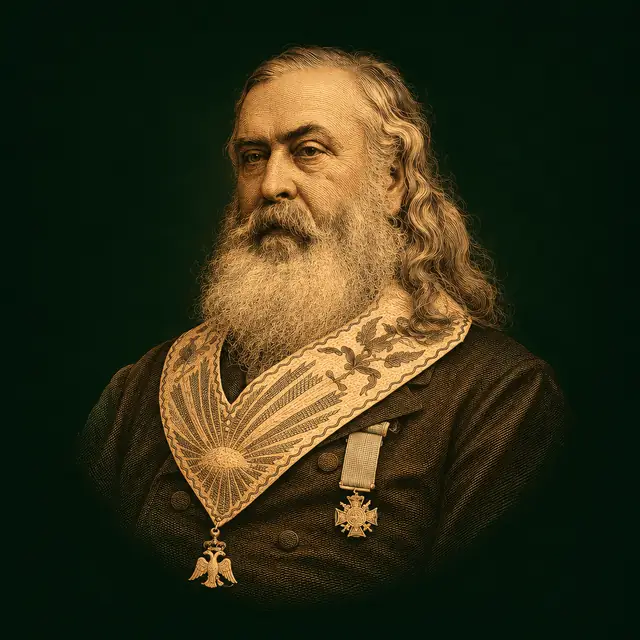
Who was Albert Pike, and what is truly known of them?
What is known
American lawyer, writer and Confederate brigadier general. From 1859 until his death he led the Scottish Rite of Freemasonry’s Southern Jurisdiction, whose degrees he rewrote. His Morals and Dogma (1871) is a long commentary on those degrees, much of it taken from the French occultist Éliphas Lévi.
The teaching
Taught from Morals and Dogma (1871), his commentary on the degrees of the Scottish Rite.
Teaching by symbol
Freemasonry, as Pike teaches it, is a search for light. It teaches by symbols and allegories, and each degree is a lesson that the next carries further. A symbol is not explained all at once. The three degrees of the lodge, he holds, are only the outer court of the temple: their symbols are shown to the initiate with explanations that are partial and even misleading, so that he thinks he understands them, and their true meaning is kept for those who work on through the higher degrees.
Nothing in the book beyond its morality binds a reader. Dogma, its preface explains, is meant in the old sense of teaching, and each brother is entirely free to reject whatever in it seems to him untrue or unsound.
Force ruled by intellect
The first degree opens with force. Force without rule is wasted and does harm, like gunpowder burned in the open air or steam with nothing to hold it; it strikes blindly and recoils on itself. The force of the people is such a force. It must be husbanded and directed, as steam is made to turn great wheels and weave fine lace, and it must be ruled by intellect, which is to a people what the needle of the compass is to a ship. The lesson runs through the whole degree: liberty needs law, and a free people needs knowledge and wisdom to govern itself.
The mysteries behind the degrees
Pike reads the degrees as heirs of the mysteries of the old world. In Egypt and India, in Persia and Greece, among the Kabbalists and the Hermetic philosophers, he finds the same truths taught under veils to those found worthy: one God, the immortality of the soul, and a struggle of light against darkness, which the Persians told as the war of Ormuzd and Ahriman. Masonry, in his account, keeps those truths in its own symbols.
So the legend of Hiram, the master builder slain and raised, is for him one more telling of an old story: Osiris slain and found again by Isis, Adonis mourned and returned, the sun dying in the winter signs and rising again. Its meaning, as he gives it, is the death and return of light, and the immortality of the soul.
The lost Word
The Word that the Master Mason loses and the later degrees seek is, for Pike, the true name of God, and the true name stands for the true knowledge of God, which humanity lost when it took the symbols for the thing. In the degrees beyond the third the name is found again, engraved on a plate of gold in a vault beneath the temple, and the finding is the seeker's own: knowledge of God recovered by long work.
Toleration and duty
Masonry, for Pike, asks of a man belief in God and in the immortality of the soul, and no further creed. Pike counts toleration among the first Masonic duties: every man's faith is to be respected, since the truth that all of them reach after is greater than any one of them, and no man has a right to persecute another for his belief. The Rose Croix degree, as he rewrote it, gives its lesson of a new law of love in Christian dress, but reads it so that a man of any faith can take it for his own.
Its morality is practical: work, truthfulness, the keeping of faith, help for the weak and the wronged, and service to one's country and to humankind. The degrees exist, in his reading, to make better men and better citizens.
The light-bearer
One passage of the nineteenth degree is quoted against him more than any other. It speaks of the faith that aspires to God alone and despises all the pomps and works of Lucifer, and then dwells, after Lévi, on the strangeness of the name: Lucifer, the light-bearer, given to the spirit of darkness. Read in its place, it sets the faith that seeks God alone against that dazzling light, which he takes for the force that blinds feeble, sensual and selfish souls. The instructions praising Lucifer that are quoted as his were made by Léo Taxil's hoax.
The Royal Secret
The thirty-second degree, the Sublime Prince of the Royal Secret, gathers the whole course into one teaching: equilibrium. The universe, as Pike teaches it after Lévi and the Kabbalists, is held together by the balance of opposites, and harmony arises from the analogy of contraries. Necessity and liberty, the divine and the human, authority and free will, faith and reason, spirit and flesh are not to be chosen between but held in balance, each correcting the other. That balance in the universe, in the state and in a man's own soul is the Royal Secret, and the Prince who knows it is to keep it in his own life.
Orders and memberships
A Freemason, documented and public: Sovereign Grand Commander of the Scottish Rite, Southern Jurisdiction. He was not a Jesuit. A role in the early Ku Klux Klan is alleged in some later accounts and has not been proven.
The legend
That he was the secret head of world Freemasonry. No such office exists: Freemasonry has no single head, and his authority was over one jurisdiction of one rite.
What was forged, or is false
The “Luciferian” instructions quoted in his name come from the hoax of Léo Taxil, who confessed it in public in 1897. The letter to Mazzini foretelling three world wars has never been produced; the story was spread by conspiracy writers of the 1950s.
Their works
- Morals and DogmaBook, 1871
His long commentary on the thirty-two degrees of the Scottish Rite, given to its members for many years. Much of it is taken from Éliphas Lévi and other writers without saying so. It is often quoted out of context by critics of Freemasonry.
Ask the Oracle about it - The Magnum OpusRitual, 1857
His first rewriting of the rituals of the Scottish Rite, privately printed in a few copies. The rituals he went on to revise are, in their main lines, still used in the Southern Jurisdiction.
Ask the Oracle about it - Prose Sketches and PoemsBook, 1834
His first book, written after his journeys west to Santa Fe, with tales and verses of the frontier. It shows the young poet before the lawyer and the Mason. It was printed at Boston and is one of the earliest books of writing from the American Southwest.
Ask the Oracle about it - Indo-Aryan Deities and WorshipBook, printed 1930
His study of the gods of the Rig Veda, written in his last years and printed long after his death by the Scottish Rite. Like his work on the Zend Avesta it shows his late interest in the oldest scriptures of India and Persia.
Ask the Oracle about it - The Luciferian instructionsForgery, printed 1894
Words praising Lucifer that are still quoted as instructions Pike gave to Masons in 1889. They first appear in writings that came out of the hoax of Léo Taxil, who confessed it in public in 1897.
A forgery: Pike never wrote them.
Ask the Oracle about it
How the house tells a life
This life is told from the record, with what is documented, what is legend and what was forged kept apart. A membership in an order is stated only where documents show it. A person’s chart explains none of their deeds.
The arts it feeds
Lives near it in time
Lives and legends
Napoleon BonaparteMarie Anne LenormandFrancis BarrettMarie LaveauEdward Bulwer-LyttonAllan KardecÉliphas LéviPaschal Beverly RandolphAndrew Jackson DavisHelena BlavatskyHenry Steel OlcottDaniel Dunglas HomeThe whole tree

