
Henry Steel Olcott
1832 to 1907
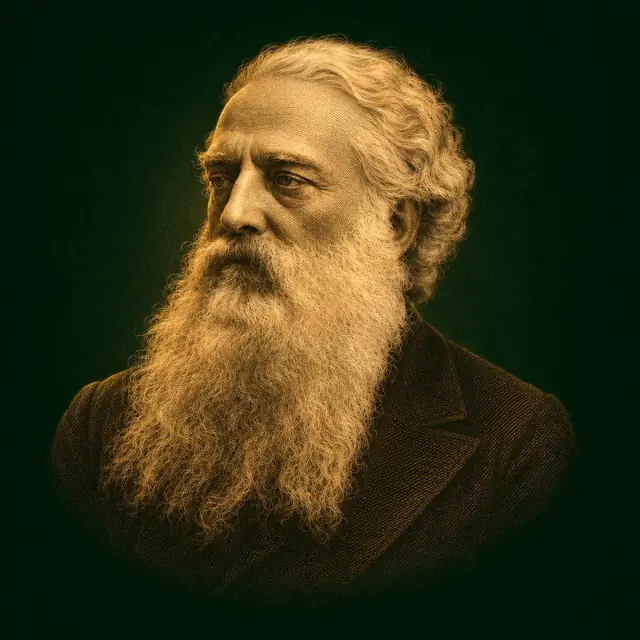
Who was Henry Steel Olcott, and what is truly known of them?
What is known
American lawyer and journalist, born at Orange, New Jersey. In the Civil War he investigated fraud in army supply with the rank of colonel, and in 1865 served on the inquiry into Lincoln’s murder. Reporting on séances at a Vermont farmhouse in 1874 he met Helena Blavatsky, and in November 1875 they founded the Theosophical Society in New York, with Olcott as president for the rest of his life. They moved to India in 1879 and to Adyar, near Madras, in 1882. In Ceylon in 1880 he formally took the Buddhist precepts; he wrote a Buddhist Catechism (1881), helped design the Buddhist flag, and founded Buddhist schools there.
The teaching
Taught from his Buddhist Catechism (1881), the fourteen Buddhist beliefs he drew up (1891) and Old Diary Leaves.
The Buddha's teaching, question by question
A Buddhist Catechism teaches the doctrine as a child is taught, by question and answer. The Buddha is not a god and is not to be prayed to as one: he was a man, the prince Siddhartha, who by his own efforts through many lives reached perfect wisdom and showed the way to others. A Buddhist takes refuge in three, the Buddha, his teaching and his order of monks, as guides and not as saviours, for no one can be saved by another and each must work out their own deliverance.
The core is the four noble truths: that life in the round of births is bound up with suffering; that the cause of suffering is craving, born of ignorance; that suffering ends when craving ends; and that the way to its ending is the noble eightfold path of right views, right aims, right speech, right conduct, right livelihood, right effort, right mindfulness and right concentration. The five precepts a lay follower takes are to refrain from killing, from stealing, from sexual wrong, from lying and from intoxicating drink and drugs.
No lasting soul passes from life to life. What carries over is karma, the sum of a being's deeds and of the craving that drives it, which brings a new being into existence as one flame lights another. Nirvana is the state in which craving and all its causes are put out, so that no new birth follows.
Fourteen beliefs for all Buddhists
In 1891 Olcott drew up fourteen fundamental beliefs and put them to the leading monks of the Buddhist lands, so that the schools of the south and of the north could own a common ground. They begin with tolerance: Buddhists are taught to show the same forbearance and brotherly love to all, whatever their faith. The universe was evolved, not created, and it runs by law and not by the caprice of any god. The four truths, the eightfold path and the law of karma follow, with the teaching that each being's lot is the fruit of its own deeds.
The last of them holds to the Buddha's counsel to the Kalamas: no one is to believe a thing because a sage has said it, a book holds it or tradition affirms it, unless it agrees with reason. The Buddha, it adds, taught that it is a parent's duty to have the child educated in science and literature.
The six colours
The flag Olcott helped to shape for the Buddhists of Ceylon carries six bands: blue, yellow, red, white and orange, and a sixth made of all five together. They are the colours of the rays said to have shone from the Buddha's body at his enlightenment, and the flag was meant to be flown by every school of Buddhism alike, as a sign that the teaching is one.
Each to the depth of their own faith
As president of the Theosophical Society Olcott taught brotherhood across the religions, not conversion. A Hindu, in his teaching, should become a better Hindu and a Buddhist a better Buddhist, by finding the deeper meaning of the faith they were born to, and he urged the peoples of India and Ceylon to value and revive their own religions and learning rather than give them up. The Society, he held, has no creed of its own to put in their place.
Healing by the hand
In Ceylon and India in the early 1880s Olcott practised mesmeric healing, treating the sick by passes and by the laying on of hands, and Old Diary Leaves records the crowds who came to him. He held that a vital force passes from a healthy and willing healer to the sick, governed by the healer's will and purity of motive; he also found that it drained his own strength, and in the end he gave it up. The house teaches it as what he held and practised, and promises no cure from it.
Orders and memberships
The Theosophical Society, of which he was co-founder and first president from 1875 to 1907. The Society’s own histories call him a New York Freemason; the lodge record is not one the house has seen.
The legend
That Masters living in Tibet guided the Society by letters that fell from the air, and that one of them visited him in New York and left his turban behind. The visit is his own account. A report for the Society for Psychical Research in 1885 judged the letters a fraud by Blavatsky; a later study printed by the same society in 1986 found that report unsound.
Their works
- A Buddhist CatechismTeaching, 1881
A short book of questions and answers on the teaching of the Buddha, written in Ceylon and approved by the monk Hikkaduwe Sumangala. It was used in the Buddhist schools he founded and went through many editions and languages.
Ask the Oracle about it - Old Diary LeavesDiary, 1895 to 1935
His history of the Theosophical Society in six volumes, drawn from his diaries, telling of its founding with Blavatsky and of their years in India. It is a main source for her life, told from his side.
Ask the Oracle about it - People from the Other WorldAccount, 1875
His book on the séances of the Eddy brothers at their Vermont farmhouse, which he reported for a New York paper in 1874. It was there that he met Helena Blavatsky.
Ask the Oracle about it
How the house tells a life
This life is told from the record, with what is documented, what is legend and what was forged kept apart. A membership in an order is stated only where documents show it. A person’s chart explains none of their deeds.
The arts it feeds
Lives near it in time
Lives and legends
Allan KardecAlbert PikeÉliphas LéviPaschal Beverly RandolphAndrew Jackson DavisHelena BlavatskyDaniel Dunglas HomeThe Fox sistersAnna KingsfordAnnie BesantWilliam Wynn WestcottCharles LeadbeaterThe whole tree

