
Helena Blavatsky
1831 to 1891
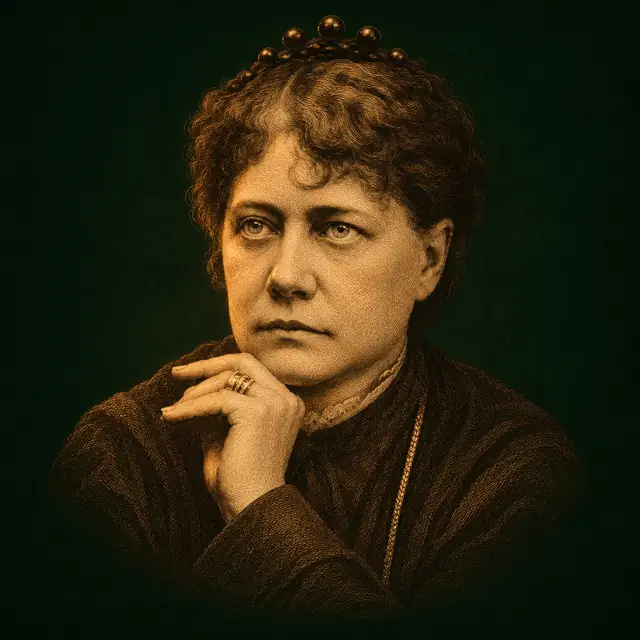
Who was Helena Blavatsky, and what is truly known of them?
What is known
Russian-born writer who founded the Theosophical Society in New York in 1875 with Henry Steel Olcott and William Quan Judge. Isis Unveiled (1877) and The Secret Doctrine (1888) brought Hindu and Buddhist ideas, karma and reincarnation among them, into Western esotericism.
The teaching
Taught from her own books, above all The Secret Doctrine (1888), The Key to Theosophy and The Voice of the Silence (1889).
Three fundamental propositions
The Secret Doctrine rests on three propositions. The first is an omnipresent, eternal, boundless and immutable principle, beyond the reach of thought, of which nothing can truly be said; every name given to it lessens it. All that exists is its expression, and it is the one root of spirit and of matter.
The second is the eternity of the universe as a boundless plane, on which numberless universes appear and disappear in turn, and with it the absolute universality of the law of periodicity, of flux and reflux, ebb and flow, which science finds in every part of nature. Nothing is made once and for ever: worlds and beings come forth, grow, pass away and come forth again.
The third is the fundamental identity of every soul with the universal oversoul, itself an aspect of the unknown root, and the obligatory pilgrimage of every soul through the cycle of incarnation under cyclic and karmic law. No soul is exempt and none is lost. Each goes the whole road, and rises at last by its own effort and merit.
The night and the day of the universe
The Stanzas of Dzyan, round which the book is built, open in the night between universes, which she calls pralaya. The eternal parent, space, sleeps wrapped in her ever invisible robes; time is not, for it lies asleep in the infinite bosom of duration; universal mind is not, for there are no beings to contain it. Then the night ends. A vibration stirs in the darkness, a ray goes out into the germ, the one becomes two and three, and the day of manifestation, the manvantara, begins, to run its course and close in another night.
The force that carries the divine thought into matter she calls Fohat: the bridge between spirit and substance, the energy that impresses the ideas of the divine mind on matter as the laws of nature. Through Fohat and the hosts of intelligences she calls the Dhyan Chohans the universe is shaped by mind from within, and nothing in it is dead or blind.
The pilgrimage of the soul
Spirit descends into matter and rises out of it again. The divine spark passes down through the elemental kingdoms, the mineral, the plant and the animal, gaining form and experience, until in the human being it awakens to itself; from there it climbs by its own effort, life after life, back toward the spirit it came from, now conscious and individual. The arc of descent and the arc of ascent together make the circle of evolution, and the human kingdom stands at its turning.
Karma, as The Key to Theosophy states it, is the ultimate law of the universe and the source of all its other laws: the unerring law that adjusts effect to cause on every plane and restores every broken balance. It is not a punishment laid on from outside. What a person does, thinks and wishes comes back to them, in this life or another, and so each makes their own future. Between lives the lower self is shed in kama-loka, the place of desire, and the higher rests in devachan until it is drawn back to birth.
Personality and individuality
A human being has seven principles, from the dense body to the spirit, whose names are given in The planes and the cord. They fall into two groups: a lower four, the body, its life, its double and its desires, which die; and a higher three, mind, the spiritual soul and spirit, which do not. Mind stands between, drawn down by desire and up by the spiritual soul.
From this comes her distinction between the personality and the individuality. The personality is the mask of one life, the name, face and character that last from birth to death. The individuality is the reincarnating ego, the higher mind joined to the spiritual soul, which wears one personality after another as an actor plays many parts. It is the individuality that learns, and the work of each life is to give it something worth keeping.
Brotherhood and the three objects
The Key to Theosophy gives the Society three objects: to form the nucleus of a universal brotherhood of humanity without distinction of race, colour or creed; to promote the study of the scriptures, religions and sciences of the world, and above all of the old literature of Asia; and to investigate the hidden mysteries of nature and the psychic and spiritual powers latent in human beings. Only the first binds a member. The Society's motto is that there is no religion higher than truth.
Theosophy, in her teaching, is not a new religion but the wisdom at the root of them all, which she calls the Wisdom-Religion, kept whole by a few and veiled in the symbols of every faith. Isis Unveiled had made the case against two opponents at once: against the churches, for taking the veil for the truth, and against the science of her day, for denying whatever cannot be weighed.
The Masters
Behind the Society, she teaches, stand the Masters, or Mahatmas: men who have gone ahead of humanity on the same road, perfected themselves through many lives and gained knowledge and powers that others have yet to reach. They live apart, in the East, and they work for humanity through pupils and by persuasion, never by compulsion, leaving each person free.
The Voice of the Silence
The Voice of the Silence teaches the path of the disciple in short verses. Its first lesson is that the mind is the great slayer of the real, and that the disciple must slay the slayer: the restless, grasping mind must be stilled before the voice of the silence, the voice of the spirit within, can be heard. The way passes through three halls, of ignorance, of learning and of wisdom, and through seven portals, each opened by its own key: charity, harmony in word and act, patience, indifference to pleasure and pain, dauntless energy, contemplation and wisdom.
She sets the doctrine of the eye, the learning of the head, below the doctrine of the heart, the wisdom of the soul. At the end of the road stand two paths: the open path, which leads to liberation for oneself, and the secret path of renunciation, on which the one who has won freedom refuses it in order to stay and help a suffering world. The second she calls the higher, and its rule is that the disciple's soul should lend its ear to every cry of pain.
The root races
The second volume of The Secret Doctrine sets out seven root races of humanity, each on its own continent, and that teaching is given, with what it alleges and the facts that refute it, in Lemuria and Mu. It is a ranking of peoples, and it is false: all living people are one species, which arose in Africa, and no lost continent of Lemuria or Atlantis ever held a people.
Orders and memberships
Founder of the Theosophical Society, an open society with published aims. Her “Masters” or Mahatmas are her own account; no independent record of them exists.
The legend
Her years of study in Tibet, which cannot be confirmed. A report for the Society for Psychical Research in 1885 judged her phenomena fraudulent; a re-examination published by the same society in 1986 found that report unfair. Her teaching of “root races” was later put to racist uses she did not live to see.
Their works
- The Secret DoctrineBook, 1888
Her two great volumes on the making of the cosmos and of humankind, built round stanzas she said came from a book called Dzyan. It teaches cycles of worlds and of root races, an idea later put to racist uses she did not live to see. It is the central book of Theosophy.
The Book of Dzyan she cites has never been found by anyone else.
Ask the Oracle about it - Isis UnveiledBook, 1877
Her first large book, in two volumes, written in New York, arguing that all religions share a hidden root against both the churches and the science of her day. Critics showed that much of it is drawn from the books she had at hand.
Ask the Oracle about it - The Voice of the SilenceBook, 1889
A short book of verses on the path of the disciple, which she said she had translated from a Tibetan text she had learned by heart. It was praised by some Buddhists of her day.
No source text for it has been found.
Ask the Oracle about it - The Key to TheosophyBook, 1889
An introduction to Theosophy in the form of questions and answers, written for newcomers in London. It is the plainest statement of what the Society taught in her lifetime.
Ask the Oracle about it - From the Caves and Jungles of HindostanLetters, 1879 to 1880
Travel letters written in Russian for a Moscow paper after she reached India, mixing journey, legend and story. They are the liveliest of her writings. They were later gathered as a book and put into English, and they mix what she saw with much that cannot be checked.
Ask the Oracle about it - The Mahatma Letters to A. P. SinnettLetters, printed 1923
Letters said to come from her Masters, Koot Hoomi and Morya, to the journalist Alfred Sinnett, now in the British Library. A report for the Society for Psychical Research in 1885 judged them her fraud, and a study printed by the same society in 1986 found that report unsound.
Said to be the Masters’ own; their authorship is disputed.
Ask the Oracle about it
How the house tells a life
This life is told from the record, with what is documented, what is legend and what was forged kept apart. A membership in an order is stated only where documents show it. A person’s chart explains none of their deeds.
The arts it feeds
Lives near it in time
Lives and legends
Edward Bulwer-LyttonAllan KardecAlbert PikeÉliphas LéviPaschal Beverly RandolphAndrew Jackson DavisHenry Steel OlcottDaniel Dunglas HomeThe Fox sistersAnna KingsfordAnnie BesantWilliam Wynn WestcottThe whole tree

