

Mystical systems
Pilgrimage
Direct answer
Pilgrimage: A pilgrimage is a journey to a holy place made for the sake of the place itself, kept in some form by nearly every religion, each with its own road and rules.
$0 today, then $19/month after 7 days. Cancel anytime.
At a glance
- Also called
- holy journey, sacred journey
- Found in
- Mystical Systems
- Related
- Camino de Santiago, Kumbh Mela, Labyrinth, Temple
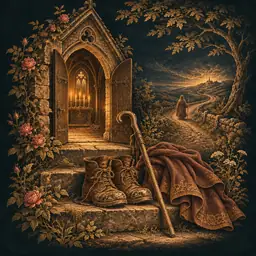
A pilgrimage is a journey to a holy place made for the sake of the place itself, kept in some form by nearly every religion, each with its own road and rules.
A lineage map for books and systems; it avoids presenting symbolic traditions as literal fact.
Understand the chapter you are in.
Your life’s turning points, measured from your birth.
Walk through Alex’s whole example first


Prefer to explore first?
 The Road of AgesThe turning points of your whole life, from your own chart
Walk my road
What makes a journey a pilgrimage?
A pilgrimage differs from other travel in its end and its manner. The end is a place held holy: a tomb, a river, a mountain, a city. The manner is set by custom: a known road, a dress or a badge, rites on the way and at arrival. The traveller is expected to come home changed, or at least thoughtful.
Islam asks the hajj to Mecca of every Muslim who is able. Hindus travel to river crossings and temple towns, Buddhists to the places of the Buddha's life, Jews in ancient times to the Temple at Jerusalem, Christians to Jerusalem, Rome and Santiago. Many people now walk the old roads with no religion at all.
On the tree of the hidden arts: Sacred places.
What sets Pilgrimage apart
A pilgrimage is defined by its road as much as by its goal. The same shrine reached by car in an afternoon is a visit; reached on foot over weeks it is something else, and every tradition knows the difference. The customs repeat across religions that never met: a plain dress, a token carried home, walking round the holy thing, hospitality owed to the traveller. The road also levels: on it a banker and a farmhand are both only pilgrims.
- Word: from Latin peregrinus, a stranger or traveller abroad
- Required in: Islam, as the hajj, for those able to make it
- Hindu name: tirtha yatra, a journey to a crossing place
- Buddhist sites: four places of the life of the Buddha, named in an early text
- Classic study: Victor and Edith Turner, 1978
Often mistaken for something else: Tourism goes to see a place and returns the same; pilgrimage goes to a place held holy, in a set manner, and expects the traveller to be altered.
The story behind Pilgrimage
The English word comes through French from Latin peregrinus, a stranger or one who travels abroad. An early Buddhist text names four places a follower should see, and the Hebrew Bible sets three pilgrim feasts in the year. Christian pilgrimage to the Holy Land is recorded from the fourth century, and Chaucer set his Canterbury Tales on a pilgrim road in the 1390s. In 1978 the anthropologists Victor and Edith Turner described how strangers on such a road come to treat one another as equals.
Why Pilgrimage matters
Pilgrimage is the form of religion that asks most of the body, and the one a person of no faith can most easily share.
How to read Pilgrimage
Scholars sort a journey as pilgrimage by three parts: leaving ordinary life, a time on the road outside it, and a return.
Pilgrimage in practice: an example
Someone at a turning point walks for a month to a far shrine, and says afterwards that the walking mattered more than the arriving.
Where readings of Pilgrimage go wrong
A long walk needs training and care of the feet, and a shrine of a living faith has its own rules of dress and entry.
Sources and editorial method
This entry summarizes the tradition in the Almanac's own words; where no source is listed, it is an editorial summary rather than a primary text, and symbolic readings are named as the tradition's, not as fact.
- Source
- The Great Almanac Dictionary
- Category
- Mystical Systems
- Aliases
- pilgrim, pilgrimage meaning, what is a pilgrimage, holy journey, sacred journey
- Last updated
- 2026-09-26
See Pilgrimage in your personal almanac
A definition tells you what it is; your own birth chart tells you what it means for you. The Oracle casts your real chart and answers for your love, your work, and your year ahead, in conversation. It opens with the 7-day Oracle trial.
Speak with the OracleRelated terms
More in Mystical Systems
- Savasana
- Temperance
- Western Esotericism
- Astral Projection
- Christian Theurgy
- Five Vayus
- Ifrit
- Melencolia I
From the reference page to your own chart
Every word here
is in your own chart.
- Your life’s turning points, measured from your birth
- A practical next step to consider
- It opens with 7 days free: the AI Oracle on thirty hidden arts, and your daily horoscope
$0 today, then $19/month after 7 days. Cancel anytime.
Common questions
What makes a journey a pilgrimage?
Its goal is a place held sacred, and it is made in a set way: by a known road, with customs along it. Tradition expects the pilgrim to be changed by the going as much as by the arriving.
Do you have to be religious to go on pilgrimage?
No road asks for proof of belief, though some holy cities admit only members of the faith. On the road to Santiago many walkers give reasons that are not, or not only, religious.
What are the best known pilgrimages?
The hajj to Mecca, the Kumbh Mela in India, the roads to Santiago, Rome and Jerusalem, the circuit of eighty-eight temples on Shikoku in Japan, and the walk round Mount Kailash in Tibet.


