

Mystical systems
Kumbh Mela
Direct answer
Kumbh Mela: The Kumbh Mela is a Hindu pilgrimage and fair held in turn at four river towns of India, where pilgrims bathe on set days in numbers that reach tens of millions.
$0 today, then $19/month after 7 days. Cancel anytime.
At a glance
- Also called
- kumbha mela, maha kumbh, hindu bathing festival
- Found in
- Mystical Systems
- Related
- Pilgrimage, Camino de Santiago, Temple
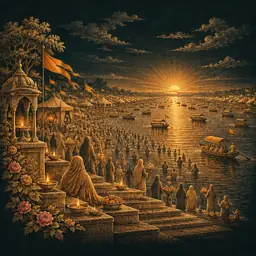
The Kumbh Mela is a Hindu pilgrimage and fair held in turn at four river towns of India, where pilgrims bathe on set days in numbers that reach tens of millions.
A lineage map for books and systems; it avoids presenting symbolic traditions as literal fact.
Understand the chapter you are in.
Your life’s turning points, measured from your birth.
Walk through Alex’s whole example first


Prefer to explore first?
 The Road of AgesThe turning points of your whole life, from your own chart
Walk my road
What is the Kumbh Mela?
Kumbh means a water pot and mela a fair or gathering. The tradition holds that when the gods and their rivals churned the ocean for the nectar of immortality, drops fell from the pot at four places: Prayagraj, where the Ganges and the Yamuna meet, Haridwar on the Ganges, Nashik on the Godavari and Ujjain on the Shipra. Bathing at these places at the right time is held to wash away wrongdoing.
Each town holds its fair about every twelve years, timed by the places of Jupiter, the Sun and the Moon among the signs. Orders of holy men bathe first, in procession, and the pilgrims follow. A city of tents is raised on the river flats for the weeks of the fair.
On the tree of the hidden arts: Sacred places.
What sets Kumbh Mela apart
Nothing else gathers so many people in one place by a rule of the sky. The dates are not fixed in the civil calendar; they are reckoned from where Jupiter, the Sun and the Moon stand, so each fair is announced by the almanac makers. The order of bathing is a matter of rank among the orders of ascetics and was once fought over with weapons. For the weeks of the fair a planned city with roads, bridges of boats and hospitals stands on ground that is river bed for the rest of the year.
- Name: kumbh, a pot, and mela, a fair
- Four sites: Prayagraj, Haridwar, Nashik and Ujjain
- Cycle: about twelve years at each site
- First to bathe: the orders of ascetics, in procession
- UNESCO: listed as intangible heritage in 2017
Often mistaken for something else: A yearly bathing fair is held at Prayagraj every winter; the Kumbh is the far greater gathering that comes round only when Jupiter returns.
The story behind Kumbh Mela
Bathing festivals at the rivers are very old, and a Chinese pilgrim of the seventh century described a great gathering at Prayag. Whether that was a Kumbh is debated. The name Kumbh Mela is found for Haridwar by the late seventeenth century, and historians date the fair at Prayagraj in its present form to the nineteenth. It is now counted the largest gathering of people anywhere: officials reported some thirty million bathers on a single day in 2013. UNESCO listed it as living heritage in 2017.
Why Kumbh Mela matters
Kumbh Mela shows a pilgrimage at the scale of a nation, kept by a calendar of the sky and run by the orders of a living faith.
How to read Kumbh Mela
Hindus speak of taking a holy dip at the Kumbh; the days are announced years ahead from the reckoning of the almanacs.
Kumbh Mela in practice: an example
A family travels overnight by train to bathe at dawn at the meeting of the rivers on the chief day, as their grandparents did.
Where readings of Kumbh Mela go wrong
People have died in crushes on the chief bathing days; the figures for attendance are official estimates and cannot be checked.
Sources and editorial method
This entry summarizes the tradition in the Almanac's own words; where no source is listed, it is an editorial summary rather than a primary text, and symbolic readings are named as the tradition's, not as fact.
- Source
- The Great Almanac Dictionary
- Category
- Mystical Systems
- Aliases
- kumbha mela, maha kumbh, kumbh mela prayagraj, hindu bathing festival, kumbh mela meaning
- Last updated
- 2026-09-26
See Kumbh Mela in your personal almanac
A definition tells you what it is; your own birth chart tells you what it means for you. The Oracle casts your real chart and answers for your love, your work, and your year ahead, in conversation. It opens with the 7-day Oracle trial.
Speak with the OracleRelated terms
More in Mystical Systems
- Myth of Er
- Pythia
- Solve et Coagula
- The Tower
- Adam Kadmon
- Bhagavad Gita
- Doggerland
- Great Pyramid of Giza
From the reference page to your own chart
Every word here
is in your own chart.
- Your life’s turning points, measured from your birth
- A practical next step to consider
- It opens with 7 days free: the AI Oracle on thirty hidden arts, and your daily horoscope
$0 today, then $19/month after 7 days. Cancel anytime.
Common questions
What is the Kumbh Mela?
It is a Hindu pilgrimage and fair at which people bathe in a sacred river on days fixed by the calendar. It is held in turn at Prayagraj, Haridwar, Nashik and Ujjain.
How often is the Kumbh Mela held?
Each of the four towns holds it about every twelve years, so one falls somewhere roughly every three years. Prayagraj and Haridwar also hold a half Kumbh midway between.
Why do pilgrims bathe at the Kumbh Mela?
The tradition holds that drops of the nectar of immortality fell at these four places, and that bathing there at the appointed time cleanses a person of wrongdoing.


