

Mystical systems
Camino de Santiago
Direct answer
Camino de Santiago: The Camino de Santiago, the Way of Saint James, is the network of pilgrim roads leading to the shrine of the apostle James at Santiago de Compostela in north-west Spain.
$0 today, then $19/month after 7 days. Cancel anytime.
At a glance
- Also called
- way of saint james, the camino, camino frances, road to santiago
- Found in
- Mystical Systems
- Related
- Pilgrimage, Kumbh Mela, Labyrinth
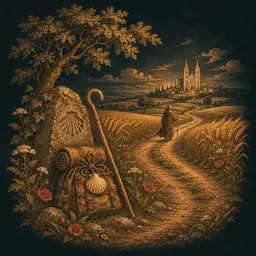

The Camino de Santiago, the Way of Saint James, is the network of pilgrim roads leading to the shrine of the apostle James at Santiago de Compostela in north-west Spain.
A lineage map for books and systems; it avoids presenting symbolic traditions as literal fact.
Understand the chapter you are in.
Your life’s turning points, measured from your birth.
Walk through Alex’s whole example first


Prefer to explore first?
 The Road of AgesThe turning points of your whole life, from your own chart
Walk my road
How long is the Camino de Santiago?
There is no single Camino. Roads from all over Europe join in Spain and end at the cathedral of Santiago de Compostela, where tradition places the tomb of James, one of the twelve apostles. The best known, the French Way, runs nearly eight hundred kilometres from the Pyrenees across the north of Spain, and most people take about five weeks to walk it.
Walkers carry a paper credential that is stamped at each night's lodging. Those who have covered at least the last hundred kilometres on foot may ask at Santiago for the Compostela, a certificate in Latin. The scallop shell is the badge of the road, and yellow arrows mark the way.
On the tree of the hidden arts: Sacred places.
What sets Camino de Santiago apart
The Camino is the one medieval pilgrim road in Europe that works today as it did then: a marked way with cheap shared lodging a day's walk apart and a credential that opens their doors. Its revival was the work of a few people in the 1980s, a priest with a tin of yellow paint among them. It is unusual, too, in keeping count: the pilgrim office records every certificate, with the walker's country, age, route and stated reason.
- Ends at: the cathedral of Santiago de Compostela, Galicia
- French Way: nearly 800 kilometres from Saint-Jean-Pied-de-Port
- Certificate: the Compostela, for the last 100 kilometres on foot
- Oldest guidebook: book five of the Codex Calixtinus, about 1140
- Badge: the scallop shell
Often mistaken for something else: The hajj is an obligation of a faith, open to its members only and kept on fixed days; the Camino is voluntary, open to all, and walked at any season.
The story behind Camino de Santiago
A tomb said to be that of James was reported in Galicia in the ninth century, and a church was built over it. By the twelfth century the road had hospices, bridges and a guidebook, the fifth book of the Codex Calixtinus of about 1140. Numbers fell away after the Reformation. A parish priest, Elías Valiña, began painting the yellow arrows in the 1980s, when a few thousand people a year arrived on foot; in 2023 more than four hundred thousand collected the certificate.
Why Camino de Santiago matters
Camino de Santiago is the old pilgrim road that has most fully come back to life, and it shows what the form still gives people.
How to read Camino de Santiago
Walkers speak of doing the Camino for a stage of a week or for the whole road, and return in later years to take up where they stopped.
Camino de Santiago in practice: an example
A walker leaves the Pyrenees in May with a pack and a shell and reaches the cathedral square five weeks and many blisters later.
Where readings of Camino de Santiago go wrong
The daily distances are hard on unprepared feet and joints: train beforehand, and ask a doctor first if health is in question.
Sources and editorial method
This entry summarizes the tradition in the Almanac's own words; where no source is listed, it is an editorial summary rather than a primary text, and symbolic readings are named as the tradition's, not as fact.
- Source
- The Great Almanac Dictionary
- Category
- Mystical Systems
- Aliases
- way of saint james, the camino, camino frances, road to santiago, santiago de compostela pilgrimage
- Last updated
- 2026-09-26
See Camino de Santiago in your personal almanac
A definition tells you what it is; your own birth chart tells you what it means for you. The Oracle casts your real chart and answers for your love, your work, and your year ahead, in conversation. It opens with the 7-day Oracle trial.
Speak with the OracleRelated terms
More in Mystical Systems
- Essential Oil
- Hildegard of Bingen
- Lyonesse
- Om Mani Padme Hum
- Rubedo
- Tai Chi Chuan
- Unitive Way
- Ancient Astronauts
From the reference page to your own chart
Every word here
is in your own chart.
- Your life’s turning points, measured from your birth
- A practical next step to consider
- It opens with 7 days free: the AI Oracle on thirty hidden arts, and your daily horoscope
$0 today, then $19/month after 7 days. Cancel anytime.
Common questions
How long is the Camino de Santiago?
It depends on the road. The French Way from Saint-Jean-Pied-de-Port is close to eight hundred kilometres and takes about five weeks on foot. Many people walk only the last hundred kilometres.
Is Saint James really buried at Santiago?
The church holds that he is, and bones found in 1879 were declared his by the Pope in 1884. Historians find no early evidence that James was ever in Spain and regard the tomb as a matter of faith.
What is the Compostela?
It is the certificate given by the pilgrim office at Santiago to those who have walked at least the last hundred kilometres, or cycled the last two hundred, and had their credential stamped on the way.


