Sigils and symbols
Labyrinth
Direct answer
Labyrinth is a single-path walking or drawn pattern used for pilgrimage, contemplation, journey symbolism, prayer, and sometimes mythic descent.
Labyrinth means a winding single path for symbolic journey, prayer, or contemplation.
$0 today, then $12/month after 7 days. Cancel anytime.
At a glance
- Found in
- Sigils, Seals & Symbols
- Related
- Sacred Symbol, Sigil, Discernment, Spell
Labyrinth means a winding single path for symbolic journey, prayer, or contemplation.
A conceptual orientation, not an exact historical reproduction of every mark or seal.
What does your own chart say about you?
Choose love, work or purpose. Your reading is written from your chart. Your reading uses your own birth details.
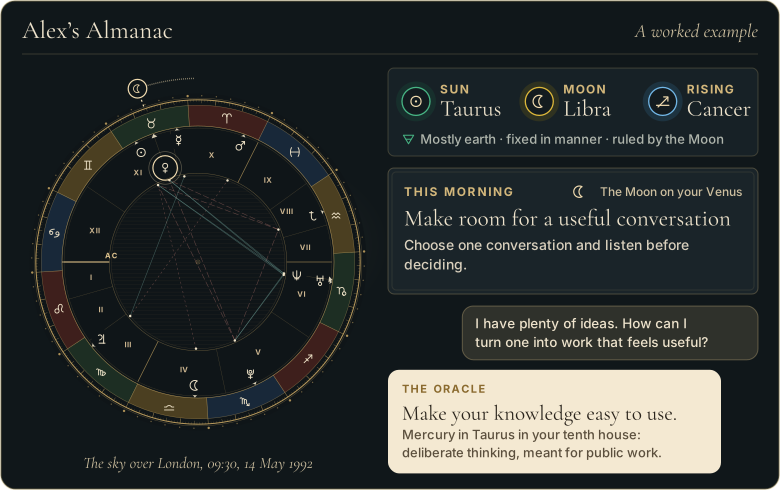
Walk through Alex’s whole example first
 The Road of AgesSee the turning points of your whole life, from your birth date
See your road's shape
The Road of AgesSee the turning points of your whole life, from your birth date
See your road's shape
Prefer to explore first?
 The Road of AgesThe turning points of your whole life, from your own chart
Walk my road
The Road of AgesThe turning points of your whole life, from your own chart
Walk my road
Free, by email
Your daily Almanac letter
One short letter at 7 each morning: the day’s theme read for your own chart, and one thing to do with it.
The story behind Labyrinth
Labyrinths appear in ancient myth, Roman floors, medieval churches such as Chartres, garden designs, and modern contemplative practice.
The spiritual meaning of Labyrinth
Spiritually, Labyrinth asks how a winding path can still move toward center and return.
Labyrinth in the Bible
Christian prayer may use walking and pilgrimage imagery, but the pattern itself is not a spiritual mechanism.
Why Labyrinth matters
Labyrinth matters because it differs from a maze: the aim is journey and return, not puzzle-solving or entrapment.
Where readings of Labyrinth go wrong
The usual misreading is to treat labyrinth walking as divination, therapy, or mystical guarantee.
Sources and editorial method
This entry summarizes the tradition in the Almanac's own words; where no source is listed, it is an editorial summary rather than a primary text, and symbolic readings are named as the tradition's, not as fact.
Recorded here as history and symbol. No rite is taught on this page.
- Source
- The Great Almanac Dictionary
- Category
- Sigils, Seals & Symbols
- Last updated
- 2026-09-26
Walk symbols with humility
A definition tells you what it is; your own birth chart tells you what it means for you. The Oracle casts your real chart and answers for your love, your work, and your year ahead, in conversation. It opens with the 7-day Seeker trial.
Speak with the OracleYour year, written once from your chart alone: the Cosmic Codex reads the whole of it, month by month. Open the Cosmic Codex
Related terms
More in Sigils, Seals & Symbols
- Mirror Symbol
- Rod of Asclepius
- Solar Cross
- Triangle
- Aegishjalmur
- Bodhi Tree Symbol
- Crucifix
- Eye of Horus
From the reference page to your own chart
Every word here
is in your own chart.
- A personal reading about love, work or purpose, written from your chart
- A practical next step to consider
- It opens with 7 days free, with the AI Oracle and daily guidance
$0 today, then $12/month after 7 days. Cancel anytime.
Common questions
What is a labyrinth?
Labyrinth is a single-path walking or drawn pattern used for pilgrimage, contemplation, journey symbolism, prayer, and sometimes mythic descent.
Where does a labyrinth come from?
Labyrinths appear in ancient myth, Roman floors, medieval churches such as Chartres, garden designs, and modern contemplative practice.
What does a labyrinth mean spiritually?
Spiritually, Labyrinth asks how a winding path can still move toward center and return.
What do people get wrong about a labyrinth?
The usual misreading is to treat labyrinth walking as divination, therapy, or mystical guarantee.
Free, by email
The Almanac, in your inbox at 7
One short letter at 7 each morning: the day’s theme read for your own chart, and one thing to do with it.