

Mystical systems
Great Pyramid of Giza
Direct answer
Great Pyramid of Giza: The Great Pyramid of Giza is the tomb of the Egyptian king Khufu, finished about 2560 BCE: the oldest and largest of the three pyramids on the Giza plateau.
$0 today, then $19/month after 7 days. Cancel anytime.
At a glance
- Also called
- pyramid of khufu, pyramid of cheops, who built the great pyramid, giza pyramid
- Found in
- Mystical Systems
- Related
- Megalith, Stonehenge, Temple
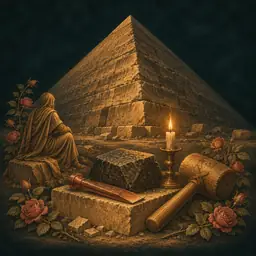

The Great Pyramid of Giza is the tomb of the Egyptian king Khufu, finished about 2560 BCE: the oldest and largest of the three pyramids on the Giza plateau.
A lineage map for books and systems; it avoids presenting symbolic traditions as literal fact.
Understand the chapter you are in.
Your life’s turning points, measured from your birth.
Walk through Alex’s whole example first


Prefer to explore first?
 The Road of AgesThe turning points of your whole life, from your own chart
Walk my road
Who built the Great Pyramid?
The Great Pyramid stood about 146 metres high on a base some 230 metres to a side, and was built of roughly 2.3 million blocks. Most are limestone quarried a few hundred metres away; the smooth white casing, now almost all gone, came from Tura across the Nile, and the granite of the burial chamber from Aswan, far to the south. For nearly four thousand years nothing taller was built by human hands.
Great Pyramid of Giza’s sides face north, south, east and west to within a small fraction of a degree. Inside are three chambers, a tall sloping gallery and narrow shafts. It is the only one of the seven wonders of the ancient world that still stands.
On the tree of the hidden arts: Sacred places.
What sets Great Pyramid of Giza apart
No other ancient building is so large and so exact at once. The base is level to within a couple of centimetres, and its four sides are equal to within a tiny part of their length. The builders reached that with cords, plumb lines, water and the stars. The pyramid also keeps the records of its own making: quarry marks, levelling lines, the names of the gangs, and at a harbour far away the logbook of a crew that supplied it.
- Built for: Khufu, Fourth Dynasty, finished about 2560 BCE
- Height: about 146 metres when new, about 138 now
- Base: about 230 metres each side
- Blocks: roughly 2.3 million
- Logbook: the papyri of Merer, found at Wadi al-Jarf in 2013
Often mistaken for something else: The pyramids of Khafre and Menkaure beside it are later and smaller; Khafre's looks taller only because it stands on higher ground and keeps some casing at its tip.
The story behind Great Pyramid of Giza
Great Pyramid of Giza was built for Khufu, second king of the Fourth Dynasty, in a reign of more than twenty years. Gangs left his name in red paint in sealed spaces above the burial chamber, found in 1837. A town of the builders of the next two reigns was excavated from 1988 and tombs of workers were found in 1990. In 2013 papyri found at a harbour on the Red Sea gave the logbook of a boat crew that carried casing stone to the site in the last years of the reign. Herodotus, two thousand years later, told of a hundred thousand men forced to the work; the evidence is of fed and housed work gangs.
Why Great Pyramid of Giza matters
Great Pyramid of Giza is the monument most often given to someone other than its builders, and the one for which the builders are best documented.
How to read Great Pyramid of Giza
Egyptologists treat it as the high point of a line of experiments that runs from the step pyramid at Saqqara through the bent one at Dahshur.
Great Pyramid of Giza in practice: an example
Asked whether a lost people built it, a reader can name the inspector Merer, whose own logbook of stone deliveries survives.
Where readings of Great Pyramid of Giza go wrong
Climbing it is against Egyptian law, and the passages inside are steep, hot and close: they are not for anyone unwell.
Sources and editorial method
This entry summarizes the tradition in the Almanac's own words; where no source is listed, it is an editorial summary rather than a primary text, and symbolic readings are named as the tradition's, not as fact.
- Source
- The Great Almanac Dictionary
- Category
- Mystical Systems
- Aliases
- great pyramid, pyramid of khufu, pyramid of cheops, who built the great pyramid, giza pyramid
- Last updated
- 2026-09-26
See Great Pyramid of Giza in your personal almanac
A definition tells you what it is; your own birth chart tells you what it means for you. The Oracle casts your real chart and answers for your love, your work, and your year ahead, in conversation. It opens with the 7-day Oracle trial.
Speak with the OracleRelated terms
More in Mystical Systems
From the reference page to your own chart
Every word here
is in your own chart.
- Your life’s turning points, measured from your birth
- A practical next step to consider
- It opens with 7 days free: the AI Oracle on thirty hidden arts, and your daily horoscope
$0 today, then $19/month after 7 days. Cancel anytime.
Common questions
Who built the Great Pyramid?
Egyptian work gangs in the reign of King Khufu, about 4,500 years ago. A town, bakeries, tools and tombs of the pyramid builders, mostly of the next two reigns, have been excavated beside the plateau, and a logbook of stone deliveries survives.
Was the Great Pyramid built by slaves?
The evidence says no. The workers were housed, fed on bread, beer and meat, treated for injuries and buried with honour near the king they served.
How long did it take to build?
About twenty years, within the reign of Khufu. That means setting a block every few minutes through the working day, which is why the logistics impress engineers more than any mystery does.


