
Andrew Jackson Davis
1826 to 1910
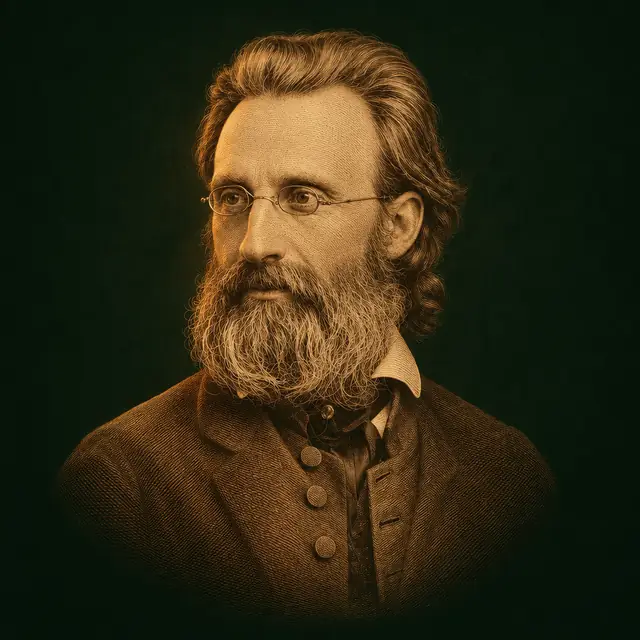
Who was Andrew Jackson Davis, and what is truly known of them?
What is known
American clairvoyant, born in Orange County, New York, with little schooling and apprenticed to a shoemaker at Poughkeepsie. A local tailor mesmerised him in 1843, and in trance he began to describe illnesses. Between 1845 and 1847, in New York, he dictated in that state a long book on the origin of the world and the life after death, The Principles of Nature, Her Divine Revelations, which a clergyman took down. The Great Harmonia followed from 1850. He named the next world the Summerland, founded Sunday schools called Children’s Progressive Lyceums in 1863, took a medical degree in the 1880s, and ended as a physician and bookseller in Boston.
The teaching
Taught from his trance books, above all The Principles of Nature (1847) and The Great Harmonia (1850 to 1861).
The Univercoelum
The Principles of Nature begins before the worlds. In the beginning, Davis teaches, the universe was one boundless ocean of liquid fire, which he calls the Univercoelum, without form but full of motion, and in it the Great Positive Mind, the source of all. By its motion the fire gathered into suns, and the suns gave birth to planets, each cooling and ripening until it could bear life. All of it came about by law, and the same law is working still.
God and nature are not two. God is the Great Positive Mind, the soul and moving power of the universe, and nature is its body, the negative in which it works. There are no miracles, since nothing breaks the law, and no revelation greater than nature itself, which is the true word of God.
The law of progression
Everything rises. The mineral prepares the plant, the plant the animal and the animal the human being, each the crown of the order below it and the ground of the order above, and the human being is nature's highest work on earth, the place where its long climb becomes conscious of itself. The same law goes on after death, as the spirit rises through finer and finer conditions toward its source. There was no fall of man and there is no eternal punishment. What is called evil is immaturity and disorder, a stage to be outgrown.
Death, the second birth
The Great Harmonia describes death as Davis says he watched it in trance at a deathbed. The spiritual principle withdrew from the feet and hands toward the brain; a luminous atmosphere gathered above the head; within it a body formed, the spiritual body, the same person in finer substance; a thread of vital life joined it for a while to the old body, and when the thread parted the new body rose free. Death in this teaching is a second birth into a higher life.
The Summerland
The world beyond has a place. A Stellar Key to the Summer Land teaches that the finest particles rising from the suns and planets gather far out among the stars into a broad zone of refined matter, and that this zone is the Summerland, the home of the dead. It has ground, rivers, groves and dwellings. Its people live in societies drawn together by affinity, each finding the company that suits its nature, and they go on learning and rising there as they did on earth. The book gives diagrams of where the zone lies, out in the Milky Way.
Health as harmony
The first volume of The Great Harmonia, The Physician, teaches that the body is the instrument of the spirit and that health is harmony, the even flow of the spiritual principle through the body. Disease is its disturbance, an excess or a want in one part, and healing is the restoring of balance by right living: fresh air, water, sunlight, plain food, work and rest, and above all a calm mind. Davis gave remedies from his trances; the house teaches his doctrine of harmony and none of them, and no part of it stands in place of a doctor.
The calm mind is the heart of the whole philosophy. His autobiography takes its title from that rule, which he says was shown him in vision written on a staff: under all circumstances keep an even mind.
The Diakka
Davis kept his Harmonial Philosophy apart from the séance, and he warned against it. In the lower reaches of the Summerland, he teaches, live the Diakka, spirits who left the body clever but unformed in heart: idle and without conscience, they amuse themselves by deceiving the living, speaking through mediums under great names, playing tricks and leading the credulous on. A message is therefore to be judged by its reason and its goodness, never by the name it claims, and the true use of the world of spirit is the growth of one's own mind and life.
The Children's Progressive Lyceum
For children Davis made a school without a creed. In the Children's Progressive Lyceum they were taught in small groups by age, under names drawn from nature such as Fountain, Stream, River and Lake, and the hour joined singing, marching with banners, light exercises of the body, readings spoken in turn and questions answered by the children themselves. Its aim is harmonial: body, mind and spirit grown together, the child drawn out rather than filled up, and no doctrine pressed on it.
Orders and memberships
No order is documented. Spiritualists called him their forerunner, since his first book appeared the year before the rappings at Hydesville, but he kept his “Harmonial Philosophy” apart from the séance and in later years criticised it.
The legend
That his trance books foretold the motor car, the typewriter and the coming of Spiritualism. Passages are read that way after the event. Critics at the time pointed out how closely the first book follows Swedenborg, whom he said he had never read.
Their works
- The Principles of Nature, Her Divine RevelationsBook, 1847
The long book he dictated in trance in New York between 1845 and 1847, taken down by the clergyman William Fishbough, on the origin of the world and the life after death. It appeared the year before the rappings at Hydesville, and Spiritualists counted him their forerunner. Critics noted how closely it follows Swedenborg.
Ask the Oracle about it - The Great HarmoniaBook, 1850 to 1861
Several volumes on the physician, the teacher, the seer, the reformer and the thinker, setting out what he called the Harmonial Philosophy. It was read across the early Spiritualist movement.
Ask the Oracle about it - The Magic StaffBook, 1857
His autobiography, telling of his poor childhood, his apprenticeship to a shoemaker at Poughkeepsie and his first trances under a tailor who mesmerised him. It is the main source for his early life.
Ask the Oracle about it - A Stellar Key to the Summer LandBook, 1867
His account of the Summerland, the next world as he described it, with diagrams of where it lies among the stars. The name Summerland passed into Spiritualism and later into modern Paganism.
Ask the Oracle about it
How the house tells a life
This life is told from the record, with what is documented, what is legend and what was forged kept apart. A membership in an order is stated only where documents show it. A person’s chart explains none of their deeds.
The arts it feeds
Lives near it in time
Lives and legends
Marie LaveauEdward Bulwer-LyttonAllan KardecAlbert PikeÉliphas LéviPaschal Beverly RandolphHelena BlavatskyHenry Steel OlcottDaniel Dunglas HomeThe Fox sistersAnna KingsfordAnnie BesantThe whole tree

