
Marie Laveau
1801 to 1881
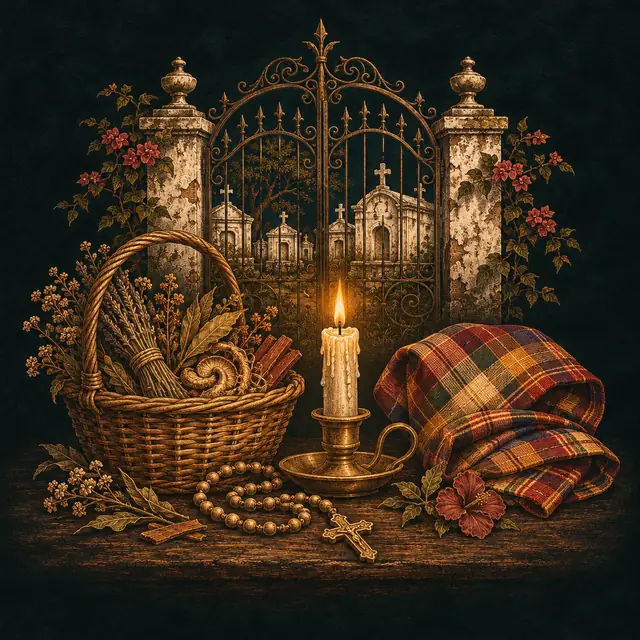
Who was Marie Laveau, and what is truly known of them?
What is known
A free woman of colour of New Orleans, baptised there in 1801. Church records show her marriage to Jacques Paris in 1819 and, after his death, a long union with Christophe Glapion, with whom she had children. She was a Catholic all her life and a priestess of Vodou, the religion that West African and Haitian people had brought to Louisiana, and newspapers of her day called her its queen. The same papers record her nursing the sick in the yellow fever epidemics and sitting with men condemned to hang. She died in June 1881 and was buried in St Louis Cemetery No. 1.
The teaching
Taught from what the newspapers of her city recorded of her rites, with Zora Neale Hurston's Hoodoo in America (1931).
The Church and the spirits
Marie Laveau kept two services side by side. She heard Mass and kept her place in the cathedral parish, and she served the spirits of New Orleans Vodou, the religion that West African and Haitian people had brought to the city. In that faith God is above all, and beneath Him the spirits and the honoured dead come near to help the living; many of the spirits are honoured in the figures of the Catholic saints, so that a statue of St Peter or of the Virgin on a home altar can stand for a power of Africa as well.
The altar and the service
The service centres on the altar: statues of the saints, candles, flowers, and offerings of food and drink set out for the spirits, before which the priestess prays, sings and calls. In the larger rites that the newspapers describe there is drumming, song in Louisiana Creole and dancing, and a spirit may come down and mount a dancer, as the faith says, moving in the dancer's body; the priestess leads the gathering, keeps its order and speaks with the spirits on its behalf. The snake is honoured as the sign of a great spirit, the Damballah of Haiti, whom old New Orleans called Li Grand Zombi.
St John's Eve
The great feast of the year is St John's Eve, the night of 23 June, when the faithful gather by the water on the shores of Bayou St John and Lake Pontchartrain. The newspapers of her later years tell of fires on the shore, a shared meal, songs and dances through the night and washing in the lake at midnight, and some of them name Marie Laveau as the queen who led it. The feast of the saint who baptised in the Jordan is kept with water and with fire.
Gris-gris and the work
People came to the priestess for help in the trials of life: love, health, money, a case in the courts, an enemy. Her answer is the work: prayers and candles at the altar for the one who asks, and gris-gris, small charms of cloth holding herbs, roots, stones and other small things, blessed and given to be carried or kept for protection and luck. The herbs of the craft went into baths and teas as well, and some of them are poisons; the house teaches them as the craft's lore and gives no recipes.
Mercy for the sick and the condemned
The priestess's service reaches those whom others leave alone. In the epidemics she nursed the sick, and she went to men condemned to hang, prayed with them and set up an altar in the condemned cell with candles and the images of the saints, so that no man went to his death without prayer. In her faith the care of the dying is part of the service owed to God, to the saints and to the spirits.
Orders and memberships
No order is documented, and Vodou has no lodge: it is a religion served by priestesses and priests, of whom she was the best known in her city. She kept her place in the Catholic parish of St Louis Cathedral to the end.
The legend
That she never aged, ruled the city through secrets heard while dressing ladies’ hair, and kept a great snake. A daughter of the same name seems to have followed her, which would explain the first; no record shows her working as a hairdresser; and most of the rest was written by journalists after her death and gathered in a book of 1946. Marking her tomb with crosses is a visitors’ custom of the twentieth century.
Their works
- Hoodoo in AmericaAccount, 1931
A long study by the writer Zora Neale Hurston, printed in the Journal of American Folklore, from her work among practitioners in New Orleans. It records the stories still told of Marie Laveau and the people who claimed her line.
Ask the Oracle about it - Voodoo in New OrleansAccount, 1946
A popular book by Robert Tallant that gathered the newspaper tales written after her death into a single picture of the Voodoo Queen. Much of the legend of her ageless power and her snake comes from it.
Built largely on tales printed after her death, not on records of her life.
Ask the Oracle about it - Voodoo Queen: The Spirited Lives of Marie LaveauBiography, 2004
A life of Laveau by the anthropologist Martha Ward, setting her among the free people of colour of New Orleans. It argues that a daughter of the same name carried on her work, which would explain the legend that she never aged.
Ask the Oracle about it - A New Orleans Voudou PriestessBiography, 2006
A study by the historian Carolyn Morrow Long of the legend and reality of Marie Laveau, built on church, court and city records. It is the most careful account of what can be known of her life.
Ask the Oracle about it
How the house tells a life
This life is told from the record, with what is documented, what is legend and what was forged kept apart. A membership in an order is stated only where documents show it. A person’s chart explains none of their deeds.
The arts it feeds
Lives near it in time
Lives and legends
EtteillaCount CagliostroAdam WeishauptNapoleon BonaparteMarie Anne LenormandFrancis BarrettEdward Bulwer-LyttonAllan KardecAlbert PikeÉliphas LéviPaschal Beverly RandolphAndrew Jackson DavisThe whole tree

