
Planetary rulerships
The old scheme that gave each plant and stone a planet.
What are the planetary rulerships of herbs and stones in the old traditions?
What plants, scents and stones have stood for in the traditions, and how to use them for the senses and the attention. They are symbols here, never medicine, and nothing is swallowed or put on the skin.
What each has stood for, and safe uses
Ask the OracleWhat do herbs, oils and stones stand for in the traditions, and how do I use them safely?
Plants, scents and stones were the stuff of religion and of medicine alike for most of history. Resins were burned in temples, herbs were hung over doors, and stones were worn for what they were believed to do. Old books gave each plant and stone a planet, a sign and a purpose, and those tables of likeness, the magical correspondences, are still printed today.
The house reads all of it as symbol and as something for the senses: what a thing has stood for, how it smells, what it is like to hold. It is not medicine. Nothing here is swallowed or put on the skin, smoke and flame are treated with care, and the claims made for crystals and oils are set beside what has actually been tested.
As the old natural magic of virtues and correspondences teaches it.
The old books of plants, scents and stones begin from one idea: every thing in nature has virtues, powers that belong to it and that it can share with what comes near it. Some of a thing's virtues follow from what it is made of, its heat or coolness, its moisture or dryness. Others follow from no element at all, but from the whole form and kind of the thing. These the books call occult virtues, occult meaning only hidden, because their cause lies out of sight and they are known only by what they do. The classic example is the lodestone, which draws iron to itself though nothing in its heat or cold accounts for it.
Herbals, lapidaries and books of perfume are therefore all books of virtues, setting down what each plant, stone or scent was held to do and to mean, and by what signs it was known. To learn this art is to learn that language, in which everything else in it is written.
The ground of the virtues is the four elements. Fire is hot and dry, air hot and moist, water cold and moist, and earth cold and dry, and every bodily thing is a mixture of them in its own proportion. A plant's temperature, as the herbals call it, is that proportion: it is hot or cold, moist or dry, each in one of four degrees, and the degrees are taught with the planets on Planetary rulerships.
The old physicians read a plant's qualities with their senses. What bites the tongue or brings tears, mustard, garlic and onion, is hot; what is watery and bland, lettuce, cucumber and purslane, is cold and moist. The senses were the first instruments of the art, and they remain the way a student comes to know a thing, though here they are used to look, to smell and to hold, and never to taste.
The second foundation is that the world is one living body, and a person a small copy of it, the microcosm answering to the macrocosm. In Agrippa's teaching the world has a soul, and the virtues of things are poured into them from the ideas in the divine mind, through that soul and by the rays of the stars. Between the soul of the world and its body runs the spirit of the world, a fine and quick medium, almost not a body at all, and through it the hidden virtues reach the things that hold them.
Marsilio Ficino gives a person the same three parts: a soul, a body, and between them a spirit, a fine, warm vapour made from the purest blood by the heat of the heart, which the soul uses as its instrument. What feeds this spirit most readily is what is most like it: light, clean air, music and sweet odours. That is why scent and smoke stand near the centre of this art, and why Ficino sends the melancholy scholar out into sunlight, among green and fragrant things.
The rays of the stars carry the virtues, and the seven planets of the old sky give them their families. In their old order, from the farthest inward, they are Saturn, Jupiter, Mars, the Sun, Venus, Mercury and the Moon. Each has a nature: Saturn cold and dry, slow and heavy; Jupiter warm and moist, temperate and generous; Mars hot and dry, sharp and fierce; the Sun hot and dry, bright and royal; Venus moist and temperate, sweet and lovely; Mercury changeable, taking on the nature of whatever it joins; and the Moon cool and moist, pale and quick to grow.
Everything that shares a planet's nature belongs to its family, and the family runs through every kingdom of nature at once: a metal, a stone, a plant, a scent, a colour, a creature and a day of the week. Gold, the marigold that turns to follow the light, frankincense and Sunday belong together under the Sun; lead, the onyx, the binding herbs and Saturday under Saturn. These chains are the magical correspondences. A thing shows its family by its look, its taste and smell, where it grows and what it does, and the doctrine of signatures adds that nature marks each thing with a sign of its use, though some of the plants with the handsomest signs are poisons. The whole of each family, herb by herb, is taught on Planetary rulerships.
The art meets its things in three ways. A resin or a dried herb is given to fire, and what is best in it rises as smoke, which the traditions read as prayer going up and as the hallowing of a place; this is the teaching of Incense and smoke. A plant's scent is drawn off by steam or by pressing into a few drops of essential oil, its volatile part concentrated far beyond the leaf or the flower; this is the teaching of Oils and scent. A stone is not changed at all. It is worn, carried or set where it can be seen, and its virtue was held to work by nearness and touch; this is the teaching of Stones and crystals.
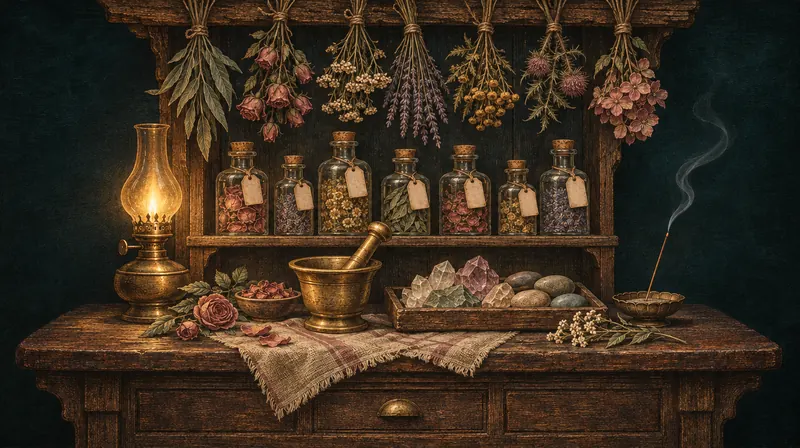
A fourth way gathers the other three. A shelf or a small table set apart, holding a sprig, a grain of resin and a stone of one family, is at once the household shrine of many peoples and the planetary table of Ficino and Agrippa, and it is taught on A small table.
The herbals carry their warnings inside their teaching. The strongest herbs, hot or cold in the fourth degree, are the ones that blister the skin or stupefy the senses, and Saturn's family holds most of the deadly plants, hemlock, henbane, mandrake and the nightshades among them. Paracelsus put the rule in a sentence: all things are poison and none is without poison, and only the dose makes a thing not a poison. That is why no dose of anything is given here, and nothing is taken inwardly.
The house adds the limits that using these things for the senses requires. Nothing in this art is swallowed, and no oil goes on the skin; no stone is put in drinking water and no crystal water is drunk; smoke is kept small, with a window open and the flame always watched. Many herbs and oils are harmful in pregnancy and to children, cats, dogs and birds, so the label, a doctor or a vet comes first, and nothing here stands in for treatment.
A student begins by coming to know three things well, one of each kind: a plant, a resin and a stone. A sprig of rosemary or bay from the kitchen, a few tears of frankincense in a dish, and a common stone such as a piece of rock crystal or a smooth pebble, chosen for its colour and its weight in the hand, will do. Each is met the old way, through the senses first: looked at in daylight, smelled, the stone held and turned, and each impression written down before anything is read about it.
Only then does the student look the thing up: its element and temperature, its planet and its day, what the herbals, the rites and the lapidaries say of it, and what it has stood for. Rosemary turns out to be the Sun's in Culpeper and remembrance in Shakespeare; frankincense is the Sun's resin, and the gift the Fathers of the Church read as owed to God; the stone has its own story. Over a month the three become familiar, as a word in a new language does, and the student adds a fourth.
On a thing's own day it may be set out and sat with for a few minutes, a sprig of the Sun's on a Sunday, a stone of Venus on a Friday. And a ceremony that belongs to a people is left to them: the four sacred medicines of many nations of North America are taught by their own elders, in their own communities. A reader outside them who wishes to burn something burns a pinch of rosemary, and calls it rosemary.
Planetary rulerships is the grammar of the art: the seven planets and their natures, their herbs, stones and metals, and their days and hours. It is the page to read first, because every other page uses its words. The three pages after it each take one kind of thing: Incense and smoke, then Oils and scent, then Stones and crystals. Each teaches what the traditions have said of its things, with what has been tested set beside it.
A small table comes last, because it gathers all the rest: the household shrines of many lands, the planetary table of the natural magicians, the four elements at their quarters and the table that follows the season. A student who has read the other four pages can set one out with understanding, and keep it safely.
Herbs, oils and stones are spoken of here as symbols and for the senses, not as medicine. Do not swallow any herb, oil or crystal water on the Oracle’s word; many are harmful in pregnancy and to children and animals. Nothing here replaces treatment from a doctor.
Each one is a question you can ask.
The old scheme that gave each plant and stone a planet.
What are the planetary rulerships of herbs and stones in the old traditions?
Frankincense, myrrh and the rest: what each has stood for.
What have frankincense, myrrh and other incense stood for in the traditions?
What tradition says of them, and what has not been shown.
What do the traditions say of crystals and stones, and what is actually known?
For the senses only, and with care.
How do I use scented essential oils safely, for the senses only?
A few things set out as a place for attention.
How do I set up a simple table of herbs and stones as a place for attention?
Each opens its page in the dictionary.
Swiss physician and alchemist, born Theophrastus von Hohenheim. He turned alchemy towards medicine, brought minerals and chemicals into the pharmacy, and taught that the dose makes the poison. A treatise printed after his death (1566) describes the four kinds of elemental beings: gnomes, undines, sylphs and salamanders.
Florentine priest, physician and scholar, head of the circle the Medici gathered at Careggi. He put all of Plato into Latin and, before it, the Corpus Hermeticum, which he believed as old as Moses. His Three Books on Life (1489) teach how to temper the planets within oneself by music, scent, food and image, and are the first book of what is now called psychological astrology. He gave the West the phrase “Platonic love” and the idea of one ancient theology running from Hermes to Plato.
Hildegard of BingenAlbertus MagnusArnald of VillanovaCirceMarie Laveau
The spirit realmThe Tree of LifeAlchemyThe Hermetic principlesSacred geometry
Make today specific
The same sky reaches everyone differently. Your birth details turn a general forecast into one theme, and one thing worth doing about it.
One instrument, one answer. Explore the preview; membership opens every tool.
Read more

