
A small table
A few things set out as a place for attention.
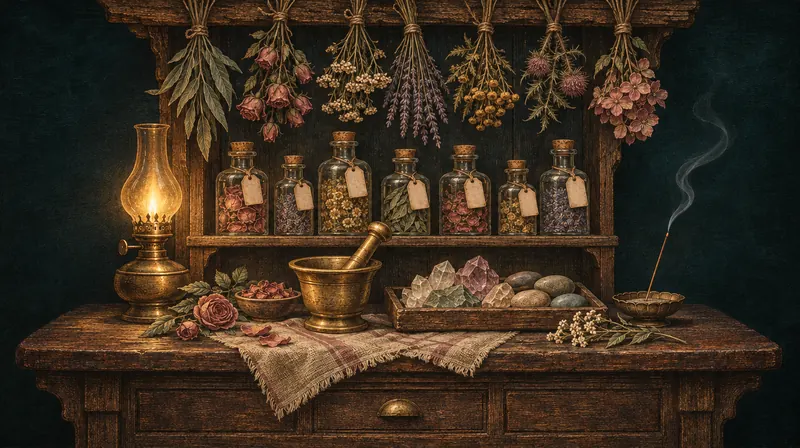
How do I set up a simple table of herbs and stones as a place for attention?
What it is
A small table is a place set aside for attention: a shelf or a corner with a few chosen things on it. Homes have had them in every culture. The Romans kept a shrine to the household spirits, Orthodox Christians keep an icon corner, Japanese homes a shelf for the kami or for the ancestors, and Mexican families build an ofrenda for the Day of the Dead. A reader's own can be as plain as a cloth, a stone, a sprig and a bowl of water.
The teaching
As the custom of the household shrine in many lands teaches it.
A place set apart
In every tradition that keeps one, a household shrine is a small place set apart from ordinary use, so that attention has somewhere to go. It is made clean before anything is put on it, and kept clean. It is placed where it can be seen and where it will not be knocked or used for other things. It is tended at fixed times, and the things on it are chosen because they mean something, not because they are many. What follows is how several peoples have kept such a place, and how the old natural magic set out a table for a single planet.
The Roman lararium
A Roman house kept a shrine to its Lares, the guardian spirits of the household: a niche or a little temple near the hearth or the kitchen, painted with the Lares as dancing youths pouring wine, the genius of the head of the family making an offering, and a serpent, the spirit of the place. A little food from the meal, wine and incense were offered there. On the first day of the month, on the Nones and the Ides and on feast days, as Cato writes, the household hung a garland over the hearth and prayed to the Lar. A boy who came of age dedicated his childhood amulet, the bulla, to the Lares.
The beautiful corner
An Orthodox home keeps its icons in one corner, called in Russian the beautiful corner, set toward the east where it can be: Christ, the Mother of God and the saints of the family, with a small oil lamp burning before them. Prayers are said there morning and evening, and a guest entering the room greets the icons first. Blessed things are kept beside them, water from the feast of the Theophany, palms from Palm Sunday, candles from the night of Easter. The icon, in this teaching, is a window, and the honour given to it passes to the one it shows.
The god-shelf and the Buddhist altar
A Japanese home may keep a kamidana, a god-shelf set high on a wall facing south or east, holding a small shrine and the paper talismans of the great shrine at Ise and of the local shrine. Each morning water, rice and salt are offered, with sake on the first and fifteenth of the month and fresh sprigs of the evergreen sakaki, and the household bows twice, claps twice and bows once.
Many homes also keep a butsudan, the Buddhist altar for the family's dead, with a principal image of the Buddha and the memorial tablets of the ancestors. Before it a candle is lit, incense is offered, flowers, rice and tea are set out, and a small bell is struck.
The ofrenda
For the Day of the Dead, Mexican families build an ofrenda, an offering table for those who have died, often in tiers. On it go photographs of the dead; candles to light their way; marigolds, whose colour and scent are said to guide them home, sometimes laid in a path of petals; cut paper banners, the bread of the dead and sugar skulls; the food, drink and small pleasures each one loved; water for the thirst of the journey, salt, and copal burning. The dead are welcomed for the night and remembered by name.
Shrines of daily worship
A Hindu home keeps a shrine, a shelf or a small room, for the images of the family's gods. Daily worship there follows a pattern of welcome: the lamp is lit, incense is offered, water, flowers and food are presented, a bell is rung, and the flame is waved before the image in the rite called aarti. The food offered is then shared as prasad, the god's gift returned.
A Chinese home may keep an altar of the ancestors, with their tablets and a burner for incense, where sticks are lit and food is set out at the new year and on the days of remembrance.
A table for one planet
The Renaissance natural magic of Marsilio Ficino and Agrippa used the correspondences to gather the things of a single planet in one place, so that the place would take in that planet's life. For the Sun one would bring gold, saffron and the bright colours, frankincense, cinnamon and the bay; for Venus roses, myrtle and sweet scents, and white, green and rosy colours; for Jupiter the oak, the sapphire and the colours of the air.
Ficino advised the learned, whom he thought prone to the melancholy of Saturn, to draw on the three kindly planets he called the Graces, Jupiter, the Sun and Venus, through their colours, their scents, their foods, their music, and walks in sunlight among green things.
The four elements
Many modern traditions of Western magic set the four elements on the table, each at its quarter, after the order of the Golden Dawn: air in the east, as incense or a feather; fire in the south, as a candle; water in the west, as a bowl or a cup; earth in the north, as a stone, salt or a dish of soil. The elements stand for the whole world gathered into a small space, and the one who sits before them sits, as it were, at its centre.
A table for the season
A table can also follow the year. Schools in the Waldorf tradition keep a nature table, where children set out what they find on their walks, buds, shells, leaves, conkers and seeds, on a cloth whose colour changes with the season. Modern pagans mark the eight festivals of the wheel of the year in the same way: snowdrops at Imbolc, eggs and spring flowers at the spring equinox, flowers at midsummer, grain at the harvest, apples and the memory of the dead at Samhain. The table changes as the world outside does, and that is its teaching.
Keeping it
Every tradition above asks the same of its keeper: a fixed time, a small act and steady care. Fresh water each morning, the flower changed when it fades, the dust wiped away, the light lit and put out; a bow, a word or a minute of silence. The act is small so that it can be kept, and it is kept so that the place stays alive. In those traditions the food that is offered is afterwards shared and eaten; on the house's table there is no food, so that nothing spoils and nothing tempts a child or an animal.
Safe keeping
A flame on a table is never left alone, and it stands in a holder that cannot tip, away from curtains and books and out of the reach of children and cats. Incense is burned as the teaching on smoke describes. Lilies, all of them, with their pollen and even the water in their vase, can kill a cat, and foxglove, oleander and lily of the valley are poisonous to people and to pets, so the flowers on a table are chosen with care. Small stones are a choking danger for small children.
How it is practised
The reader clears a small surface and chooses a few things that mean something: a stone, perhaps a birthstone; a fresh sprig or flower, changed when it fades; a bowl of water; a grain of frankincense in a dish, unlit, or a candle that is never left alone. They sit before it for a few minutes each day at the same hour. The things are there to be looked at and to mark the place. Nothing on the table is eaten or drunk.
Where it comes from
The Roman household shrine was the lararium, where a little food and incense were offered each day. In the Russian tradition the icon corner is called the beautiful corner. Renaissance writers on natural magic, Ficino and Agrippa among them, used the magical correspondences to gather the things of one planet in one place, so that a table for the Sun might hold gold cloth, a marigold and frankincense. Modern books on herbs and crystals have turned that idea into the home altar.
What is known, and what is not
Household shrines are documented across cultures and ages. What a table does for the person who keeps it is a matter of habit and attention: a fixed place and time make a pause easier to keep. One set of experiments published in 2014 reported that people who performed small rituals after a loss felt more in control; it has not been widely repeated. No object on the table has been shown to do anything by itself.
Its words
- Birthstone
- The gem assigned to the month of a person's birth. The modern list was agreed by American jewellers in 1912.
- Frankincense
- The fragrant resin of Boswellia trees from Arabia and the Horn of Africa, burned as incense in temples and churches for some four thousand years.
- Magical Correspondences
- The tables of likeness that link each planet with its own plants, stones, metals, colours and scents, used in astrology and ritual.
Ask the Oracle further
Which herbs and crystals belong on a small table for the season I am in?What did household shrines hold before anyone sold crystals for them?
Before you practise
Herbs, oils and stones are spoken of here as symbols and for the senses, not as medicine. Do not swallow any herb, oil or crystal water on the Oracle’s word; many are harmful in pregnancy and to children and animals. Nothing here replaces treatment from a doctor.
Its other branches
Planetary rulershipsIncense and smokeStones and crystalsOils and scentThe whole artSearch the tree

