
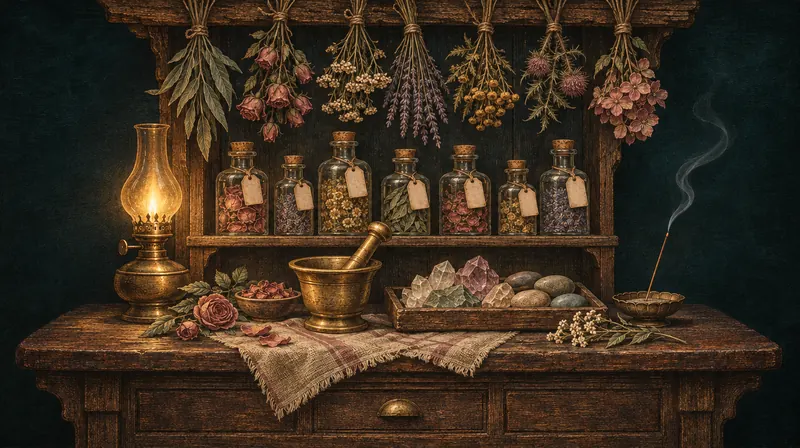
What have frankincense, myrrh and other incense stood for in the traditions?
What it is
Incense is fragrant plant matter burned for its smoke: resins, woods, barks and leaves. The two most famous are frankincense and myrrh, both resins that seep from small trees of the dry lands of Arabia and the Horn of Africa. The fragrant wood called palo santo, from Ecuador and Peru, is burned in sticks, and dragon's blood is a deep red resin that comes from several unrelated trees. The rising smoke has stood for prayer going up, for the presence of the holy, and for the cleansing of a place. Smudging is the English name for the burning of sacred plants in the ceremonies of many Indigenous peoples of North America.
The teaching
As the long tradition of sacred incense teaches it.
What is burned
Incense is fragrant matter burned for its smoke. Resins are the oldest and the most prized: frankincense, myrrh, benzoin, storax, labdanum, mastic and the copal of the Americas. Woods follow, sandalwood, cedar and the dark, resin-soaked aloeswood of Asia; then barks and spices such as cinnamon and cloves; then leaves and herbs, bay, juniper, rosemary and sage. They are burned loose on a glowing coal, pressed into cones and sticks, or kneaded with honey into small balls.
Frankincense
Frankincense is the milky resin of small Boswellia trees of southern Arabia and the Horn of Africa, gathered as tears where the bark is cut and graded by its paleness. Its smoke is bright, lemony and clean. In the traditions it is the incense of the divine: of worship offered to God, of purity, and of prayer rising. When the Magi bring it to the child in Matthew's gospel, the Fathers of the Church read it as the gift owed to God, beside gold for a king and myrrh for one who would die.
Myrrh
Myrrh is the bitter resin of thorny Commiphora trees from the same lands, and its name comes from the Semitic word for bitter. It is the scent of mortality and also of love. Egypt used it in embalming, and in the Gospel of John, Nicodemus brings a mixture of myrrh and aloes, about a hundred pounds' weight, for the burial of Jesus. Yet the Song of Songs says, 'A bundle of myrrh is my well-beloved unto me', and in the book of Esther the women of the palace are prepared for six months with oil of myrrh. Bitterness, death and desire meet in it.
The holy incense
Exodus gives the incense of the tabernacle exactly: 'sweet spices, stacte, and onycha, and galbanum; these sweet spices with pure frankincense: of each shall there be a like weight', blended by the art of the apothecary, pure and holy. Stacte is a resin gathered in drops; onycha is taken by some for the shell-lid of a sea snail and by others for a resin; galbanum is a bitter gum. It was burned on a golden altar every morning and every evening, and its recipe was forbidden for any private use. Rabbinic tradition counts eleven spices in the incense of the Temple.
In the book of Revelation the smoke of the incense rises with the prayers of the saints before God. That is the meaning incense has kept in Jewish and Christian worship: what is offered goes up, and the scent fills the holy place.
Egypt's three offerings
Plutarch records that the priests of Egypt offered incense to the Sun three times a day: resin at sunrise, to purify and quicken the heavy air of the night; myrrh at midday, to scatter the thick vapours the Sun draws up from the earth; and kyphi at sunset. Kyphi was compounded of sixteen things, among them honey, wine, raisins, resin, myrrh, mastic, two kinds of juniper berry, cardamom and calamus, mixed while sacred writings were read aloud to the perfumers. Its scent, he says, brought sleep, loosened the knots of the day's cares, and brightened the imagination as a mirror is brightened, so that dreams came clearer.
A fume for each planet
Agrippa gives the fumes of the planets by the part of the plant. To Saturn belong the fragrant roots; to Jupiter the fragrant fruits, such as nutmeg and cloves; to Mars the fragrant woods, such as sandalwood, cypress and aloeswood; to the Sun the gums and resins, frankincense, mastic, benzoin, storax and labdanum; to Venus the flowers, roses and violets; to Mercury the peels and the seeds, cinnamon, cassia, mace and citron peel; and to the Moon the leaves, of the myrtle and the bay. A sweet and precious fume, he adds, belongs to every good work.
Copal and the four medicines
In Mesoamerica the incense of the gods was copal, the resin of tropical trees, burned by the Maya and the Aztecs in their temples. It is burned still, in village churches, in rites of healing and on the altars of the Day of the Dead.
Further north, many Anishinaabe, Cree and other nations teach four sacred medicines, tobacco, sage, sweetgrass and cedar, whose smoke carries prayer and cleanses; the burning of them is what English calls smudging. That ceremony is theirs to lead and to teach, and its teaching is given in their own communities, by their own elders.
Sandalwood and aloeswood
In India sandalwood is the scent of worship: burned as incense, ground into a paste for marking the brow and anointing images, and carved into sacred things, because its fragrance is held to cool and calm the mind and to last. Aloeswood, also called agarwood or oud, is the heartwood of Aquilaria trees, darkened with resin where the tree has fought an infection. It is among the costliest of all incense, and prized from Arabia to Japan.
Listening to incense
Japan made of incense an art, kodo, the way of fragrance, in which one is said not to smell an incense but to listen to it. A sliver of aloeswood is warmed on a thin plate over charcoal buried in ash in a small cup, which passes from guest to guest; each holds it close, breathes in, and attends. Aloeswoods are sorted into six kinds, most of them named after the lands they were thought to come from, and their scents into five tastes: sweet, sour, hot, salty and bitter.
In the game called Genji-ko five portions, drawn at random from five kinds of incense, are burned one after another, the guests judge which of them were the same, and each of the fifty-two possible patterns bears the name of a chapter of The Tale of Genji. The ten virtues of incense, traditionally credited to the Song poet Huang Tingjian and spread in Japan, some say, by the monk Ikkyu, praise it among other things as a companion in solitude, a moment of peace amid busy affairs, and a thing that satisfies even in a small amount.
Censing in church
In the churches of East and West the censer is swung before the altar, the gospel book, the icons, the clergy and the people, and the coffin at a funeral. Its smoke honours what it reaches, marks it as set apart for God, and rises, as the Revelation shows it, with the prayers of those present. In the Orthodox churches the deacon censes each icon and then the people, honouring in each of them the image of God.
Burning it safely
The traditions burn a little, and so does the house. One stick or cone, or a pinch of resin on a charcoal disc, set in a holder that cannot tip, on sand or ash in a bowl that can take the heat, with the charcoal lifted by tongs and never by the fingers. A window stays open, for smoke is smoke, and burning charcoal in a closed room gives off carbon monoxide. Nothing burns unwatched, near curtains or paper, or within reach of a child or a pet; birds, whose lungs are delicate, are kept well away, and so is anyone with asthma. A minute of the scent is enough, and the rite asks no more.
How it is practised
A reader who burns incense keeps it small and safe: one stick, or a pinch of resin on charcoal, in a holder that cannot tip, with a window open, never left burning and never near a child, a pet or a curtain. The scent is the point, and a minute of sitting with it is enough. Smudging belongs to the peoples whose ceremony it is; a reader outside them can burn a garden herb such as rosemary and call it what it is.
Where it comes from
Egypt burned incense daily in its temples and made a compound called kyphi, whose recipe is carved on temple walls. The incense of the Temple in Jerusalem, as Exodus describes it, contained frankincense, and a psalm asks that prayer rise like it. The Gospel of Matthew has the Magi bring gold, frankincense and myrrh. Churches of East and West still swing censers. In Japan the appreciation of fine incense became an art, kodo, in which one is said to listen to the scent.
What is known, and what is not
The religious use of incense is documented across four thousand years. Its smoke is also smoke: studies of homes and temples link heavy, regular burning with fine particles in the air and irritation of the lungs, which is the reason for the open window. That smoke clears bad energy from a room is the belief of those who say so. White sage has been taken from the wild in great quantity, and Native voices have asked that it not be bought as a product.
Its words
- Frankincense
- The fragrant resin of Boswellia trees from Arabia and the Horn of Africa, burned as incense in temples and churches for some four thousand years.
- Myrrh
- The bitter, fragrant resin of Commiphora trees, used in the ancient world for incense, perfume and the anointing of the dead.
- Kyphi
- The compound incense of the Egyptian temples, made of raisins, wine, honey and resins and burned at nightfall, as Plutarch reports.
- Palo Santo
- Holy wood: the fragrant heartwood of a tree of the dry forests of Ecuador and Peru, burned in sticks. Where it was gathered is worth asking.
- Dragon's Blood
- A deep red resin sold under one name from several unrelated trees and palms, known since antiquity as pigment, varnish and incense.
- Smudging
- The English name for the burning of sacred plants such as sage, sweetgrass and cedar in the ceremonies of many Indigenous peoples of North America.
Ask the Oracle further
What was in the incense burned in the temples of Egypt and Jerusalem?Is it respectful for me to practise smudging, and what could I burn instead?
Before you practise
Herbs, oils and stones are spoken of here as symbols and for the senses, not as medicine. Do not swallow any herb, oil or crystal water on the Oracle’s word; many are harmful in pregnancy and to children and animals. Nothing here replaces treatment from a doctor.
Its other branches
Planetary rulershipsStones and crystalsOils and scentA small tableThe whole artSearch the tree

