
Planetary rulerships
The old scheme that gave each plant and stone a planet.
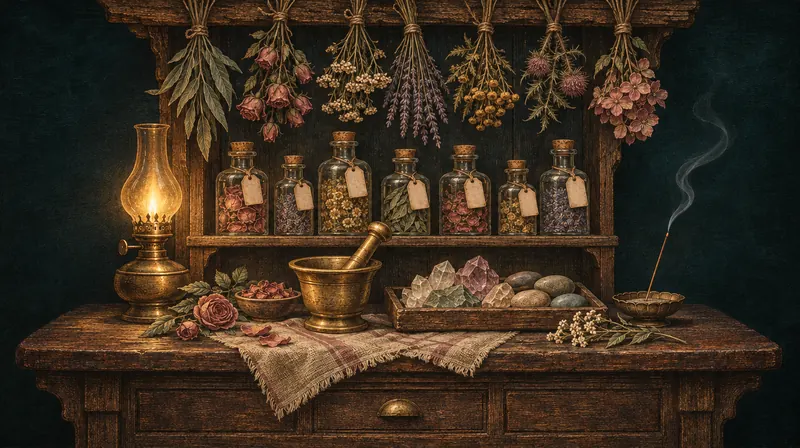
What are the planetary rulerships of herbs and stones in the old traditions?
What it is
The old scheme gave every plant and stone a ruling planet. Hot, sharp and thorny plants went to Mars; fragrant, golden ones that turn to the light went to the Sun; cool and watery ones to the Moon; sweet-scented flowers to Venus. A related belief, the doctrine of signatures, held that a plant's shape or colour was a sign of its purpose. The lists of such links are known as magical correspondences. Custom honoured plants of its own: mugwort for the road and the midsummer fire, vervain for oaths, mistletoe for midwinter.
The teaching
As the astrological herbal of Nicholas Culpeper teaches it.
Like to like
Culpeper's herbal rests on one picture of the world. The creation is a single body made of contrary elements held in harmony, and a human being is an epitome of it, a small world answering to the great. The stars move the great world, and their motions show in the body and in every herb, so a physician who would know why an herb works must, as he says, look up as high as the stars. Each plant therefore has a governing planet, and its virtues are that planet's nature acting through it.
Two rules join the planets to the cure. 'Sympathy and antipathy,' he writes, 'are two hinges upon which the whole mode of physic turns.' By sympathy every planet cures its own diseases: the herbs of the Sun and the Moon cure the eyes, Saturn's the spleen, Jupiter's the liver, Mars's the gall, and Venus's the organs of generation. By antipathy a disease is opposed with the herbs of the opposite planet: Jupiter's with Mercury's, those of the Sun and Moon with Saturn's, and Mars's with Venus's, each also the other way about.
How a plant shows its planet
A plant shows its ruler by its look, its taste and smell, the place it grows and what it does. Agrippa says the same of all things: they are known by their likeness to the heavens in figure and motion, by their colours and odours, and by the effects of their working. Culpeper argues it plainly of wormwood: 'What delights in martial places, is a martial herb'; wormwood grows about forges and ironworks, so it is Mars's. Henbane grows rank in ditches and by the places where filth is emptied, which are Saturn's places, so it is Saturn's, and he scolds the astrologers who gave it to Jupiter.
Beside the planets stands the doctrine of signatures, taught by Paracelsus and Jakob Böhme: nature marks each thing with a sign of what it is for. The walnut, with a kernel like the brain and a shell like the skull, was for the head; lungwort, its leaves spotted like diseased lungs, for the chest; eyebright, its flower marked like an eye, for the sight; St John's wort, its leaves pricked with holes, for wounds; and yellow flowers and saps for jaundice. The signature was taught as a sign for remembering, and several plants with handsome signatures are poisonous.
Heat, cold and their degrees
Every herb has a temperature as well, hot or cold, moist or dry, graded in four degrees. An herb hot in the first degree is as warm as the body's own heat and cherishes it; in the second it is somewhat hotter; in the third it is so hot that it can cause a fever if it is given unwisely; in the fourth it burns and blisters the skin, as mustard seed and crowfoot do. Cold descends by the same four steps, and in the fourth it stupefies the senses, as hemlock and henbane do. Moisture never passes the second degree. Of cucumbers Culpeper says that if they were one degree colder they would be poison: the strongest herbs were the most dangerous, and the old books say so.
The Sun
The Sun's herbs are warm, golden and cordial, and turn toward the light; they strengthen the heart and the vital spirit, and the eyes, which the two lights of heaven rule. Culpeper gives the Sun rosemary, angelica, marigolds, saffron, St John's wort, eyebright, celandine, rue and the bay tree, which, he says, resists witchcraft very potently. Agrippa adds the plants that turn to follow the Sun, the marigold and the heliotrope, with peony, balm, ginger, gentian and vervain, the cedar, the palm, the ash, the ivy and the vine, and among sweet things frankincense, saffron, cinnamon, cloves and yellow honey.
The Moon
The Moon's herbs are cool and moist, watery, pale and quick to grow. Culpeper gives her lettuce, which cools and moistens the heat that Mars causes, cucumbers, purslane, chickweed, watercress, the white lilies and the water lilies, the willow, and the poppy, from whose juice, he notes, opium is made. Agrippa gives her the plants that follow her as the heliotrope follows the Sun, with hyssop, the chaste tree, the olive and rosemary, which Culpeper gave to the Sun. Among stones she has crystal, pearl, beryl and the stone the old books call selenites, said to hold a little moon that waxes and wanes with hers.
Mercury
Mercury, quick and changeable, rules herbs of mixed nature, fine leaves and subtle scent, and the brain. Culpeper gives him lavender, which, he says, carries his effects very potently, with fennel, dill, caraway, parsley, sweet marjoram, valerian and the hazel. Agrippa adds cinquefoil, the herb mercury, fumitory and pimpernel, and all plants with small leaves and mixed colours.
Venus
Venus rules sweet, soft and lovely herbs, flowers of scent, and the herbs of love and of women's bodies. Culpeper gives her violets, a fine pleasing plant of Venus, of a mild nature; thyme, yarrow, vervain, mint, mugwort, feverfew, cowslips, the elder, and the foxglove, which is a deadly poison. Of roses, after a jibe at how much the authors have quarrelled over them, he rules that red roses are under Jupiter, damask under Venus, white under the Moon, and Provence roses under the King of France. Agrippa adds maidenhair, coriander and the myrtle, valerian, which Culpeper gave to Mercury, the sweet perfumes, ladanum, musk and sandalwood, and the sweet fruits, pears, figs and pomegranates.
Mars
Mars rules the hot, sharp, biting and thorny: herbs that sting, burn the tongue or bring tears, and that grow by forges and fires. Culpeper gives him nettles, garlic, which he calls the poor man's treacle, onions, mustard, wormwood, basil, hops, barberry and the hawthorn. Basil, he reports, is an herb all the authors are at odds about, Galen and Dioscorides against Pliny and the Arabians; he settles it as Mars's, under Scorpio, and repeats the old tales that it breeds venomous creatures. Agrippa adds the radish, the laurel, the leek, the hellebores and wolfsbane, and all plants that are poisonous through too much heat.
Jupiter
Jupiter, warm, moist and generous, rules the liver and the blood, and the herbs that nourish and cleanse. 'Jupiter claims this,' Culpeper says of sage, 'and bids me tell you, it is good for the liver, and to breed blood.' He gives Jupiter borage and bugloss, dandelion, betony, agrimony, hyssop, balm, the docks, sweet cicely, liverwort, lungwort, the red rose and the oak. Agrippa gives him the lucky trees, the oak, the beech, the hazel, the olive, the vine and the fruit trees, with mint, mace and the violet, and among stones the sapphire, the beryl and green jasper.
Saturn
Saturn, cold, dry and slow, rules the spleen, the bones and melancholy, the herbs that bind, cool and bring sleep, and most of the deadly ones. Culpeper gives him comfrey, which he takes to be under Capricorn, cold, dry and earthy; mullein, shepherd's purse, ivy, horsetail, Solomon's seal, the beech and the elm; and hemlock, henbane and the nightshades. Agrippa adds the daffodil, cumin, hellebore and the mandrake, rue, which Culpeper gave to the Sun, and all dark, heavy and earthy things.
Here the herbal's warnings are part of the teaching. Hemlock, henbane, mandrake, deadly nightshade, wolfsbane, the hellebores and foxglove are poisons that have killed people who handled them as remedies, and comfrey, once a great wound herb, is now known to harm the liver when it is taken inwardly. They are named here for what they have meant, and never to be gathered, brewed or eaten.
Stones and metals of the seven
Agrippa's scale of the number seven gives each planet a metal and a stone: to Saturn lead and the onyx; to Jupiter tin and the sapphire; to Mars iron and the diamond; to the Sun gold and the carbuncle; to Venus copper and the emerald; to Mercury quicksilver and the agate; to the Moon silver and crystal. Elsewhere he gives longer lists: to Mars also the lodestone, the bloodstone and the amethyst; to Venus the carnelian, lapis lazuli and coral; to the Sun the chrysolite, the hyacinth and the heliotrope, which was said to turn the Sun's rays the colour of blood. The metals agree from author to author, and the stones differ from book to book.
Days, hours and gathering
Each planet rules a day as well: Sunday the Sun, Monday the Moon, Tuesday Mars, Wednesday Mercury, Thursday Jupiter, Friday Venus and Saturday Saturn, as the names of the days still show in many tongues. Culpeper tells his reader to gather each herb in the hour of the planet that governs it, with that planet strong in the sky, and angelica, an herb of the Sun, when the Sun is in Leo. Agrippa adds that the herbs of Saturn, Mars and Jupiter are gathered facing east or south, and those of Venus, Mercury and the Moon facing west or north.
In this house the reader keeps the calendar and the colours and leaves the medicine: a sprig on its planet's day is looked at and smelled, and nothing is taken on the strength of a star. Many herbs are harmful in pregnancy and to children and animals, and quicksilver and the poisonous plants are not handled at all.
How it is practised
The scheme is used here as a language of symbol. A reader who knows which planet is strong in their chart, or which planet has the day, can look up the plants tradition gives to it and bring one into the room: a sprig of rosemary on a Sunday, a bowl of lavender by the desk. The plant is looked at and smelled. Nothing is eaten, brewed or put on the skin on the strength of a planet.
Where it comes from
Greek and Arabic astrology already matched plants and stones to planets, and Agrippa printed long tables of them in 1533. Paracelsus and, after him, Jakob Böhme taught that nature is marked with signatures to be read. In England Nicholas Culpeper gave each herb a planet in 1652: rosemary to the Sun, lettuce to the Moon, lavender to Mercury, violets to Venus, nettles to Mars, sage to Jupiter and comfrey to Saturn. William Coles set out the signatures in 1657.
What is known, and what is not
The correspondences are well documented as a tradition, and they differ from author to author. No physical link between a planet and a plant has been found. The doctrine of signatures fails as a guide to what plants do: birthwort, long given in childbirth because of the shape of its flower, damages the kidneys. Mandrake and belladonna, both famous in the old lore, are poisonous in every part. Historians think the signs were often noticed after a use was already known, as an aid to memory.
Its words
- Magical Correspondences
- The tables of likeness that link each planet with its own plants, stones, metals, colours and scents, used in astrology and ritual.
- Doctrine of Signatures
- The old belief that a plant's shape or colour is a sign of what it is good for, as the walnut was said to be for the head.
- Mugwort
- Artemisia vulgaris, a bitter wayside herb of travellers and the midsummer fire in European lore. Kept for scent and symbol, never eaten or brewed.
- Vervain
- Verbena officinalis, a slight roadside plant that the Romans called the sacred herb and carried when treaties were made.
- Mistletoe
- The evergreen that grows on the branches of trees: sacred to the Druids in Pliny, fatal to Baldr in Norse myth, and poisonous if eaten.
- Mandrake
- A poisonous Mediterranean plant whose forked root looks like a small human figure, and the subject of the legend of the root that screams.
- Belladonna
- Deadly nightshade: a woodland plant with black berries, poisonous in every part, named in the lore of witches and given to Saturn.
Ask the Oracle further
Which herbs did Culpeper give to the planet that rules my chart?Is there any truth in the doctrine of signatures for herbs?
Before you practise
Herbs, oils and stones are spoken of here as symbols and for the senses, not as medicine. Do not swallow any herb, oil or crystal water on the Oracle’s word; many are harmful in pregnancy and to children and animals. Nothing here replaces treatment from a doctor.
Its other branches
Incense and smokeStones and crystalsOils and scentA small tableThe whole artSearch the tree

