
Stones and crystals
What tradition says of them, and what has not been shown.
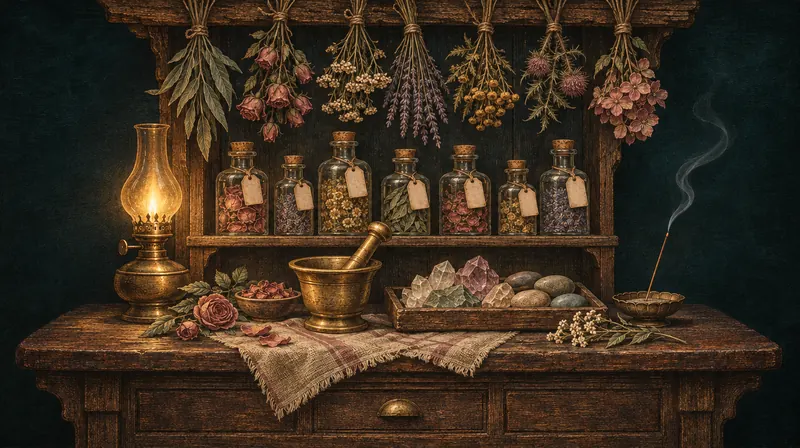
What do the traditions say of crystals and stones, and what is actually known?
What it is
Stones have been worn and carried for what they were believed to do for as long as there are records. Amethyst was said to keep its wearer sober, coral to guard children, bloodstone to stop bleeding. A book that lists such powers is called a lapidary. A birthstone is the gem given to the month of a person's birth. Today the same beliefs are sold under the name of crystal healing, with clear quartz, amethyst and rose quartz the favourites.
The teaching
As the lore of the lapidaries and the crystal books after them teaches it.
The lapidary's art
A lapidary is a book of stones, and its teaching is that every stone has virtues of its own, given by its nature, its colour and the star it answers to. Some virtues come from the name, as the amethyst's from a Greek word meaning not drunk; some from the look, as red stones were given to the blood and green ones to the eyes; some from the stone's behaviour, as amber and the lodestone draw things to themselves. The virtue was held to work by nearness and touch: a stone was worn, set in a ring or carried, and some books held that its power was greatest when an image proper to its planet was engraved on it at the right hour.
Amethyst
The special and traditional virtue of the amethyst was against drunkenness: worn on the body, it kept its owner sober, and wine drunk from an amethyst cup was said to do no harm. Later books widened its power, to govern evil thoughts, to quicken the wits and to cool the passion of love. Agrippa gives it to Mars. A French poem of the Renaissance tells how the maiden Amethyst, fleeing the tigers of Bacchus, was turned by Diana into white stone, and how the repentant god poured wine over her and gave the stone its violet.
Bloodstone
The bloodstone is a dark green stone flecked with red, called by the ancients heliotrope, the sun-turner: plunged into a vessel of water and set in sunlight, it was said to turn the Sun's reflection the colour of blood. Its traditional virtue was to stop bleeding. Christian legend read its red flecks as the blood of Christ, so that gem cutters carved the thorn-crowned head of Christ with the spots for drops of blood. Pliny reports, and mocks, the magicians' claim that with the herb of the same name it made its wearer invisible.
Coral, amber and jet
Red coral guards. Hung on infants, Pliny says, it was believed to protect them, and it was carried against storms at sea, against the evil eye and against bleeding. In Italian belief it keeps its power only if it is unworked and worn where it can be seen; broken, it loses its virtue, and it grows pale when its wearer is ill.
Amber, rubbed, draws straws and feathers to itself, and its Greek name, elektron, gave the language the word electricity. Jet, the black stone of Whitby, does the same when rubbed; it was carved into amulets against the evil eye and, in Victorian Britain, into the jewellery of mourning. One caution belongs here: amber necklaces sold for teething babies can choke or strangle a child, and doctors advise against them.
Lodestone
The lodestone, the natural magnet, was the stone of attraction and of love. Plato's Socrates compares inspiration to it: the Muse draws the poet as the magnet draws an iron ring, and the ring draws another, and so on down a chain of reciters and hearers. The Greek poem on stones called the Lithica says that a lodestone laid under the head of a sleeping wife makes her embrace her husband if she is faithful, and start from the bed in terror if she is not. Agrippa gives it both to Mars and to Saturn.
Emerald and sapphire
The emerald belongs to Venus. Pliny says that no colour is more restful to the eye than its green, and that gem engravers refreshed their tired eyes by gazing at it; Nero, he says, watched the gladiators in an emerald. The medieval books held that it revealed whether a lover's oaths were true, and Albertus Magnus tells of a king of Hungary whose emerald broke in three when he embraced his wife.
The sapphire, the colour of a clear sky, is the stone of heaven. Agrippa gives it to Jupiter, it was set in the rings of bishops, and it was worn for peace of mind and for the favour of God.
Diamond and turquoise
The diamond took its name from the Greek adamas, the unconquerable, for its hardness, and so it was thought to give victory, strength and courage. Pliny says that only the blood of a goat, fresh and warm, could soften it. Marbode makes it a guard against terrors of the night, set in gold and worn on the left arm, and a later writer calls it the gem of reconciliation, which kept a husband's love.
The turquoise protected its rider from falling, and was said to change its colour with the health of its wearer. A jester of the Emperor Charles V, asked what the property of the turquoise was, answered that if you fell from a high tower wearing one, the turquoise would not break.
Rock crystal
Rock crystal was believed to be ice frozen so long and so hard that it could never melt again, which is what its Greek name means, and in China and Japan the same belief gave it a name meaning water crystal. Clear and without colour, it was the stone of the Moon and of clear sight. Polished into a ball or a flat stone, it was gazed into for visions, as John Dee's scryer Edward Kelley gazed into his shew-stone. In Japan it was the perfect jewel, and its smaller pieces were said to be the congealed breath of the white dragon.
The stones of the months
The modern birthstones give each month a gem, with a second stone in some months: January the garnet; February the amethyst; March the bloodstone or the aquamarine; April the diamond; May the emerald; June the pearl or the moonstone; July the ruby; August the sardonyx or the peridot; September the sapphire; October the opal or the tourmaline; November the topaz; December the turquoise or the lapis lazuli. Later lists have added other stones, but this is the list on which the custom rests.
The crystal books of today
The modern crystal books teach that each stone has its own vibration, which meets the body's energy field and can steady or lift it. Stones are laid on the energy centres of the body, carnelian low on the belly, rose quartz over the heart, blue stones at the throat and amethyst at the brow or the crown. They are carried for a purpose: rose quartz for love and for love of oneself, amethyst for calm and sleep, clear quartz as a master stone that strengthens the others.
A new stone is cleansed, by running water, moonlight, smoke, sound or burying in earth, and charged in sunlight or moonlight. Then it is programmed: held while the intention it is to keep is spoken or pictured, and afterwards kept where it will be seen.
Keeping stones safely
Stones are for the eye and the hand. Some minerals are toxic: malachite holds copper, cinnabar mercury, galena lead and realgar arsenic, so their dust is not breathed and hands are washed after holding them. Others, such as selenite and halite, dissolve or crumble in water, so the water cleansing of the crystal books is not for them, and amethyst, rose quartz and some fluorite fade in strong sun. No stone is put in drinking water, and no gem water is drunk. Small stones are kept from small children and from pets, who may swallow them.
How it is practised
A stone is used here as an object for attention. A reader chooses one because they like its colour or weight, or because tradition gives it to their month or planet, and keeps it where it will be seen: on a desk, in a pocket. Picking it up becomes a cue to stop for a breath and recall an intention. Stones are not swallowed and crystal water is not drunk; some minerals shed harmful dust or dissolve, so they stay dry and whole.
Where it comes from
Theophrastus wrote on stones about 300 BCE, and Pliny gathered Roman gem lore in 77 CE while mocking much of it. Marbode of Rennes put sixty stones into Latin verse in the late eleventh century. Exodus describes a priestly breastplate set with twelve stones for the twelve tribes; the historian Josephus linked them with the months and the zodiac, which is the root of the birthstone. The present list was fixed by American jewellers in 1912. The modern crystal movement dates from the 1970s and 1980s.
What is known, and what is not
The lore is well documented. The effects are not. In a study presented in 2001 the psychologist Christopher French gave people either quartz crystals or glass fakes to hold; both groups reported the same tingling and warmth, and those told what to expect reported more. Quartz does give a tiny electric charge when squeezed, which is why it is used in watches, but that has nothing to do with mood. Reporters have also found child labour in some mines that supply the trade.
Its words
- Lapidary
- A book that describes stones and the powers once believed to belong to them; also the craft of cutting and polishing gems.
- Birthstone
- The gem assigned to the month of a person's birth. The modern list was agreed by American jewellers in 1912.
- Amethyst
- Purple quartz, named from the Greek for not drunken and long worn in the belief that it kept its wearer sober. The birthstone of February.
- Crystal Healing
- The modern practice, dating from the 1970s and 1980s, of placing or carrying stones for wellbeing. Tests point to expectation, not to the stone.
Ask the Oracle further
What did the old books of gemstones say about the stone of my birth month?Why do people feel something when they hold crystals?
Before you practise
Herbs, oils and stones are spoken of here as symbols and for the senses, not as medicine. Do not swallow any herb, oil or crystal water on the Oracle’s word; many are harmful in pregnancy and to children and animals. Nothing here replaces treatment from a doctor.
Its other branches
Planetary rulershipsIncense and smokeOils and scentA small tableThe whole artSearch the tree

