
Arnald of Villanova
About 1240 to 1311
Who was Arnald of Villanova, and what is truly known of them?
What is known
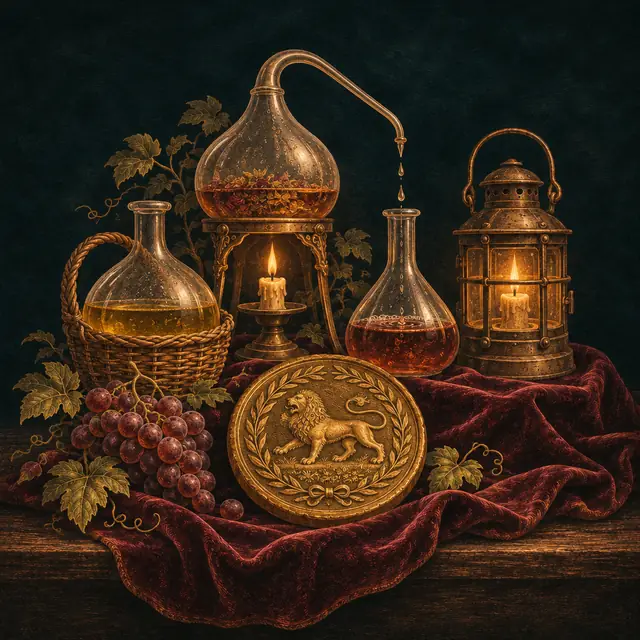
Physician and religious reformer of the Crown of Aragon, born about 1240. He studied medicine at Montpellier, where he later taught, and was physician to Peter III and James II of Aragon and to Popes Boniface VIII and Clement V; in 1301 he treated Boniface for the stone, by report with a gold seal engraved with a lion. He wrote on regimen and on medical theory, and translated Arabic medical works. From the 1290s he also wrote that the Antichrist would come within the next century and that the Church must be reformed. The theologians of Paris had him arrested for it in 1299, and an inquisition at Tarragona in 1316 condemned a list of his religious writings. He died at sea off Genoa in 1311.
The teaching
Taught from his own books, above all the Regimen of Health and the Mirror of Medicine, with his treatise on Antichrist.
The physician's three kinds of things
Arnald teaches medicine as the schools taught it, in an order of three. First come the natural things, of which the body is made and by which it lives: the elements and their mixture, the humours, the members, the powers, their workings and the spirits. Then come the things not natural, which are not parts of the body but keep it or change it according to how they are used. Last come the things against nature: the disease, its cause and its signs. Health is the right state of the first, the physician keeps it by governing the second, and he restores it by knowing the third.
The six things a life is ruled by
His Regimen, written for the king of Aragon, sets out the things not natural one by one, since every person meets them every day. There is the air breathed, which should be clear and clean, far from marshes and foul smells; exercise and rest, the exercise taken before eating and stopped before weariness; food and drink, taken when there is hunger and thirst, in measure, and not again before the last meal is digested; sleep and waking, the sleep coming at night and not straight after a meal; the body's filling and emptying, kept in balance; and the passions of the mind.
The last he counts as great as any. Gladness and calm strengthen the spirits and the body with them, while anger, fear and long sadness weaken both, and so the physician must look after a person's peace of mind as carefully as his table. This is the medicine of its age, read for its order and its good sense, and not taken as advice for anyone's health.
Complexion and the degrees of medicines
Every body and every medicine has a complexion, a mixture of hot and cold, moist and dry, and a medicine's strength is measured in degrees. Arnald, following the Arabic philosopher al-Kindi, teaches that the degrees rise by doubling. A medicine hot in the first degree has twice as much heat as cold in it, in the second degree four times as much, in the third eight times and in the fourth sixteen. With that rule the physician can reckon the complexion of a compound from the strengths and weights of its parts, and fit it to the complexion of the sick person, so that it corrects the excess without overshooting it.
Daniel's numbers
As a reader of prophecy Arnald works from the book of Daniel: And from the time that the daily sacrifice shall be taken away, and the abomination that maketh desolate set up, there shall be a thousand two hundred and ninety days. In prophecy, he holds, a day stands for a year. Counted from the day the sacrifice ceased, the twelve hundred and ninety years end within the century then about to begin, and so the coming of Antichrist is near.
The nearness is a call to reform. The Church must turn back to the poverty and plainness of the Gospel, its clergy must leave their wealth and their pride, and every Christian must amend his life while there is time. Such truths, he holds, may be shown to simple people and to laymen as well as to masters of theology, for God gives the understanding of the scriptures to whom he will.
The alchemy under his name
The books of alchemy printed under his name, the Rosarius philosophorum first among them, teach the stone in the language of sulphur and quicksilver: a single matter cleansed and joined in one vessel over a gentle fire, passing through black and white to red. They are the work of other hands, and the art they teach is taught on the pages of Alchemy.
Orders and memberships
He was a layman, married, and belonged to no religious order, though he defended the Spiritual Franciscans and the Beguins. No secret order is documented.
The legend
That he was an alchemist who made gold before the papal court, and the first to distil brandy. A lawyer of the time reported the gold; the distilling of wine was known before him, and the book on wines that carries the story is no longer held to be his.
What was forged, or is false
The alchemical books printed under his name, the Rosarius philosophorum among them, are now generally held to be by other hands. None stands in the lists of his works made near his lifetime.
Their works
- Regimen of HealthBook, about 1305 to 1308
A book of rules for a healthy life written for King James II of Aragon, on air, exercise, food, drink, sleep and the passions of the mind. It was copied and translated widely and is among the best known health books of the Middle Ages.
Ask the Oracle about it - Mirror of MedicineBook, about 1308
The Speculum medicinae, his fullest work of medical theory, on the natures, humours and powers of the body and on how drugs act upon it. It shows the learned physician of Montpellier at his height.
Ask the Oracle about it - On the Time of the Coming of AntichristTreatise, about 1297 to 1300
A treatise which held, from the prophecies of Daniel, that the Antichrist would come within the next century and that the Church must reform. The theologians of Paris arrested him for it in 1299.
Ask the Oracle about it - Rosarius philosophorumTreatise, later Middle Ages
A Latin book of alchemy printed under his name, one of the many that made him a master of the art in later legend. It teaches the work on the stone in the language of sulphur and mercury.
It is held to be by other hands, and stands in no list of his works made near his lifetime.
Ask the Oracle about it - Book on WinesBook, later Middle Ages
A book on medicinal wines and their uses that went under his name and carried the story that he was the first to distil brandy, the water of life. The distilling of wine was known before him.
It is no longer held to be his.
Ask the Oracle about it
How the house tells a life
This life is told from the record, with what is documented, what is legend and what was forged kept apart. A membership in an order is stated only where documents show it. A person’s chart explains none of their deeds.
The arts it feeds
Lives near it in time
Lives and legends
Zosimos of PanopolisJabir ibn HayyanAbu Ma’sharMichael ScotAbraham AbulafiaMoses de LeónJacques de MolayNicolas FlamelJohannes TrithemiusCornelius AgrippaParacelsusNostradamusThe whole tree

