
Zosimos of Panopolis
Active about AD 300
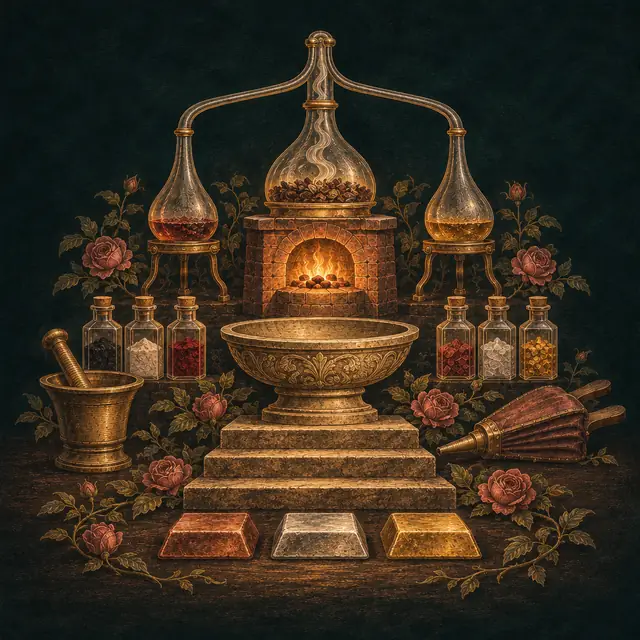
Who was Zosimos of Panopolis, and what is truly known of them?
What is known
Alchemist from Panopolis, now Akhmim, in Upper Egypt, who wrote in Greek and probably worked at Alexandria. He is the earliest writer on alchemy whose own books survive in any quantity, in Greek fragments and in Syriac and Arabic versions. A Byzantine lexicon credits him with twenty-eight books addressed to Theosebeia, a woman he calls his sister in the art. He describes furnaces and stills and names older authorities, Mary the Jewess above all. In the pieces known as the Visions he tells dreams in which a priest is cut apart and remade on a bowl-shaped altar and a man of copper turns to silver and then gold, and he reads the work on metals as a cleansing of the soul. He draws on the Hermetic books and urges Theosebeia to read them. Carl Jung published a study of the dreams in 1938.
The teaching
Taught from his own writings, above all the Visions, the Final Count and On the Letter Omega.
The priest on the altar
Zosimos teaches the work through a dream. He falls asleep and sees a priest standing above a bowl-shaped altar reached by fifteen steps. The priest tells him that he has gone down the fifteen steps of darkness and up the steps of light, and that the one who sacrifices him renews him, casting off the coarseness of the body, so that, consecrated by necessity, he becomes spirit. He is Ion, priest of the innermost sanctuary, and he bears a torment beyond bearing: a man came at dawn, cut him apart with a sword according to the rule of harmony and burned him in the fire, so that he might learn to change his body into spirit.
Then Zosimos sees people in the boiling water of the altar, crying out, who are there because they wish to attain excellence, and he sees a man of copper, then of silver, then of gold. He wakes and asks himself whether this is not the composition of the waters, and he understands that it is.
What the dream shows
The dream is the work in the vessel told as a passion. The metal is the man; its cutting, boiling and burning are the operations; the boiling water of the altar is the divine water of the art, which dissolves bodies and draws out their spirit; and the change from copper to silver to gold is the change of the matter. It is told of a man because the same work is done on the one who works: the coarse body is put off so that spirit can appear, in the metal and in the soul alike.
The temple of one stone
In another of the dreams he is shown how to enter. Build a temple of a single stone, white as white lead or alabaster, with neither beginning nor end in its building, and inside it a spring of pure water shining like the sun. The entrance is narrow, and a serpent lies at it, guarding the temple: seize it, sacrifice it, flay it, part its flesh from its bones, and lay its members together at the entrance as a step; then go up and enter. Within, the man of copper sitting in the spring is changing his colour; he is becoming a man of silver, and in a little while he can be a man of gold.
Natural tinctures and timely ones
In the Final Count he warns Theosebeia against a counterfeit of the art. The spirits who oversee the districts of Egypt, he says, took hold of the natural tinctures, the colourings that work by the nature of the substances themselves, and put in their place timely tinctures, which work only at the moments the spirits allow and only for those who sacrifice to them. Their priests and followers bargain with them for success. The natural tinctures need no such bargain.
So he tells her not to run about looking for God, but to sit quietly at home, for God is everywhere and not shut up in a small place as the spirits are. Let the body be still, and still the passions with it, desire and pleasure, anger and grief; then call on the divine, and it comes. When she has made her soul perfect and holds the natural tinctures, she is to spit on matter, hasten to Poimandres, be baptised in the mixing bowl and go up to her own kind.
Adam and the man of light
On the Letter Omega joins the art to the Hermetic and Gnostic books. The first man, whom Zosimos sets beside Thoth, is called Adam by the Hebrews, and his name has four letters that stand in Greek for the four quarters of the world: east, west, north and south. That outer Adam is made of the four elements and belongs to fate. Within him is the man of light, whose common name, Zosimos says, is Phos, the Greek word for light. He was once in paradise and was persuaded to put on the body made of elements; he is the true self, and the work is his return.
Hermes, he says, teaches that the spiritual man, the one who knows himself, should do nothing by magic, even when it seems good, and should do no violence to necessity. He should let fate do what it will with its own clay, which is the body, and go on seeking himself and knowing God. The philosophers, Hermes and Zoroaster agree, stand above fate: they neither rejoice in its gifts nor are cast down by its blows, for they live in the mind.
The hands and the soul together
Practice is never left behind. He describes the stills and furnaces with drawings and gives Mary the credit for many of them, and her vessels are taught on her own page. And he sends Theosebeia to the Hermetic books for the mind behind the art, so that the hands and the soul learn together. Every vapour of that workshop is a poison, and the furnaces are taught as the history of an art.
Orders and memberships
None is documented. He writes as one teacher among rivals, warning Theosebeia against a priest named Neilos and others who, he says, work with spirits and for gain. His praise of the Hermetic writings shows that he knew circles where they were read.
The legend
His own account of where the art came from. Drawing on the tradition of the Book of Enoch, he says that fallen angels taught the working of metals to women they loved, and that the first book of it was called Chema, which gave the art its name. It is a story he passes on, and where the word chemistry comes from is still not settled. Arabic books that bear his name are of disputed authorship.
Their works
- On ExcellenceTreatise, about 300
The pieces known as the Visions, in which Zosimos tells his dreams of a priest who is cut apart and remade on a bowl shaped altar, and of men of copper turning to silver and gold. He reads the work on metals as a cleansing and a remaking. Carl Jung’s study of 1938 made these dreams famous far beyond the history of chemistry.
Ask the Oracle about it - The Final CountLetters, about 300
A letter to Theosebeia warning her against rival teachers who work by bargaining with spirits, and urging her to calm her soul and read the Hermetic books instead. It is one of the earliest places where alchemy is set beside the Hermetic writings, and it survives in Greek.
Ask the Oracle about it - On the Letter OmegaTreatise, about 300
A short treatise on furnaces that turns into a discussion of fate and of the inner man, citing Hermes, Zoroaster and a teacher named Nikotheos, and setting Adam beside the Greek Thoth. It is one of the few places where his alchemy, his reading of the Hermetic books and his Gnostic sources meet in one text.
Ask the Oracle about it - On Apparatus and FurnacesTreatise, about 300
A working account of stills and furnaces, with drawings of the apparatus, in which he credits Mary the Jewess with several devices, among them the three armed still and the kerotakis; later alchemy also gave her name to the water bath, the bain marie. It is the best witness to the practical side of Greek alchemy.
Ask the Oracle about it
How the house tells a life
This life is told from the record, with what is documented, what is legend and what was forged kept apart. A membership in an order is stated only where documents show it. A person’s chart explains none of their deeds.
The arts it feeds
Lives near it in time
Lives and legends
Apollonius of TyanaSimon MagusVettius ValensApuleiusMary the ProphetessIamblichusJabir ibn HayyanAbu Ma’sharMichael ScotAbraham AbulafiaMoses de LeónArnald of VillanovaThe whole tree

