
Apollonius of Tyana
About AD 15 to about 100; the dates are uncertain
Who was Apollonius of Tyana, and what is truly known of them?
What is known
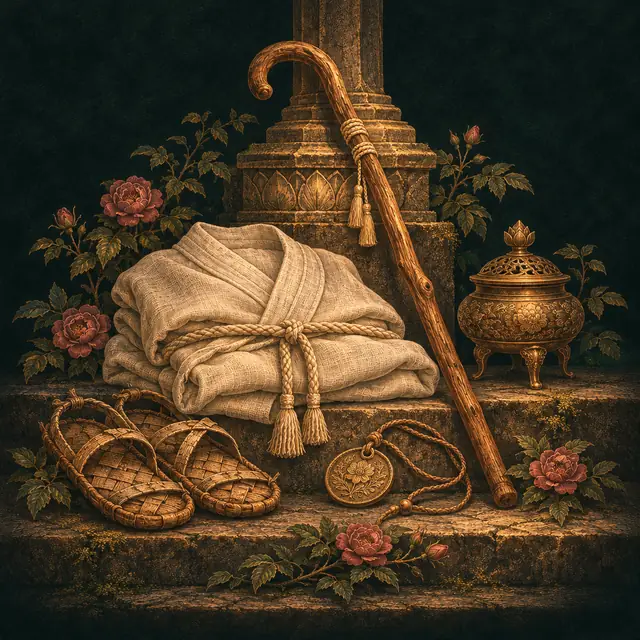
Greek wandering teacher from Tyana in Cappadocia, who lived in the first century AD. Nearly all that is told of him comes from one book, the Life of Apollonius that Philostratus wrote at the wish of the empress Julia Domna and finished after her death in 217. It shows a follower of the Pythagorean way who wore linen, ate no flesh, would offer no blood sacrifice and kept silence for five years, who travelled to Babylon, India and Egypt and was tried at Rome before the emperor Domitian. Philostratus says he used the notebooks of a disciple, Damis, which most scholars take for an invention. A collection of letters under his name and a fragment On Sacrifices survive, and their authorship is doubted. The emperor Caracalla built him a shrine at Tyana.
The teaching
Taught from Philostratus's Life of Apollonius, with the letters and the fragment On Sacrifices that go under his name.
The way of Pythagoras
Apollonius teaches the life of Pythagoras as a rule to be lived, and the Life gives his reason for each part of it. He eats nothing that has had a soul, because flesh is impure and makes the mind gross. He drinks no wine, because wine troubles the clear air of the mind, even though it comes from a plant. He wears linen and not wool, since wool is shorn from a living creature and linen grows clean out of the earth; he goes barefoot, lets his hair grow, and gives his inheritance away, keeping only what he needs.
The rule is for the sake of seeing. Tried before the emperor, he explains that he knew of the plague at Ephesus before it came because his light diet kept his senses unclouded, so that he saw what was coming as in a bright mirror. His prayer asks for the same plainness: grant me, gods, to have little and to need nothing.
Sacrifice without blood
To the first god, who is one and set apart from everything, nothing at all should be sacrificed, he teaches. No fire is to be lit for him and nothing of the senses offered, not even a word spoken aloud. He is honoured only with the better word, the one that does not pass through the mouth: the silent thought of the mind. The noblest of beings is to be asked for good things by the noblest thing in us, the mind, which needs no organ to reach him.
To the gods below that first one he offers frankincense and prayer, never a slain victim. At Babylon, the Life tells, while the king offered a horse to the Sun, Apollonius asked leave to sacrifice in his own way: he threw a handful of frankincense on the fire and prayed to the Sun to send him as far over the earth as pleased them both, and to let him know good men and never know bad ones, nor they him. A letter under his name puts the teaching shortly: the gods need no sacrifices; what pleases them is wisdom, and doing good to those who deserve it.
So he prays without asking for things. His own prayer, the Life says, was only this: gods, give me what is due to me. The gods know what is just, and a good man needs to ask them for nothing more.
Knowing oneself first
Among the sages of India, whom the Life makes his teachers, he hears the first principle of wisdom: they know all things because they begin by knowing themselves. They teach him that the cosmos is a living creature, male and female in one, made of five elements, the fifth being the aether from which the gods are made. They teach too that the soul has lived before. Their chief, Iarchas, tells Apollonius that in a former life he was the pilot of an Egyptian ship who refused a pirate's bribe to betray it.
Imagination and the images of the gods
On the Nile, faced with naked sages who mocked the Greek statues of the gods, he defends them with a teaching about the mind. The sculptors did not go up to heaven to copy the gods, he says; imagination made those images, and imagination is a wiser craftsman than imitation. Imitation can make only what it has seen. Imagination makes what it has not seen as well, shaping it by reference to what truly is. That is how the image of a god can be true without being the likeness of anything an eye has seen.
Nothing is born and nothing dies
In a letter of consolation to a Roman whose son had died, he teaches that no one dies except in appearance, just as no one is born except in appearance. When being passes into becoming it seems to be birth, and when it passes back from becoming into being it seems to be death; in truth nothing comes to be and nothing perishes. The one substance becomes visible when it thickens into matter and invisible when it thins out again, and it alone acts and suffers in all things. So the father is asked to honour God rather than to mourn.
The Life ends on the same teaching. After his passing, it tells, a young man who doubted that the soul survives saw him in a dream and heard him say that the soul is immortal and belongs not to its owner but to Providence; freed from the worn body, it springs up like a swift horse loosed from the traces and mingles with the light air, glad to leave its hard servitude. Yet the young man is asked what good it does him to know it now, since it is known for certain only by those who are no longer among the living.
Orders and memberships
He is shown living by the Pythagorean rule, a way of life and not an order with a roll of members. No school of his own is documented. The Life has him seek initiation at Eleusis, where the priest at first refused him as a wizard.
The legend
The wonders of the Life: that at Ephesus he saw the murder of Domitian as it happened in Rome, raised a girl from her bier, cast out demons, vanished from the emperor’s court and did not die but was taken up. Later ages made him a maker of talismans that guarded cities, and under the Arabic name Balinus a master of hidden sciences.
What was forged, or is false
About AD 303 the official Hierocles set him up as a rival to Christ, and Eusebius answered; the comparison has been reused ever since and rests on Philostratus alone. The Arabic Book of the Secret of Creation, in which the Emerald Tablet first appears, was put out under his name some seven centuries after his death.
Their works
- The Life of Apollonius of TyanaBiography, after AD 217
Philostratus wrote eight books at the wish of the empress Julia Domna, telling of the sage’s travels to Babylon, India, Egypt and Ethiopia, his wonders and his trial before Domitian. It is almost the only source for his life, and it reads as much like a romance as a history. Pagans later set it against the Gospels.
Philostratus claims to use the notebooks of a disciple, Damis, which most scholars think he invented.
Ask the Oracle about it - The Letters of ApolloniusLetters, uncertain
Some hundred short letters under his name, many of them to cities, kings and philosophers, sharp in tone and full of Pythagorean counsel. Philostratus quotes some of them in the Life. They are the main body of writing that may preserve his own voice.
Their authorship is doubted; some may be his, many are probably later inventions.
Ask the Oracle about it - On SacrificesTreatise, 1st century AD
A short passage preserved by Eusebius from a book on sacrifices ascribed to him. It says that the highest god should be offered no blood and no fire, nothing of the senses, but honoured only with silent thought, in keeping with what the Life tells of his refusal of blood sacrifice.
Only a fragment survives, and whether it is truly his is uncertain.
Ask the Oracle about it - The Lover of TruthBook, about AD 303
Sossianus Hierocles, a Roman governor who took part in the persecution of Christians, wrote a book setting the wonders of Apollonius above those of Jesus. It is lost, and known from a reply written against it, ascribed to Eusebius. It made Apollonius a pagan rival to Christ for centuries.
The book is lost, and whether Eusebius wrote the surviving reply is disputed.
Ask the Oracle about it
How the house tells a life
This life is told from the record, with what is documented, what is legend and what was forged kept apart. A membership in an order is stated only where documents show it. A person’s chart explains none of their deeds.
The arts it feeds
Fasting and disciplineThe Hermetic principlesMagic and protection
Lives near it in time
Lives and legends
PythagorasSimon MagusVettius ValensApuleiusMary the ProphetessIamblichusZosimos of PanopolisJabir ibn HayyanAbu Ma’sharMichael ScotAbraham AbulafiaMoses de LeónThe whole tree

