
Pythagoras
About 570 to about 495 BC
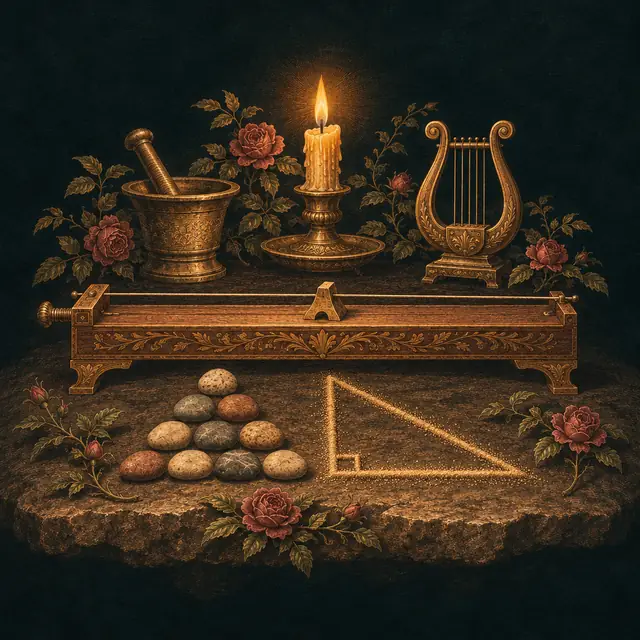
Who was Pythagoras, and what is truly known of them?
What is known
Greek teacher from Samos who founded a community at Croton in southern Italy. He left no writings; what is known comes from authors writing generations and centuries later. His school taught that number and harmony order the world, and that souls pass from life to life.
The teaching
Taught from what Aristotle and the later lives by Porphyry and Iamblichus record of his teaching.
The soul that passes
The soul, Pythagoras teaches, is immortal. It does not end with the body but passes into other living things, human and animal. What has happened comes round again in its turn, so that nothing is wholly new, and everything born with life in it is kin to everything else. The lives give these four as the best known of all his teachings, and the whole way of life his followers kept rests on them.
His school told that he remembered his own earlier lives. Once, when he was Aethalides, Hermes offered him any gift but deathlessness, and he asked to keep his memory through life and through death; so he could recall being Euphorbus, who fought at Troy, and the lives that came after. The memory is the point of the story: a soul that has been made clean keeps the thread of its lives, and the life of the brotherhood was a cleansing of the soul for the lives to come.
All that lives is kin
Because souls pass between bodies, he forbids killing the creatures that do no harm, and his followers kept from flesh and from blood sacrifice. At Delos, Aristotle reports, he would worship only at the altar of Apollo the Begetter, where nothing but wheat, barley and cakes was laid and no victim was ever slain. The sources differ on how strict the rule was: the later lives make it strict, while Aristoxenus, a pupil of Aristotle, says he refused only the ploughing ox and the ram. The rule against beans is the most famous of all, and the old writers already argued over its reason.
Number, the wisest thing
Asked what is wisest, his followers answered number, and after it the one who gave things their names; asked what is most beautiful, harmony. That all things are made of number or are like numbers, that its elements are the odd and the even, and that the tetractys of one, two, three and four holds the ratios of the octave, the fifth and the fourth, is taught in full on the page of Pythagoras and number, under Sacred geometry.
What belongs to him is the hearing of it. He is said to have been the first to call the whole order of the heavens a kosmos, an arrangement both ordered and fitting. The stars and planets, his school teaches, move at speeds that stand in the ratios of the musical intervals, and so their motion makes a harmony. We do not hear it because it has sounded since our birth, as a smith stops hearing his own hammers. The lives say that Pythagoras alone could hear it, and that he made music for his pupils in its likeness.
Music for the soul
Music, he teaches, cleanses the soul as medicine cleanses the body, and the school called this cleansing katharsis. In the morning they sang to the lyre to wake the mind from sleep and make it clear for the day. In the evening they sang to quiet the disturbances of the day and to prepare for calm sleep and good dreams. There were melodies against grief, against anger and against desire, and he preferred the lyre to the pipe, whose sound he judged too exciting for settled and free minds.
Of medicine itself his followers valued regimen most: food, exercise and rest each in its measure, with poultices before drugs, and the knife and the cautery last of all. The care of the body and the care of the soul were one discipline.
Silence and the test of entry
No one came in at once. A candidate was watched: how he laughed, how he spoke and kept silent, how he walked, what he desired, and his nature was read from his face and bearing. If he was accepted, he was left for a time to show whether he was steady, and then kept silence for five years, hearing the master's voice from behind a curtain without seeing his face. His goods went into the common store. Those who failed were sent away with twice what they had brought, and the brotherhood raised a tomb for them as for the dead.
The silence was a training, not a punishment. To master the tongue, he holds, is the hardest of all self-mastery, and whoever can hold his speech can hold the rest. Two kinds of follower came out of it: the hearers, who kept the sayings and the rule, and the learners, who were taught the reasons behind them. Among both, one phrase ended a dispute: he himself said it.
The sayings
The sayings the hearers kept are of three kinds: what a thing is, what is most so, and what must be done or left undone. What are the islands of the blessed? The sun and the moon. What is the oracle at Delphi? The tetractys, which is the harmony in which the Sirens sing. What is strongest? Judgement. What is best? Happiness.
The rules of conduct were riddles, and the later lives give their meaning. Do not stir the fire with a knife: do not provoke an angry man with sharp words. Do not step over the balance: do not go beyond what is just. Do not sit on the grain measure: do not live idly on the day's ration, but take thought for tomorrow. Do not eat the heart: do not wear away the soul with grief. Leaving home, do not turn back at the border: leaving this life, do not cling to it.
Friendship and measure
Among friends, he teaches, all things are common, and friendship is equality. His followers spoke of a friendship of all with all: of gods with men through piety, of the soul with the body, of reason with the unreasoning parts of the soul through philosophy, of citizens through good law, of husband, wife and kin through a shared life, and of the body with itself through health. Damon and Phintias, two of the brotherhood, are its proof in the tale. When the tyrant of Syracuse condemned one, the other stood surety for his life; the condemned man came back at the hour appointed, and the tyrant asked in vain to be taken into their friendship as a third.
Measure runs through all of it. With every means, the saying goes, cut away sickness from the body, ignorance from the soul, luxury from the belly, faction from the city, discord from the home, and from all things excess.
The ordered day
The day itself was a discipline. The members walked alone in the morning in quiet places, groves and temples, to set the soul in order before meeting anyone; then they met to learn and talk, trained the body, and ate a light meal at noon. The afternoon went to the city's business and to guests. In the evening they walked in twos and threes, going over what they had learned, then bathed and ate together before sunset, with offerings and a reading. The day closed with the eldest's precepts: harm no cultivated plant and no creature that does not harm humankind, speak with reverence of gods, daimons and heroes, of parents and benefactors, and stand by the law against lawlessness.
Memory was trained with the day. A follower did not rise from bed before he had recalled what he had said, heard and done the day before, in order, and then the day before that; and at night he went over the day's deeds before he slept. That nightly review, as the Golden Verses of the school give it, is taught on the page of The evening review, under Meditation.
Orders and memberships
His own community was a closed brotherhood with rules of silence: among the first known in the West.
The legend
Nearly every story of his life, his travels to Egypt and Babylon among them. The “Pythagorean” numerology that gives numbers to the letters of a name is a modern system of the early twentieth century, not his.
Their works
- On the Pythagorean LifeBiography, about AD 300
Iamblichus, a Platonist of Syria, wrote the longest life of Pythagoras to survive, as the first book of a series on his teaching. It gathers the wonders, the rules of the brotherhood at Croton and the lists of followers, and sets him out as a divine teacher. It is a work of reverence more than of history.
Iamblichus wrote some eight centuries after Pythagoras and drew on sources that were themselves late and partisan.
Ask the Oracle about it - The Life of PythagorasBiography, late 3rd century AD
Porphyry, the pupil of Plotinus, wrote a shorter life as part of his history of philosophy. It tells of the travels to Egypt and among the Chaldeans, the golden thigh, the voice of the river that greeted him, and the rules of silence and of diet that his followers kept.
Ask the Oracle about it - Lives of the Philosophers, Book EightBiography, 3rd century AD
Diogenes Laertius opens his eighth book with Pythagoras and the Italian school. He passes on the stories, the sayings and the jokes against him, including the verses of Xenophanes about a beaten puppy whose cry was the voice of a friend reborn. It preserves many older reports now lost.
Ask the Oracle about it - The Golden VersesPoem, uncertain
Some seventy lines of Greek verse on piety, self examination and the conduct of life, passing under the name of Pythagoras. They ask the reader to go over each day’s deeds at night. Much copied and commented on, by Hierocles of Alexandria among others, they were read for centuries as the teaching of the school.
Not his own: they were written by later Pythagoreans, with dates proposed from the 3rd century BC to the 4th century AD.
Ask the Oracle about it
How the house tells a life
This life is told from the record, with what is documented, what is legend and what was forged kept apart. A membership in an order is stated only where documents show it. A person’s chart explains none of their deeds.
The arts it feeds
Past lives and karmaFasting and disciplineSacred geometrySound and mantra
Lives near it in time
Lives and legends
Apollonius of TyanaSimon MagusVettius ValensApuleiusMary the ProphetessIamblichusZosimos of PanopolisJabir ibn HayyanAbu Ma’sharMichael ScotAbraham AbulafiaMoses de LeónThe whole tree

