
Michael Scot
About 1175 to about 1235
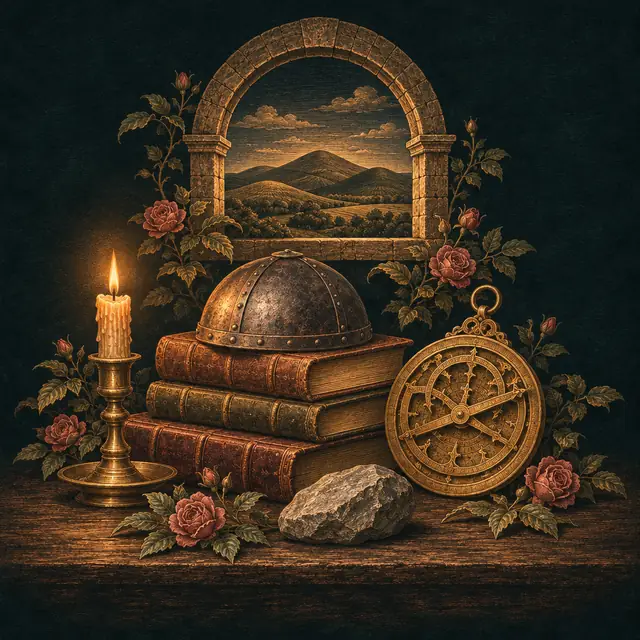
Who was Michael Scot, and what is truly known of them?
What is known
Scottish scholar, translator and court astrologer. He is recorded at Toledo in 1217, where he finished a Latin version of the astronomy of al-Bitruji, and he went on to translate Aristotle on animals and works of Averroes from the Arabic. Popes Honorius III and Gregory IX recommended him for church livings, and in 1224 he declined the archbishopric of Cashel in Ireland, saying he did not know the language. By the late 1220s he was at the court of the emperor Frederick II, for whom he wrote an introduction to astrology and a book on reading character from the body. Leonardo of Pisa dedicated the second edition of his book on reckoning to him in 1228. A poem of about 1236 speaks of him as dead.
The teaching
Taught from his Liber introductorius and his Physiognomy, with the astronomy of al-Bitruji he put into Latin.
The beginner's heaven
Michael Scot wrote his introduction for beginners, and it starts from the visible sky. It names the planets and the twelve signs and draws the constellations as figures, each with its stars, so that the student learns the heavens by their images. It gives each planet its nature, its day and its hours, teaches the signs of the coming weather, and sets music among the arts of number that the student of the heavens must know.
The arts named to be shunned
He sets out the forbidden arts so that they can be known and avoided. Divination is named by the element it uses: geomancy by earth, hydromancy by water, aeromancy by air and pyromancy by fire; to these he adds the reading of the hand, of birds and of dreams, and necromancy, which seeks out the dead. Such arts, he teaches, work with the help of demons and are forbidden to a Christian, while astrology, which reads the order God set in the heavens, belongs to wisdom.
The heavens without circles upon circles
The astronomy of al-Bitruji, which he put into Latin at Toledo, teaches a heaven without epicycles. All the heavens turn from east to west, carried round by the outermost, which God moves. The lower a heaven lies, the more slowly it follows the first motion, so that the planets fall behind it and seem to move eastward through the signs. Their wanderings to north and south come not from circles riding on circles but from the poles of their own heavens, which themselves move round in small circles.
Reading the body
The Physiognomy teaches that the soul shows itself in the body. It begins before birth, with how a child is conceived, how it grows in the womb and the signs of its coming, and then reads the grown body part by part, from the hair and the brow, the eyes, the nose and the mouth, to the voice, the neck, the hands and the gait, giving for each shape the temper and the character it shows.
The art judges by many signs together and never by one alone. The house reads it as a picture of how the Middle Ages tied the body to the soul, and not as a way to judge anyone.
The emperor's questions
Frederick put to him the questions a ruler of that age wanted answered, and Michael set them down with his answers: what holds the earth up over the deep; how many heavens there are and who rules them; where God sits, and where paradise, purgatory and hell lie; where the souls of the dead are; why the sea is salt, why some springs run sweet and others hot; and what feeds the fires that burn in the mountains of Sicily. His answers give the world as the schools of his day held it, from the abyss below to the throne above the heavens.
Orders and memberships
He was a cleric and held benefices by papal favour; no secret order is documented. In his own book he condemns the practice of magic while describing its kinds.
The legend
That he was a wizard who split the Eildon Hills in three, rode a demon horse, and foresaw his death by a falling stone, so that he wore an iron cap. Dante set him among the sorcerers in hell, Boccaccio called him a master of necromancy, and Walter Scott made him the wizard of The Lay of the Last Minstrel. None of it comes from his lifetime.
What was forged, or is false
Books of alchemy and of spirit-conjuring were later put under his name. Whether the Art of Alchemy that bears it is his is disputed.
Their works
- Liber introductoriusBook, about 1228 to 1235
His long introduction to astrology written for the emperor Frederick II, in three parts, the Book of Four Distinctions, the Particular Book and the Physiognomy. It describes the stars and planets, the weather, music and many kinds of divination and magic, which it condemns even as it sets them out. It is the fullest picture of what a court astrologer of his age knew.
Ask the Oracle about it - PhysiognomyBook, about 1230
The book on reading character from the face and body that ends his Liber introductorius, written for the emperor, with a part on conception and birth. It was printed in 1477 and went through some twenty editions, and it was the work of his most widely read in the Renaissance.
Ask the Oracle about it - On the Motions of the HeavensTranslation, 1217
His Latin version, finished at Toledo, of the astronomy of al-Bitruji, a book that tried to account for the movements of the planets without Ptolemy’s circles upon circles. It is the first work he is known to have finished, and it brought a live Arabic debate on the heavens into the Latin schools.
Ask the Oracle about it - On AnimalsTranslation, before 1220
His Latin version from the Arabic of the nineteen books of Aristotle on animals, their parts and their generation. Albertus Magnus built his own great book on animals upon it, and it was the text of Aristotle’s zoology most read in the West until a version from the Greek replaced it.
Ask the Oracle about it - Translations of AverroesTranslation, about 1220 to 1235
Latin versions of the commentaries of Averroes on Aristotle, on the heavens and on the soul among them, which brought the thought of the great Andalusian commentator into the universities of Paris and Oxford within a generation of his death.
Which of the early translations of Averroes are his is argued.
Ask the Oracle about it - The Art of AlchemyTreatise, 13th century
A Latin book of alchemy under his name, of working recipes for colours, salts and metals, which says it was learned from a master in Spain. It added to his later fame as a wizard, though it is a practical book and not a book of spells.
Whether it is his is disputed.
Ask the Oracle about it
How the house tells a life
This life is told from the record, with what is documented, what is legend and what was forged kept apart. A membership in an order is stated only where documents show it. A person’s chart explains none of their deeds.
The arts it feeds
Lives near it in time
Lives and legends
ApuleiusMary the ProphetessIamblichusZosimos of PanopolisJabir ibn HayyanAbu Ma’sharAbraham AbulafiaMoses de LeónArnald of VillanovaJacques de MolayNicolas FlamelJohannes TrithemiusThe whole tree

