
Jabir ibn Hayyan
About 721 to about 815, if he lived as told
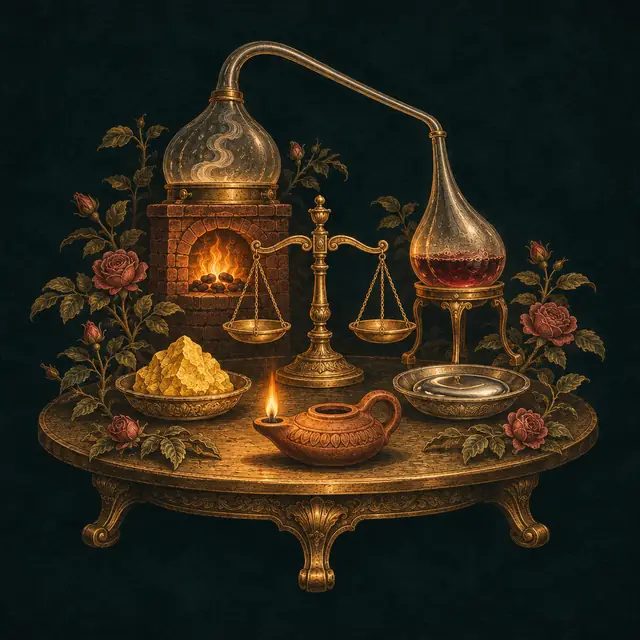
Who was Jabir ibn Hayyan, and what is truly known of them?
What is known
An alchemist of the early Abbasid age, known only from the writings under his name and from later reports. They make him a man of Kufa in Iraq, a pupil of the imam Jafar al-Sadiq and a client of the Barmakid viziers of Harun al-Rashid. Some hundreds of Arabic treatises carry his name. They teach that metals are formed of sulphur and mercury, set out a “science of the balance” that reckons the natures in a substance by number, and include an early Arabic version of the Emerald Tablet. In 1942 and 1943 the scholar Paul Kraus argued that most of them were written by a school of authors in the ninth and tenth centuries; whether one man stands behind them is still disputed.
The teaching
Taught from the Arabic books under his name, above all the Hundred and Twelve, the Seventy and the Books of the Balances.
The four natures
The books begin from the four natures: heat, cold, dryness and moisture. They are not things in themselves but qualities that come together with a substance, and every body in the world is a substance joined to the four in some proportion. Two are active, heat and cold, and two passive, dryness and moisture. One thing differs from another only by the measure in which the four are mixed in it; so to know a thing is to know its measure, and to change it is to change its measure.
The metals form in the earth from a sulphur and a mercury, as the page of Salt, sulphur and mercury teaches. The books of Jabir add that each metal shows two natures outwardly and hides two within. Lead is cold and dry without and hot and moist within; gold is hot and moist without and cold and dry within. To make one metal into another is to turn it inside out, bringing its hidden natures to the surface and sending its manifest natures within. Everything has a manifest side and a hidden side, and the art makes the hidden manifest.
The balance
The science of the balance weighs the natures in any substance. Its key is the Arabic name of the thing, for the letters of a name are not there by chance: each letter belongs to one of the four natures and stands in a certain degree of it. Weigh the letters of the name in their order, and the proportion of heat, cold, dryness and moisture in the substance appears. What has been weighed can then be corrected, by adding what is lacking and taking away what is in excess.
The proportions follow the numbers one, three, five and eight, which add to seventeen. They stand together in one corner of the square of three, whose every line adds to fifteen, and the five numbers left in that square add to twenty-eight, the number of letters in the Arabic alphabet. Seventeen, the books teach, is the measure on which the whole world is built.
Separating and joining
The elixir is made by taking a body apart into its natures and putting them together again in true measure. A substance, whether stone, plant or animal, for the books work with hair, blood and eggs as well as with minerals, is distilled again and again until it yields its four parts: a water, an oil, a fiery tincture and a dry earth. Each part is cleansed, and the books even teach the drawing out of a single nature, a heat or a coldness, as near to pure as the art can bring it. Then the parts are joined again by the balance, and what results is the elixir, which the books hold to be a medicine that brings its own right measure to whatever lacks it, a base metal or a sick body.
Spirits, bodies and stones
The things of the mine fall into three kinds. The spirits fly from the fire: sulphur, the sulphides of arsenic, quicksilver, sal ammoniac and camphor. The metallic bodies melt, can be hammered and ring when struck: gold, silver, lead, tin, copper, iron and the metal the books call Chinese iron. The stones neither fly nor bear the hammer, but break into powder. The work joins spirits to bodies, so that the spirits are held fast and the bodies are opened. Most of these substances are poisons, and the books are read here as the history of an art, never as a recipe.
Practice and the scattered teaching
The first rule of the art is to work with one's own hands and make trial. Whoever does not work and test, the books say, will never reach the least degree of mastery; a teacher can show the way, but only the work teaches it.
The teaching itself is scattered on purpose. What is begun in one book is finished in another, and a step left out here is given there, so that only one who reads all the books with care can gather the whole. The scattering guards the art from the careless and rewards the patient.
The art of generation
The boldest teaching of the books is the art of generation. If the balance of the natures is known exactly, they hold, the art can do in the vessel what nature does in the world, and bring forth not only metals but plants and animals, and in their furthest claim even a human form. It stands as the limit of the science, the point where knowing the measure of a thing becomes making it.
Among the Hundred and Twelve stands an early Arabic form of the Emerald Tablet, the teaching of the one thing, which is taught line by line on its own page, under The Hermetic principles.
Orders and memberships
No order is documented. Later tradition calls him a Sufi and a follower of the Shia imams, and the writings under his name hold a Shia teaching that Paul Kraus took for early Ismaili and later scholars set apart from it, which is one reason scholars date many of them after his lifetime.
The legend
That he made the elixir, and that his workshop was found at Kufa about a century and a half after his death with a mortar of gold in it. The tales come from later Arabic writers. That the English word gibberish comes from his name is an old guess the dictionaries doubt.
What was forged, or is false
The Latin books of “Geber”, the Summa perfectionis first among them, are not translations of his Arabic. They were written in Latin about 1300, probably by the Franciscan Paul of Taranto, and put under his name.
Their works
- The Hundred and Twelve BooksCollection, 9th or 10th century
The oldest set of books in the Jabirian corpus, short treatises on making the elixir from plants, animals and minerals, written as lessons from Jafar al-Sadiq. Among them is an early Arabic form of the Emerald Tablet. They begin the long tradition of Arabic alchemy under his name.
Most scholars since Paul Kraus hold the corpus to be the work of a school, and whether one man stands behind it is disputed.
Ask the Oracle about it - The Seventy BooksCollection, 9th or 10th century
A systematic course in alchemy, from the natures of things to the making of the elixir. It is the one large part of the corpus that reached medieval Europe in a true Latin translation, by Gerard of Cremona in the twelfth century, as the Book of Seventy.
It is held to be the work of the Jabirian school rather than of one man.
Ask the Oracle about it - The Books of the BalancesTreatise, 9th or 10th century
The books that set out the science of the balance: that the hot, cold, wet and dry in every substance can be reckoned by number from the letters of its Arabic name. It is the most original idea in the corpus, and joins alchemy to the lore of letters.
It is held to be the work of the Jabirian school rather than of one man.
Ask the Oracle about it - Summa perfectionisBook, about 1300
The Sum of Perfection, a Latin book of alchemy that went under the name of Geber and became the most used textbook of the art in Europe. It teaches that metals are made of sulphur and mercury and describes real laboratory work with clarity. It is probably by the Franciscan Paul of Taranto.
It is not a translation of Jabir; it was written in Latin and put under his name.
Ask the Oracle about it
How the house tells a life
This life is told from the record, with what is documented, what is legend and what was forged kept apart. A membership in an order is stated only where documents show it. A person’s chart explains none of their deeds.
The arts it feeds
Lives near it in time
Lives and legends
Simon MagusVettius ValensApuleiusMary the ProphetessIamblichusZosimos of PanopolisAbu Ma’sharMichael ScotAbraham AbulafiaMoses de LeónArnald of VillanovaJacques de MolayThe whole tree

