
Abraham Abulafia
1240 to after 1291
Who was Abraham Abulafia, and what is truly known of them?
What is known
Spanish Jewish mystic, born at Saragossa in 1240 and raised at Tudela. About 1260 he travelled to the Holy Land in search of the legendary river Sambation and turned back at Acre. He studied the Guide of Maimonides and the Sefer Yetzirah, and from about 1271 taught his own “prophetic Kabbalah”: a discipline of combining the letters of the divine names, with set breathing and movements of the head, meant to bring the mind to prophecy. In 1280 he went to Rome to speak with Pope Nicholas III, who, as Abulafia himself tells it, ordered him burned; the pope died that August before they met, and Abulafia was held about a month by the Franciscans and released. He wrote in Sicily through the 1280s, and nothing is known of him after 1291.
The teaching
Taught from his own manuals of the prophetic Kabbalah, above all Life of the World to Come and Light of the Intellect.
The aim is prophecy
Abulafia takes his account of prophecy from Maimonides. God's influence flows through the Active Intellect, the last of the separate minds, which governs the world below the Moon, into the human intellect and from there into the imagination, and when it comes in full a person prophesies. Maimonides held that this comes to very few. Abulafia teaches a way to prepare for it, and calls his Kabbalah prophetic for that reason.
What stands in the way is the soul's knots. The mind is tied to the forms of the things it senses and imagines, to images, desires and everyday thoughts, and so long as they bind it the influx cannot enter. The whole discipline is the untying of these knots, so that the intellect is free to receive what flows to it.
Why letters
The tool for the untying is the letters. The world was made through the twenty-two letters, as the Book of Creation teaches, and that teaching is given on the page of The twenty-two paths, under The Tree of Life. For Abulafia the letters are the purest forms the mind can hold. Combined so that they make no ordinary words, they carry no picture and no meaning to snag the imagination, and the mind that moves among them is moving among pure forms.
The science of combination, he says, is like music. The ear hears notes combined according to the melody and the instrument, and as strings struck by the right hand and the left sound together, the sweetness passes from the ear to the heart. In the same way the letters, combined in their orders, move the soul and bring it joy.
The preparation
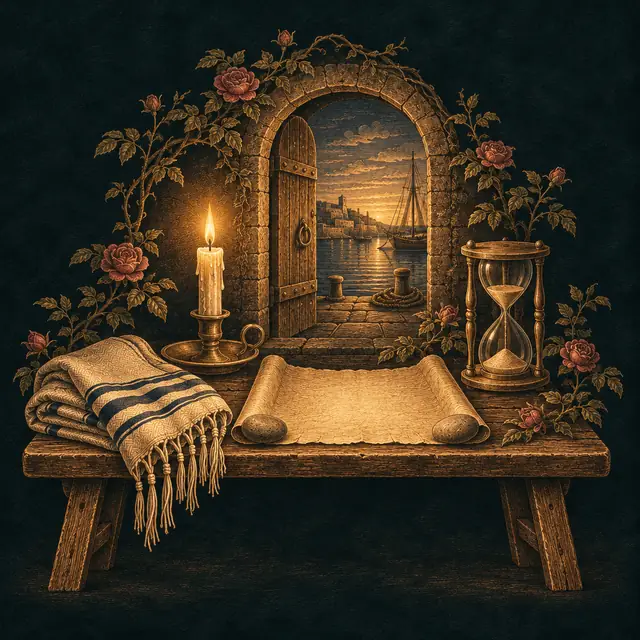
The work is done alone, in a quiet room where no voice can be heard, best of all at night. The one who combines makes the body clean and puts on clean clothes, white if possible, wraps himself in the prayer shawl and binds on the tefillin, so as to stand in awe of the presence near him, and lights many lamps until the room is bright. He empties his thoughts of the world and its concerns, takes ink, pen and tablet, and remembers that he is about to serve God in gladness of heart.
Combining the letters
He writes the letters of a divine name and begins to combine them, a few or many, exchanging them and turning them about until his heart grows warm. Each letter is joined to each of the vowels in turn and sounded aloud, and the letters of the name are laid out in tables and circles, as the manuals show for the name of seventy-two letters. The manuals give the order of the combinations exactly, and the student follows them step by step.
Each letter with its vowel is sounded on one breath, and the head moves with each vowel in the direction the manuals give for it, so that the body follows the sounds. The breath is never forced or held to the point of strain. The manuals go slowly and in order, and the tradition sets this practice within a life of study and prayer, under a teacher, and not for anyone unsettled in body or mind: it is taught here as his books teach it, and not as an exercise to take up alone.
What comes to the one who combines
When the heart is warm, the letters begin to move, and from their combinations come new things that neither tradition nor one's own reasoning could have given. Then the student is to picture the Name and its angels about him, as if they were people sitting or standing near, and to feel himself like a messenger waiting to hear his errand from the king or from his ministers. Whatever comes into the heart through the letters he considers as a whole and in its parts, as one considers a parable or a dream, and he interprets it as far as he can in agreement with reason.
The stronger the influx, the weaker the body grows, and a great trembling may seize it, as if the soul were about to leave. Abulafia's counsel for that moment is a return. Afterwards the student goes back to the things of the body: he rises, eats and drinks a little, or breathes a pleasant scent, and lets his spirit go back into its sheath until another time, glad of his portion.
Reading on rising levels
His Kabbalah reads the Torah on rising levels. The plain sense stands first, then the homilies of the sages, then the philosophers' meaning hidden in the stories, and above these the ways of the letters themselves: their numbers, the words made from their initials, their exchanges and combinations, and at the top the way of the names, which belongs to those who prophesy. Each level keeps the ones below it, and the highest is reached only through them.
The joining of the mind
The end of the way is the joining of the human intellect to the Active Intellect, so close that the two become one. The one who reaches it is not lost but taught: prophecy, for Abulafia, is the perfection of the mind itself, knowledge that comes from above into a mind made ready to hold it.
Orders and memberships
No order is documented. He taught a small circle of pupils in Spain, Greece and Sicily, Joseph Gikatilla among them. Solomon ibn Adret of Barcelona, the leading rabbi of the day, denounced him and his claims.
The legend
That he went to convert the pope to Judaism. His own account says he went to speak with the pope on behalf of the Jews; what he meant to say is not recorded. He announced himself a prophet, hinted at more, and foretold the redemption for the year 1290.
Their works
- Life of the World to ComeBook, about 1280
A manual of his prophetic Kabbalah, teaching how to combine the letters of the divine name of seventy two letters with set breathing and movements of the head, laid out in circles of letters. It is the fullest guide to his method.
Ask the Oracle about it - Light of the IntellectBook, 1285
A manual of letter combination written in Sicily for his pupils, which joins the philosophy of Maimonides on the intellect to the practice of combining the letters of the name of God. Scholars have read it as one of his clearest works.
Ask the Oracle about it - Treasure of the Hidden EdenBook, about 1285
A commentary on the Sefer Yetzirah, the old Book of Creation, written in Sicily. It includes passages on his own life, his studies and the visions that came to him, which are among the few sources for his biography.
Ask the Oracle about it - Book of the SignBook, late 1280s
A prophetic book, one of the few of his many prophetic writings to survive, telling in the voice of a vision of the coming redemption and of a figure who will battle the powers of the world.
Ask the Oracle about it
How the house tells a life
This life is told from the record, with what is documented, what is legend and what was forged kept apart. A membership in an order is stated only where documents show it. A person’s chart explains none of their deeds.
The arts it feeds
Lives near it in time
Lives and legends
Mary the ProphetessIamblichusZosimos of PanopolisJabir ibn HayyanAbu Ma’sharMichael ScotMoses de LeónArnald of VillanovaJacques de MolayNicolas FlamelJohannes TrithemiusCornelius AgrippaThe whole tree

