
Cornelius Agrippa
1486 to 1535
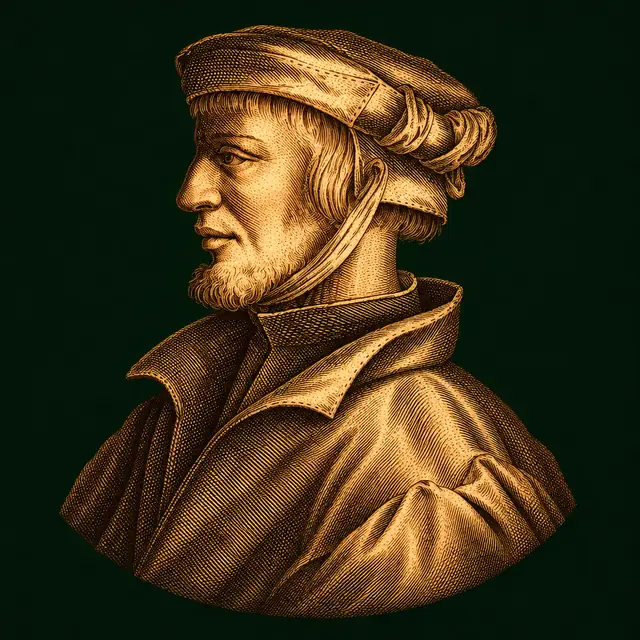
Who was Cornelius Agrippa, and what is truly known of them?
What is known
German scholar, soldier and physician, born at Cologne. He lectured on Reuchlin at Dole in 1509, served the emperor Maximilian in Italy, and was town advocate at Metz, where in 1519 he defended a woman accused of witchcraft against the inquisitor. Later he was physician to Louise of Savoy at Lyon and historian to Margaret of Austria in the Low Countries. His De occulta philosophia, drafted by 1510 and printed whole at Cologne in 1533, set out natural, celestial and ceremonial magic in three books and became the chief source of later Western magic. In 1530 he printed a book on the vanity of all the sciences, magic among them. He died at Grenoble.
The teaching
Taught from his own books, above all the Three Books of Occult Philosophy and On the Vanity of the Sciences.
Three worlds and the climb
The world, Agrippa teaches, is threefold: the elemental world of earth, water, air and fire; the celestial world of the stars; and the intellectual world of the angels and of God. Each lower world is ruled by the one above it and receives its powers from it, so that the virtue of the Creator comes down through the angels to the heavens, through the heavens to the elements, and through the elements to every animal, plant, metal and stone.
The wise, he holds, can climb back up by the same steps, and that climb is magic. Natural magic studies the elemental world, its mixtures and its hidden virtues; celestial magic studies the heavens through mathematics, number, figure and the motions of the stars; ceremonial magic, through religion, seeks the powers of the angels and of God. His three books follow the three worlds in that order.
The elements in everything
The four elements are the first matter of every body, each made of two qualities: fire hot and dry, earth dry and cold, water cold and moist, air moist and hot. None is found pure in any body here below; they are always mixed, and they pass into one another, earth melting into water, water thinning into air, air kindling into fire, and fire falling back again. As they are in the world, so they are in their own way in the heavens and the angels and in the human being: everything is made of them or answers to them.
Hidden virtues
Beside the qualities that come from the elements, things have virtues that the elements cannot explain. The magnet draws iron, the little fish called the remora holds back a ship, certain stones and herbs work against poisons. These are called occult, hidden, because their causes lie out of sight, and they are known by experience, not by reasoning from heat and cold.
Their source, he teaches, is higher. The hidden virtues come from the ideas in the mind of God, through the soul of the world and the rays of the stars, into each thing according to its fitness to receive them. Every thing carries the seal of its star: its shape, colour, scent and working show what it is kin to, and things alike draw each other while things contrary repel. The kinships of the planets with herbs, stones and scents that follow from this are taught on the page of Planetary rulerships, under Herbs, oils and stones.
The spirit of the world
Between the soul of the world and its body there must be a middle, for a soul cannot join a gross body without one. That middle is the spirit of the world, which some call the quintessence, because it is not made of the four elements but stands above them. Through it the virtues of the stars are poured into things; it is more abundant in some things than in others, and the alchemists try to draw it out of gold and silver so as to pass it into other things.
The powers of the soul
The human soul has its own powers over bodies. The passions of the mind change the body they live in: joy and fear, anger and longing alter its heat, its colour and its health, and a strong imagination can mark the body or even, he holds, reach beyond it. Fascination is a binding that passes through the eyes, when a spirit sent out from a strong and fixed gaze enters the eyes of another. A soul fixed on one desire with all its force works, he teaches, on the things it desires, and so for Agrippa every working begins in the mind of the one who works.
Number and its scales
In the second book number holds the place of honour, for God ordered all things in measure and number and weight. Agrippa gives a scale for each number from one to twelve, setting down what answers to it in every world. In the scale of one stand the one God and the one Sun; in the scale of four, the four letters of the holy name, the four elements, the four seasons, the four humours and the four quarters of the world; in the scale of seven, the seven angels who stand before God, the seven planets, the seven metals and the seven stones.
The tables of the planets, the squares of numbers with their intelligences and spirits, are taught on the pages of Magic squares, under Sacred geometry, and of Talismans and sigils, under Magic and protection. The human body too is a measure: drawn with arms outstretched it fits both a square and a circle, and its proportions answer to the harmony of the world.
Names, angels and the three guardians
The third book rises to the names of God and the orders of angels. The ten names of God answer to the ten powers of the Kabbalah, the sefirot; the name of seventy-two drawn from three verses of Exodus gives seventy-two angels, each bearing a name of God; the angels stand in nine orders, from the seraphim down to the angels nearest us; and above all the names stands the name of four letters.
Each person, he teaches, has three guardians. The holy genius is given by God and watches over the soul; the genius of the nativity comes from the stars of the birth and gives a person their natural bent; the genius of the profession comes with the way of life a person chooses. The chosen way should agree with the other two: where it does, a life goes well, and where it fights them, a person labours against their own nature.
The worthiness of the worker
No one can rise through the three worlds without being made worthy. Whoever would work in this art must first be purified in body and mind, by a clean life, by abstinence kept in measure and by quiet, and above all by faith and religion, for the highest power of the art comes from God and is given only to a mind made pure. Agrippa calls this the dignifying of the magician and puts it before every rite and figure in his book: without it the rest is empty or dangerous.
The vanity of the sciences
His book on the vanity of the sciences turns the same learning on itself. Every art and science of human beings, from grammar to medicine and from astrology to magic, is uncertain, quarrelsome and vain, built on opinion and changed by fashion, and none can give a person the truth about God or the way to live. The only sure knowledge is the word of God received in simple faith, and the unlearned who believe stand nearer to it than the learned who boast. He ends it in praise of the ass, the patient and simple beast that carried Christ, as the image of the believer who knows nothing but the word.
The nobility of women
In his declamation on the nobility of women he argues from Scripture, law and nature that women are the equals of men and in many things their betters. The soul has no sex, he says, and woman was made last, as the crown of creation, from living flesh rather than from clay, and in paradise rather than outside it; her name, Eve, means life. Her lower place comes not from nature but from custom and unjust law, which shut her out of learning and office, and he calls those laws a tyranny of men.
Orders and memberships
No order is documented. Letters show a circle of friends round him at Paris and Avignon about 1507, which later writers turned into a secret society of magicians.
The legend
That a black dog which followed him was a demon, and that he paid innkeepers with coins that turned to horn. Both tales were printed after his death by writers hostile to him; his pupil Johann Weyer wrote that the dog was a pet.
What was forged, or is false
The “Fourth Book of Occult Philosophy”, a manual for calling spirits printed under his name at Marburg in 1559, twenty-four years after his death. Weyer, who had lived in his house, said it was not his.
Their works
- De occulta philosophiaTreatise, drafted by 1510, printed 1533
The Three Books of Occult Philosophy, drafted in his youth and printed whole at Cologne in 1533, gather natural, celestial and ceremonial magic into one order: the virtues of stones and plants, the powers of number and the stars, and the names of angels. It became the chief source book of later Western magic.
Ask the Oracle about it - On the Uncertainty and Vanity of the SciencesBook, printed 1530
A sweeping attack on every art and science of his day, magic and astrology among them, which he judges vain beside plain faith in Scripture. Printed three years before his own book of magic, it has puzzled readers ever since: some take it as a recantation, others as the sceptical frame in which he wanted the magic read.
Ask the Oracle about it - On the Nobility and Preeminence of the Female SexEssay, written 1509, printed 1529
A declamation first given at Dole, arguing from Scripture, law and nature that women are the equals and in many things the betters of men, and that their lower place comes from custom and unjust law. It was much translated and stands with his defence of the woman accused of witchcraft at Metz.
Ask the Oracle about it - The Fourth Book of Occult PhilosophyTreatise, printed 1559
A manual for calling spirits, printed at Marburg under his name twenty four years after his death, with a treatise on geomancy and other pieces. It travelled with his real books for centuries and fed the trade in grimoires.
Not his: Johann Weyer, who had lived in his house, said it was a forgery.
Ask the Oracle about it
How the house tells a life
This life is told from the record, with what is documented, what is legend and what was forged kept apart. A membership in an order is stated only where documents show it. A person’s chart explains none of their deeds.
The arts it feeds
Magic and protectionThe Hermetic principlesThe Tree of LifeThe spirit realm
Lives near it in time
Lives and legends
Abraham AbulafiaMoses de LeónArnald of VillanovaJacques de MolayNicolas FlamelJohannes TrithemiusParacelsusNostradamusJohn DeeIsaac LuriaRudolf IIEdward KelleyThe whole tree

