
John Dee
1527 to 1608 or 1609
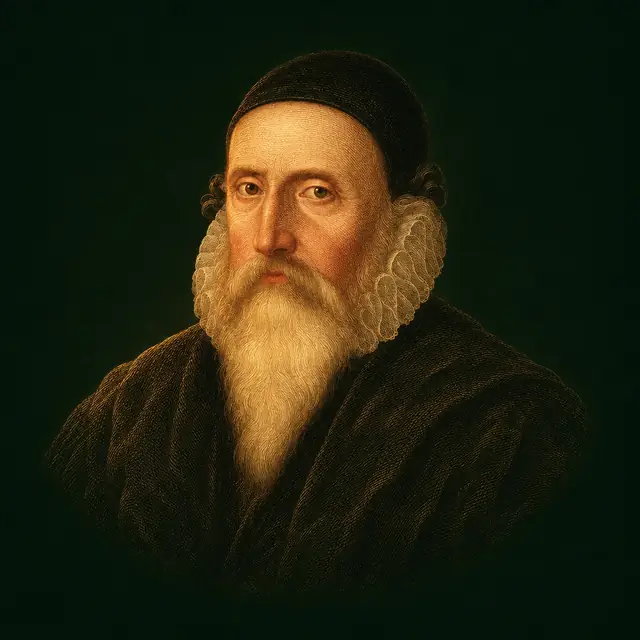
Who was John Dee, and what is truly known of them?
What is known
English mathematician, astrologer and adviser to Elizabeth I, for whose coronation in 1559 he chose the day. He owned one of the great libraries of England. From 1582, with the medium Edward Kelley, he recorded long “conversations with angels” and the language later called Enochian. He died poor, at Mortlake or in London.
The teaching
Taught from his own books, above all the Monas Hieroglyphica and the Mathematical Preface, with his records of the angels.
Three kinds of things
All things, Dee teaches in his preface to Euclid, are of three kinds. Some are supernatural, without matter and beyond change; some are natural, made of matter and always changing; and between them stand the things of mathematics, number and magnitude, which are without matter in themselves but can be thought of in matter. Standing in the middle, they lead the mind from the things of nature up toward the divine, and God himself, he holds, made all things by number.
The arts of number and measure
From the two principal arts, arithmetic of number and geometry of magnitude, he derives every art that rests on them, and gives many of them names of his own coining: perspective, of light and sight; astronomy and music; cosmography and astrology; statics, of weight; anthropography, the measuring of the human body; the arts of wheels and of spirals; the arts of air and water, of moving weights, of conveying water and of measuring time; painting, architecture and navigation; thaumaturgy, the making of marvels by mechanical means; and the master art he calls archemastry, which tests the conclusions of all the others by experience.
He wrote it in English so that craftsmen without Latin could learn, and he defends the maker of marvels against the charge of conjuring. A wooden dove that flies, as Archytas made one, or a brazen head that seems to speak, is a work of mathematics and mechanics and not of spirits, and the one who makes it should not be called a conjurer.
The rays of all things
In his first printed book Dee teaches that whatever exists in act sends out rays in every direction, and these rays fill the whole world. The stars and planets work on the world of the elements by their rays, of light and of other virtues not seen, and the effect of a ray changes with the angle at which it falls and the distance it travels. Whoever knew the art of mirrors well, he says, could gather the rays of a star and cast them on a matter more strongly than nature does.
The monad
The Monas Hieroglyphica builds one sign out of the simplest marks. At its centre is a point, around the point a circle, and the point with its circle is the Sun. A crescent touching the circle from above is the Moon. Below them stands a cross, the four elements, and at the foot two half-circles joined, the sign of Aries, the fire by which the work begins. So the one sign holds the Sun and the Moon, the elements and the fire, and from its parts all the signs of the planets and their metals can be drawn, as the page of Seven metals, seven planets shows, under Alchemy.
He sets it out in twenty-four theorems, as a geometer would. The first and simplest showing of all things was by the straight line and the circle; the circle cannot be drawn without the line, nor the line without the point; so things first came to be by way of the point and the monad, the one. The cross is two lines meeting in a point, and so a joining of two into three, and it makes four right angles, the four elements; and the whole sign is offered as a key to the one hidden order behind the arts of the stars, of the metals and of the letters.
Wisdom asked of God
Dee came to the angels because books had failed him. He had sought for years, he says, in every author he could find, and found none who could teach him the true knowledge of the creatures; so he prayed to God for wisdom, as Solomon had, and asked to be taught by his angels. The actions with the spirits were to him a form of prayer, opened and closed with prayer.
The method was always the same. A scryer, Edward Kelley above all, gazed into the shewstone, set on the great seal of God's truth on the table of practice, whose feet stood on smaller seals of wax, and told what he saw and heard; Dee asked the questions and wrote down every word. The angels named themselves, Michael, Raphael, Uriel and others, and among them a spirit in the shape of a little girl called Madimi.
Letters given one by one
Their teaching came letter by letter. An angel in the stone pointed with a rod to letters on a table, and Kelley read them out one at a time, so that whole books of letters were built up which Dee could not read until they were explained. The calls, the speeches by which the angels are addressed in their own tongue, were first given backwards, because spoken forwards in the dictation they would have taken effect, and then given again forwards with their English. The tongue has an alphabet of twenty-one letters, and its calls, its great table of four watchtowers and its thirty aethyrs are set out on the page of The grimoires, under Magic and protection.
What the angels promised
The angels told Dee that the tongue was the first language of all, the one Adam spoke in paradise and lost, and that through it the true knowledge of God and of the creatures, the knowledge Enoch had, would be given back. The diaries record that teaching as Dee received it, through his scryer's eyes and voice, and it is taught here as his records give it, not as a practice to take up.
Orders and memberships
He belonged to no known secret order. Later Rosicrucian and Golden Dawn writers claimed him and built on his papers.
The legend
That he was a spy who signed himself “007”, and that he founded the Rosicrucians. Neither is shown by any document.
Their works
- Monas HieroglyphicaTreatise, printed 1564
A short Latin work printed at Antwerp and dedicated to Maximilian II, soon to be emperor, building one sign out of the marks of the Moon, the Sun, the elements and the fire, and explaining it in twenty four theorems. It was read as a key to alchemy and the Kabbalah, and the sign reappears on the Chymical Wedding of 1616.
Ask the Oracle about it - Mathematical Preface to EuclidEssay, 1570
His long preface to the first English translation of Euclid, by Henry Billingsley, setting out every art that rests on number and measure, from navigation and architecture to music and astronomy. It was a founding text of English mathematics and an argument for teaching it in the common tongue.
Ask the Oracle about it - General and Rare Memorials of NavigationBook, printed 1577
A book written to urge Elizabeth I to build a standing navy, in which he speaks of a British empire, among the first to use the phrase. Its engraved title page is crowded with emblems of Queen, ship and Fortune.
Ask the Oracle about it - The Angel ConversationsDiary, 1581 to 1589
The books in which he wrote down what his scryers, chiefly Edward Kelley, reported seeing and hearing in the stone: the spirits’ words, the tables of letters and the language later called Enochian. Part was printed in 1659 by Meric Casaubon as A True and Faithful Relation, to show him deceived; the rest stays in manuscript in the British Library.
Ask the Oracle about it - Propaedeumata AphoristicaBook, printed 1558
One hundred and twenty aphorisms on the rays the stars and planets send into the world below and how they work on it, his first printed book. It shows the astronomer and the astrologer in one mind.
Ask the Oracle about it
How the house tells a life
This life is told from the record, with what is documented, what is legend and what was forged kept apart. A membership in an order is stated only where documents show it. A person’s chart explains none of their deeds.
The arts it feeds
Lives near it in time
Lives and legends
Jacques de MolayNicolas FlamelJohannes TrithemiusCornelius AgrippaParacelsusNostradamusIsaac LuriaRudolf IIEdward KelleyHeinrich KhunrathMichael MaierRobert FluddThe whole tree

