
Michael Maier
1568 or 1569 to 1622
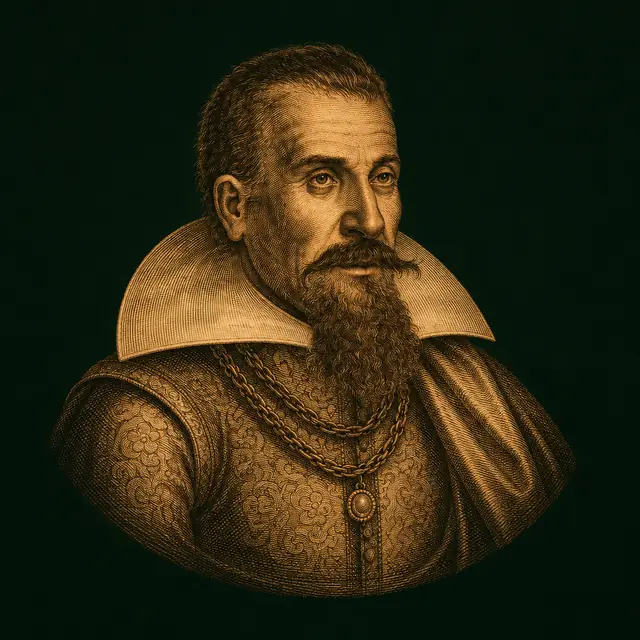
Who was Michael Maier, and what is truly known of them?
What is known
German physician and alchemical writer, born at Rendsburg in Holstein in 1568 or 1569. He studied at Rostock, Frankfurt an der Oder and Padua, took his doctorate in medicine at Basel in 1596, and in 1609 became physician to Rudolf II, who made him a count palatine. From 1611 or 1612 to 1616 he was in England, and for Christmas 1611 he sent King James a greeting in the shape of a rose. Back in Germany he printed book after book. Atalanta fugiens (1617) sets fifty alchemical emblems, engraved by Matthäus Merian, each beside a verse and a short fugue for three voices; Silentium post clamores (1617) and Themis aurea (1618) defend the Rosicrucian brotherhood against its critics. He served Landgrave Moritz of Hesse-Kassel and died at Magdeburg in 1622.
The teaching
Taught from his own books, above all Atalanta fugiens (1617), the Symbola aureae mensae (1617) and Themis aurea (1618).
A book to see, read and sing
Maier teaches the art through all the senses at once. Each of the fifty chapters of Atalanta fugiens has five parts: a motto, an engraved picture, a short Latin poem, a fugue for three voices, and a discourse in prose that explains them. The picture is for the eyes, the poem and the discourse for the mind, and the fugue for the ears, so that the teaching reaches the soul by every door and refreshes it as it instructs. Music belongs here by right: the work is a harmony of contraries, and the fugue, in which voices flee and follow and agree, is that harmony made audible.
Atalanta and the golden apples
The book takes its name from a myth. Atalanta, the swiftest of runners, will marry only the man who outruns her, and those who race her and lose are put to death. Hippomenes races her with three golden apples from Venus, and each time she draws ahead he throws one in her way; she stops to pick it up, and he wins. Later, for profaning a shrine of Cybele, the two are turned into lions.
Maier reads the myth as the work. Atalanta is the mercury of the philosophers, volatile and fleeing; Hippomenes is the sulphur that pursues her and would hold her; the golden apple is the gold that stays her flight, and the lions are the matter fixed at last. Each fugue sings the chase. One voice is Atalanta, who flees; one is Hippomenes, who follows; and the third is the apple, which keeps the same slow tune beneath every fugue in the book, as the one matter lies beneath every stage of the work.
The wind and the nurse
The first two emblems take their words from the Emerald Tablet. In the first the wind carries a child in its belly: the stone is conceived in vapour, in the volatile part of the matter that rises in the vessel. In the second the earth nurses the child at her breast: what rose must come down, be fed, and be fixed in solid form. Between them the two pictures give the whole movement of the art, from spirit into body. The tablet's own lines are taught one by one on the branch of the Emerald Tablet.
The washerwoman, the lovers and the egg
The early emblems teach the operations in pictures from daily life. Go to the woman washing linen, says the third, and do as she does: the blackened matter is washed again and again in its own water, wrung out and laid out again, until it whitens, as linen is bleached by patient washing and not by force.
Join the brother and the sister, says the fourth, and give them the cup of love to drink: the opposites of the work, the hot and the cold, Sun and Moon, the fixed and the volatile, are joined until they are one. Take the egg, says the eighth, and strike it with a fiery sword: the egg is the closed vessel with the matter in it, and the sword is the fire that opens it.
Circle, square, triangle, circle
The twenty-first emblem gives the work as geometry. Make of the man and the woman a circle, then a square, then a triangle, then a circle, says its motto, and the stone of the philosophers is made. The first circle is the matter in its first unity; the square is that unity divided into the four elements; the triangle is the four drawn up into three, body, soul and spirit; and the last circle is the three made one again, the stone. The figure shows how the art proceeds: it parts what is one, and it parts it only to join it in a higher unity.
In nature's footsteps
The forty-second emblem shows the true seeker. A philosopher walks behind Nature, who goes before him, and sets his feet in her footprints; he carries a lamp and a staff and wears spectacles. Nature, reason, experience and reading, says the motto, are his guide, his staff, his spectacles and his lamp. The alchemist invents nothing: Nature leads, and he follows. Reason holds him up as a staff does, experience lets him see what is in front of him, and reading lights the way where it is dark; without any one of the four he stumbles.
The myths as figures of the work
Maier holds that the old myths of Egypt and Greece hide the making of the stone, and he reads them so in his Arcana arcanissima and through the emblems. Typhon kills Osiris by guile and scatters his limbs, and Isis gathers them: the matter is cut apart and dissolved, and then gathered and joined again. Jason wins the golden fleece only after he has yoked the fire-breathing bulls and lulled the dragon: the stone is won through trials of fire and the taming of what flies. Saturn swallows a stone in place of his son, and the stone he brings up again is set on Mount Helicon as a monument for mortals: the heavy, dark beginning of the work brings forth what lasts.
The table of twelve nations
In the Symbola aureae mensae twelve masters, one for each nation, sit at a golden table and each defends the art: Hermes for the Egyptians, Mary the Jewess for the Hebrews, Democritus for the Greeks, Morienus for the Romans, Avicenna for the Arabs, Albertus Magnus for the Germans, Arnald of Villanova for the French, Thomas Aquinas for the Italians, Ramon Llull for the Spaniards, Roger Bacon for the English, Melchior of Hermannstadt for the Hungarians, and an unnamed Sarmatian for the Poles. Each gives a symbol and a speech, and the lesson of the feast is agreement: masters of every age and tongue, who never met, teach one art.
The book closes with a pilgrimage through the four parts of the world in search of the phoenix, the bird that is born again from its own ashes. The phoenix is the medicine, which dies in the fire and rises renewed, and the seeker must travel far to learn where it is found.
The laws of the brotherhood
Maier defends the Rosicrucian brothers as a college of the wise of a kind the world has always had: the priests of Egypt, the Magi of Persia, the Brahmins of India, the Pythagoreans and the keepers of the mysteries of Eleusis. In Themis aurea he takes the laws the Fama gives the brothers and shows each to be wise: to heal the sick freely keeps the art from greed; to wear the dress of one's country keeps the healer unnoticed; to meet once a year keeps the bond; to choose a successor keeps the fellowship alive; and silence keeps the art from those who would abuse it.
Those who wrote to the brothers and had no answer, he says in Silentium post clamores, had sought gold or fame, or had not yet been tried, for the brothers answer only those they have tested. The laws themselves, and the books they come from, are taught on the branch of the Rosicrucians.
Orders and memberships
He defended the Rosicrucians in two books and nowhere says that he met them or belonged to them; no document makes him a member. Count palatine was an imperial title and not an order.
The legend
That he founded the Rosicrucian order in England and received Robert Fludd into it: there is no record that the two ever met. That the fugues of Atalanta fugiens hide the recipe of the stone.
Their works
- Atalanta fugiensBook, printed 1617
Fifty alchemical emblems engraved by Matthäus Merian, each with a motto, a verse, a short discourse and a fugue for three voices, so that the book could be seen, read and sung. It is the best known emblem book of alchemy.
Ask the Oracle about it - Arcana arcanissimaBook, about 1614
His first large book, printed while he was in England, reading the gods and heroes of Egypt and Greece as figures of the alchemical work. It made him the leading voice of the view that the old myths hide the making of the stone.
Ask the Oracle about it - Symbola aureae mensaeBook, printed 1617
The Symbols of the Golden Table of Twelve Nations, in which twelve alchemists, one from each nation, from Hermes to Albertus Magnus and Ramon Llull, sit at a feast and each makes his case. It ends with a pilgrimage in search of the phoenix.
Ask the Oracle about it - Silentium post clamoresBook, printed 1617
Silence after the Clamours, his defence of the Rosicrucian brotherhood against its critics, explaining why so few who wrote to the brothers had received an answer. He nowhere claims to have met them.
Ask the Oracle about it - Themis aureaBook, printed 1618
The Golden Themis, setting out what he held to be the laws of the Rosicrucian fraternity, its healing without pay and its secrecy, and defending them as wise. It was translated into English in 1656.
Ask the Oracle about it - The Christmas rose for King JamesGreeting, 1611
A Latin greeting for Christmas sent to James I, written out in the shape of a rose, which survives in the Scottish records. It is the earliest witness of his time in Britain, a few years before the first Rosicrucian manifesto.
Ask the Oracle about it
How the house tells a life
This life is told from the record, with what is documented, what is legend and what was forged kept apart. A membership in an order is stated only where documents show it. A person’s chart explains none of their deeds.
The arts it feeds
Lives near it in time
Lives and legends
NostradamusJohn DeeIsaac LuriaRudolf IIEdward KelleyHeinrich KhunrathRobert FluddJohann Valentin AndreaeWilliam LillyElias AshmoleIsaac NewtonThe Count of Saint-GermainThe whole tree

